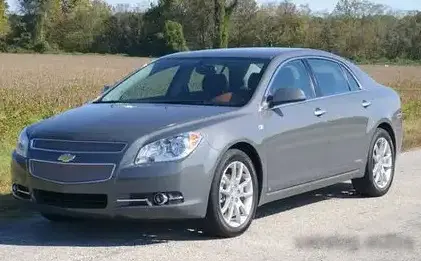
The Chevrolet Malibu VII, produced from 2008 to 2010, represented the seventh generation of Chevrolet’s mid-size sedan. This generation, built on the GM Epsilon platform, aimed to offer a more refined and contemporary alternative to established competitors like the Toyota Camry and Honda Accord. Within the Malibu VII lineup, the 2.4i variant equipped with the 169 horsepower Ecotec engine and a four-speed automatic transmission occupied a central position, balancing affordability with a reasonable level of performance and features. It was positioned as the mainstream offering, appealing to a broad range of buyers seeking a comfortable and practical family sedan.
Technical Specifications
| Brand | Chevrolet |
| Model | Malibu |
| Generation | Malibu VII |
| Type (Engine) | 2.4i (169 Hp) Ecotec Automatic 4-speed |
| Start of production | 2008 |
| End of production | 2010 |
| Powertrain Architecture | Internal Combustion engine |
| Body type | Sedan |
| Seats | 5 |
| Doors | 4 |
| Fuel consumption (urban) | 10.7 l/100 km (22 US mpg) |
| Fuel consumption (extra urban) | 7.8 l/100 km (30.2 US mpg) |
| Fuel Type | Petrol (Gasoline) |
| Weight-to-power ratio | 9.2 kg/Hp |
| Weight-to-torque ratio | 7.1 kg/Nm |
| Power | 169 Hp @ 6400 rpm |
| Power per litre | 70.9 Hp/l |
| Torque | 217 Nm @ 4500 rpm (160.05 lb.-ft. @ 4500 rpm) |
| Maximum engine speed | 6600 rpm |
| Engine layout | Front, Transverse |
| Engine Model/Code | LE5 |
| Engine displacement | 2384 cm3 (145.48 cu. in.) |
| Number of cylinders | 4 |
| Engine configuration | Inline |
| Cylinder Bore | 88 mm (3.46 in.) |
| Piston Stroke | 98 mm (3.86 in.) |
| Compression ratio | 10.4:1 |
| Number of valves per cylinder | 4 |
| Fuel injection system | Multi-port manifold injection |
| Engine aspiration | Naturally aspirated engine |
| Valvetrain | DOHC |
| Engine oil capacity | 4.7 l (4.97 US qt | 4.14 UK qt) |
| Coolant | 7.1 l (7.5 US qt | 6.25 UK qt) |
| Kerb Weight | 1549 kg (3414.96 lbs.) |
| Trunk (boot) space – maximum | 427 l (15.08 cu. ft.) |
| Fuel tank capacity | 62 l (16.38 US gal | 13.64 UK gal) |
| Length | 4872 mm (191.81 in.) |
| Width | 1785 mm (70.28 in.) |
| Height | 1451 mm (57.13 in.) |
| Wheelbase | 2852 mm (112.28 in.) |
| Front track | 1514 mm (59.61 in.) |
| Rear (Back) track | 1524 mm (60 in.) |
| Minimum turning circle | 12.3 m (40.35 ft.) |
| Drivetrain Architecture | Front wheel drive |
| Number of gears | 4 |
| Gearbox type | Automatic transmission |
| Front suspension | Independent, McPherson with coil spring and anti-roll bar |
| Rear suspension | Independent multi-link suspension |
| Front brakes | Ventilated discs |
| Rear brakes | Disc |
| Assisting systems | ABS (Anti-lock braking system) |
| Steering type | Steering rack and pinion |
| Power steering | Electric |
| Tires size | 225/50 R17 |
| Wheel rims size | 17 |
Powertrain & Engine Architecture
The heart of the Malibu 2.4i was the LE5 2.4-liter inline-four cylinder engine. This engine was part of Chevrolet’s Ecotec family, known for its focus on fuel efficiency and refinement. The LE5 featured a cast iron block with an aluminum cylinder head, incorporating dual overhead camshafts (DOHC) and four valves per cylinder. Fuel delivery was handled by a multi-port fuel injection system, providing precise fuel metering for optimal combustion. The engine produced 169 horsepower at 6400 rpm and 217 Nm (160 lb-ft) of torque at 4500 rpm. This power was then sent to the front wheels through a four-speed automatic transmission. While not the most advanced transmission available at the time, it provided smooth and predictable shifts, prioritizing comfort over outright performance. The four-speed automatic was chosen for its cost-effectiveness and reliability, aligning with the Malibu’s target market.
Driving Characteristics
The 2.4i automatic Malibu offered a comfortable and predictable driving experience. Acceleration was adequate for everyday driving, but not particularly sporty. The four-speed automatic transmission, while smooth, lacked the responsiveness of more modern transmissions with additional gears. The gear ratios were tuned for fuel economy and cruising comfort, rather than aggressive acceleration. Compared to the available 2.0L turbocharged engine (later introduced), the 2.4i offered less peak power but a broader, more accessible torque curve. The automatic transmission also eliminated the need for driver involvement with shifting, making it a popular choice for commuters and those prioritizing ease of use. The suspension was tuned for a comfortable ride, absorbing bumps and imperfections in the road effectively, though at the expense of some handling precision.
Equipment & Trim Levels
The Malibu 2.4i typically came standard with features such as air conditioning, power windows and locks, a CD player with auxiliary input, and keyless entry. Higher trim levels, such as the LT and LTZ, added features like alloy wheels, upgraded audio systems, a sunroof, and leather upholstery. Interior upholstery was typically cloth on the base models, with leather options available on higher trims. The dashboard layout was straightforward and functional, with easy-to-read gauges and intuitive controls. Optional extras included a navigation system, remote start, and a premium sound system.
Chassis & Braking
The Malibu VII utilized an independent front suspension with McPherson struts and a multi-link independent rear suspension. This setup provided a good balance of ride comfort and handling. The front brakes were ventilated discs, while the rear brakes were solid discs, providing adequate stopping power for the vehicle’s weight. All models were equipped with an Anti-lock Braking System (ABS) as standard, enhancing safety during emergency braking situations. The steering was rack-and-pinion with electric power assist, offering a light and responsive feel.
Market Reception & Comparison
The Malibu VII 2.4i was generally well-received by critics as a competent and comfortable mid-size sedan. However, it often faced criticism for its somewhat bland styling and lack of a truly engaging driving experience. Fuel economy was considered average for its class, with the EPA estimating around 22 mpg city and 30 mpg highway. Compared to the 2.0L turbo variant, the 2.4i offered slightly worse fuel economy but was generally considered more reliable due to its simpler engine design. The 2.4i also offered a more affordable entry point into the Malibu lineup, making it a popular choice for budget-conscious buyers.
Legacy
The Chevrolet Malibu VII 2.4i has proven to be a relatively reliable vehicle in the used car market. The LE5 engine is known for its durability, and the four-speed automatic transmission, while not cutting-edge, is generally dependable. Common issues include minor oil leaks and occasional sensor failures, but these are typically inexpensive to repair. Today, the Malibu VII 2.4i represents an affordable and practical option for those seeking a used mid-size sedan. While it may not offer the performance or features of more modern vehicles, it provides a comfortable and reliable transportation solution.