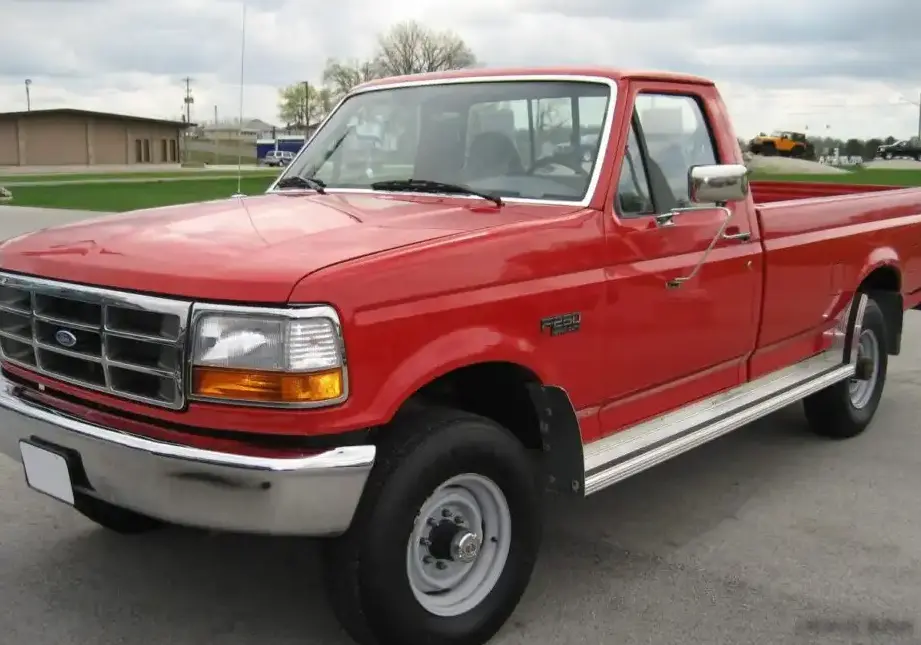
The Ford F-Series F-250 IX Regular Cab, equipped with the 4.9-liter (299 cubic inch) inline-six engine and a four-speed automatic transmission, was a work-focused variant of Ford’s immensely popular F-Series truck line. Produced from 1991 through 1993, this configuration represented an entry-level offering within the F-250 range, designed for buyers prioritizing affordability and durability over outright performance. It occupied a crucial space in the market, catering to individuals and small businesses needing a heavy-duty truck for tasks like towing, hauling, and general utility work, without the expense of larger engines or more luxurious trim packages. This particular model falls within the ninth generation of the F-Series (1987-1991), though the 1991-1993 models represent a transitional period before the more substantial redesign of the tenth generation.
Technical Specifications
| Brand | Ford |
| Model | F-Series F-250 |
| Generation | F-Series F-250 IX Regular Cab |
| Type (Engine) | 4.9 (145 Hp) Automatic |
| Start of production | August, 1991 |
| End of production | 1993 |
| Powertrain Architecture | Internal Combustion engine |
| Body type | Pick-up |
| Seats | 3 |
| Doors | 2 |
| Fuel Type | Petrol (Gasoline) |
| Power | 145 Hp |
| Power per litre | 29.5 Hp/l |
| Torque | 359 Nm / 264.78 lb.-ft. |
| Engine layout | Front, Longitudinal |
| Engine displacement | 4916 cm3 / 299.99 cu. in. |
| Number of cylinders | 6 |
| Engine configuration | Inline |
| Fuel injection system | Multi-port manifold injection |
| Engine aspiration | Naturally aspirated engine |
| Max. weight | 2994 kg / 6600.64 lbs. |
| Fuel tank capacity | 141 l / 37.25 US gal | 31.02 UK gal |
| Length | 5418 mm / 213.31 in. |
| Width | 1778 mm / 70 in. |
| Height | 1864 mm / 73.39 in. |
| Wheelbase | 3378 mm / 132.99 in. |
| Wading depth | 826 mm / 32.52 in. |
| Drivetrain Architecture | The Internal combustion engine (ICE) drives the rear wheels of the vehicle. |
| Drive wheel | Rear wheel drive |
| Number of gears and type of gearbox | 4 gears, automatic transmission |
| Front suspension | Independent coil spring |
| Rear suspension | Leaf spring |
| Front brakes | Disc |
| Rear brakes | Drum |
| Power steering | Electric Steering |
| Tires size | 215/85 R16 |
| Wheel rims size | 16 |
Powertrain & Engine Architecture
The heart of this F-250 variant was the 4.9-liter (299 cu in) Ford inline-six engine, often referred to as the “300 six” due to its historical predecessor. While technically a 4.9L, the engine’s lineage and robust design earned it the nickname. This engine, designated with various codes depending on the year (typically referencing emissions controls), was known for its exceptional durability and low-end torque. The 145 horsepower output was achieved through a naturally aspirated configuration and a multi-port fuel injection system. The engine featured a cast iron block and head, contributing to its longevity. The four-speed automatic transmission, a Ford-built unit (typically the AOD or C6 depending on specific application), was chosen for its simplicity and reliability. While not offering the quickest acceleration, the automatic transmission provided ease of use, particularly for drivers accustomed to heavier workloads. The transmission’s gear ratios were optimized for towing and hauling, prioritizing low-end grunt over high-speed performance.
Driving Characteristics
The F-250 with the 4.9L engine and automatic transmission delivered a utilitarian driving experience. Acceleration was modest, and the truck wasn’t designed for spirited driving. However, it excelled in situations requiring consistent, low-end power. The automatic transmission, while smooth in operation, lacked the responsiveness of a manual gearbox. The gear ratios were spaced to maximize torque multiplication, making it capable of hauling substantial loads. Compared to the optional 5.8L V8 or 7.5L V8 engines available in the F-250, this configuration offered significantly less horsepower and quicker acceleration. However, it also provided better fuel economy and a simpler, less expensive maintenance profile. The 4.9L engine’s inherent reliability meant fewer potential issues compared to the more complex V8 powertrains.
Equipment & Trim Levels
The F-250 IX Regular Cab with the 4.9L engine typically represented the base trim level. Standard features were minimal, focusing on functionality rather than luxury. This generally included a basic vinyl interior, a simple dashboard layout, and manual windows and locks. Air conditioning was often an optional extra, as were features like a radio and upgraded interior trim. The exterior typically featured minimal brightwork, with a focus on durability and practicality. The “IX” designation indicated a specific package level, but even within that, options were limited. Buyers could add features like a towing package, heavy-duty suspension, or a different rear axle ratio, but the overall emphasis remained on providing a cost-effective work truck.
Chassis & Braking
The F-250 chassis was built for heavy-duty use. The front suspension utilized independent coil springs, providing a reasonable ride quality for a truck of its size. The rear suspension employed leaf springs, designed to handle substantial payloads. Braking was accomplished with front disc brakes and rear drum brakes. Power steering was standard, making maneuvering the large truck easier. The tires, typically 215/85 R16, were chosen for their durability and load-carrying capacity. The frame itself was a robust ladder frame construction, providing a solid foundation for the truck’s components.
Market Reception & Comparison
The 4.9L F-250 Automatic was generally well-received by buyers seeking a dependable and affordable work truck. Critics acknowledged its lack of performance but praised its durability and fuel efficiency compared to the larger engine options. It was often seen as a smart choice for those who didn’t require the extra power of the V8 engines. Compared to the F-150, the F-250 offered a higher payload and towing capacity. Compared to the higher trim levels of the F-250, this variant offered a significant cost savings, making it accessible to a wider range of buyers. Fuel economy, while not exceptional by modern standards, was respectable for a heavy-duty truck of its era.
Legacy
The 4.9L Ford inline-six engine has earned a reputation as one of the most reliable and long-lasting engines ever produced. F-250s equipped with this powertrain continue to be found in use today, often with hundreds of thousands of miles on the odometer. The simplicity of the engine and transmission contributes to its longevity, making it relatively easy and inexpensive to maintain. In the used car market, these trucks are often sought after by those looking for a dependable and affordable work vehicle. While not a collector’s item, the 4.9L F-250 represents a significant chapter in Ford’s truck history, embodying the values of durability, practicality, and affordability.