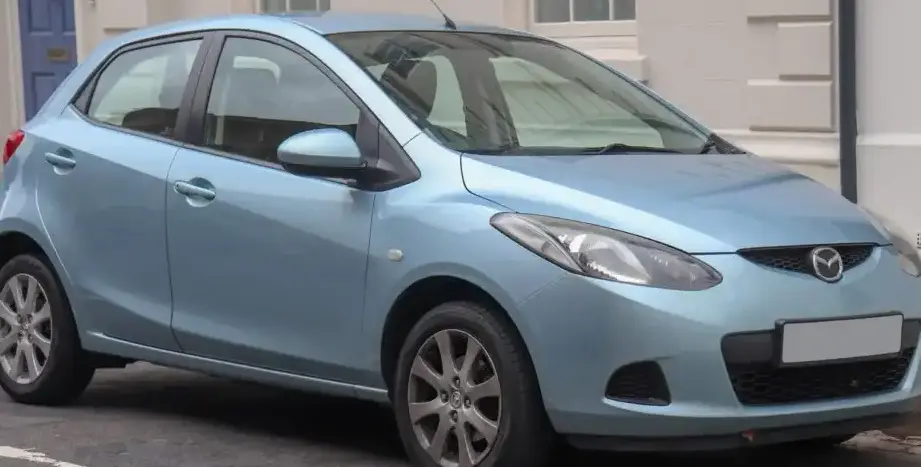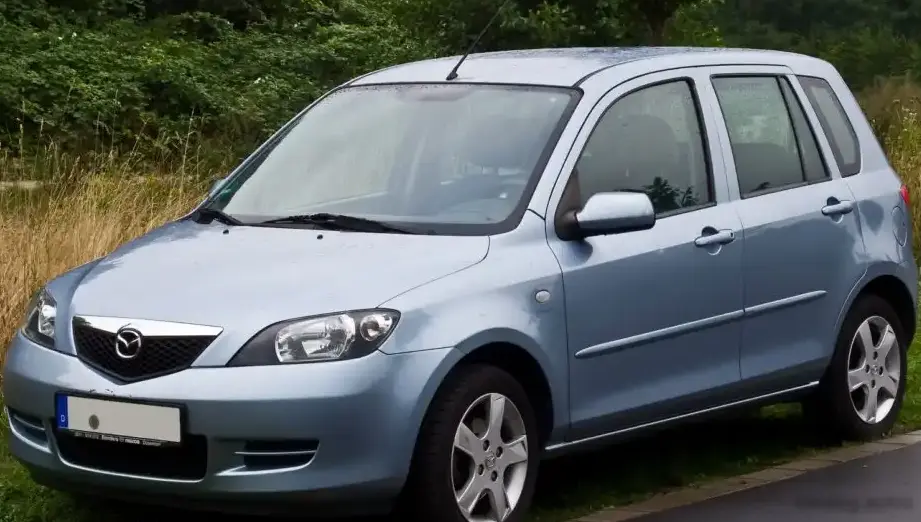
The Mazda2 I (DY) 1.4 CD, produced between 2003 and 2007, represented Mazda’s entry into the subcompact diesel market in Europe and other regions. This variant, powered by a 1.4-liter common-rail diesel engine producing 68 horsepower, was positioned as the fuel-efficient and economical choice within the DY series Mazda2 lineup. It aimed to appeal to buyers prioritizing low running costs and practicality over outright performance. The DY generation Mazda2, built on the Mazda DE platform, was a significant step forward for the brand, offering a more refined and modern package compared to its predecessor.
Technical Specifications
| Brand | Mazda |
| Model | 2 |
| Generation | I (DY) |
| Type (Engine) | 1.4 CD (68 Hp) |
| Start of production | 2003 |
| End of production | 2007 |
| Powertrain Architecture | Internal Combustion engine |
| Body type | Hatchback |
| Seats | 5 |
| Doors | 5 |
| Fuel consumption (urban) | 5.8 l/100 km (40.6 US mpg, 48.7 UK mpg, 17.2 km/l) |
| Fuel consumption (extra urban) | 4.2 l/100 km (56 US mpg, 67.3 UK mpg, 23.8 km/l) |
| Fuel consumption (combined) | 4.8 l/100 km (49 US mpg, 58.9 UK mpg, 20.8 km/l) |
| CO2 emissions | 127 g/km |
| Fuel Type | Diesel |
| Acceleration 0 – 100 km/h | 15 sec |
| Acceleration 0 – 62 mph | 15 sec |
| Acceleration 0 – 60 mph | 14.3 sec |
| Maximum speed | 160 km/h (99.42 mph) |
| Emission standard | Euro 3 |
| Weight-to-power ratio | 16 kg/Hp |
| Weight-to-torque ratio | 6.8 kg/Nm |
| Power | 68 Hp @ 4000 rpm |
| Torque | 160 Nm @ 2000 rpm (118.01 lb.-ft. @ 2000 rpm) |
| Engine layout | Front, Transverse |
| Engine Model/Code | F6JA, F6JB |
| Engine displacement | 1399 cm3 (85.37 cu. in.) |
| Number of cylinders | 4 |
| Engine configuration | Inline |
| Cylinder Bore | 73.7 mm (2.9 in.) |
| Piston Stroke | 82 mm (3.23 in.) |
| Compression ratio | 18:1 |
| Number of valves per cylinder | 2 |
| Fuel injection system | Diesel Commonrail |
| Engine aspiration | Turbocharger, Intercooler |
| Valvetrain | SOHC |
| Engine oil capacity | 3.8 l (4.02 US qt | 3.34 UK qt) |
| Coolant capacity | 5.5 l (5.81 US qt | 4.84 UK qt) |
| Kerb Weight | 1085 kg (2392.02 lbs.) |
| Max. weight | 1530 kg (3373.07 lbs.) |
| Max load | 445 kg (981.06 lbs.) |
| Trunk (boot) space – minimum | 267 l (9.43 cu. ft.) |
| Trunk (boot) space – maximum | 1044 l (36.87 cu. ft.) |
| Fuel tank capacity | 45 l (11.89 US gal | 9.9 UK gal) |
| Length | 3925 mm (154.53 in.) |
| Width | 1680 mm (66.14 in.) |
| Height | 1545 mm (60.83 in.) |
| Wheelbase | 2490 mm (98.03 in.) |
| Front track | 1470 mm (57.87 in.) |
| Rear track | 1445 mm (56.89 in.) |
| Drag coefficient (Cd) | 0.34 |
| Minimum turning circle | 9.8 m (32.15 ft.) |
| Drivetrain | Front wheel drive |
| Number of gears | 5 |
| Gearbox type | Manual transmission |
| Front suspension | Spring Strut |
| Rear suspension | Coil spring |
| Front brakes | Ventilated discs |
| Rear brakes | Drum |
| Assisting systems | ABS (Anti-lock braking system) |
| Steering type | Steering rack and pinion |
| Tires size | 195/50 R15 |
| Wheel rims size | 15 |
INTRODUCTION
The Mazda2 I (DY) 1.4 CD, launched in 2003, was a key component of Mazda’s strategy to broaden its appeal in the European and Asian subcompact car segments. This model year marked the first generation of the Mazda2 to be sold widely outside of Japan, and the 1.4 CD variant was specifically tailored to markets where diesel engines were favored due to fuel economy and tax incentives. The DY series Mazda2, built until 2007, offered a significant improvement in interior space, build quality, and driving dynamics compared to its predecessor, the Mazda Demio. The 1.4 CD trim occupied the lower end of the engine range, providing an affordable and efficient option for budget-conscious buyers.
Powertrain & Engine Architecture
At the heart of the 1.4 CD variant lies the F6JA or F6JB engine, a 1.4-liter inline-four cylinder diesel engine. This engine utilized a common-rail direct injection system, a technology that significantly improved fuel efficiency and reduced emissions compared to older diesel designs. The common-rail system, supplied by Bosch, delivered fuel at extremely high pressure directly into the combustion chamber, resulting in a more complete and efficient burn. The engine featured a single overhead camshaft (SOHC) valvetrain operating two valves per cylinder. A small turbocharger with an intercooler was employed to boost power output and improve responsiveness. The 1.4 CD was exclusively offered with a five-speed manual transmission, optimized for fuel economy and smooth operation. The transmission’s gear ratios were relatively long, prioritizing efficiency over rapid acceleration.
Driving Characteristics
The 1.4 CD variant of the Mazda2 offered a practical, if not particularly exciting, driving experience. With 68 horsepower and 160 Nm (118 lb-ft) of torque, acceleration was modest, taking approximately 15 seconds to reach 62 mph (100 km/h). However, the engine’s torque delivery was relatively strong at lower RPMs, making it suitable for everyday driving and urban commutes. The long gearing of the five-speed manual transmission further emphasized fuel efficiency, but also meant that frequent downshifts were necessary when overtaking or climbing hills. Compared to the more powerful 1.6-liter gasoline variants, the 1.4 CD lacked the punch for spirited driving, but it excelled in fuel economy, achieving combined fuel consumption figures of around 4.8 l/100 km (49 US mpg).
Equipment & Trim Levels
The 1.4 CD trim of the Mazda2 was typically the entry-level offering, focusing on essential features and affordability. Standard equipment generally included power steering, central locking, electric front windows, and an adjustable steering column. Interior upholstery was typically cloth, with a simple and functional dashboard layout. Optional extras included air conditioning, alloy wheels, and a CD player. Higher trim levels, such as the 1.6 Sport, offered more luxurious features like climate control, upgraded audio systems, and sportier styling cues. The 1.4 CD was aimed at buyers who prioritized practicality and low running costs over premium features.
Chassis & Braking
The Mazda2 DY featured a relatively simple but effective chassis design. The front suspension utilized a MacPherson strut setup, while the rear employed a torsion beam axle. This configuration provided a good balance between ride comfort and handling. The 1.4 CD variant, being the lighter engine option, benefited from slightly improved handling compared to the heavier 1.6-liter models. Braking duties were handled by ventilated discs at the front and drum brakes at the rear. Anti-lock Braking System (ABS) was standard, enhancing safety and control during emergency braking situations. The suspension tuning was geared towards comfort, providing a compliant ride on most road surfaces.
Market Reception & Comparison
The Mazda2 1.4 CD was generally well-received by automotive critics as a practical and economical subcompact car. It was praised for its fuel efficiency, comfortable ride, and surprisingly spacious interior for its size. However, some reviewers noted the engine’s lack of outright power and the somewhat basic interior trim. Compared to competitors like the Ford Fiesta, Volkswagen Polo, and Renault Clio, the Mazda2 offered a compelling combination of value, reliability, and driving dynamics. The 1.4 CD variant was particularly attractive to buyers in Europe, where diesel engines were favored due to lower fuel costs and tax benefits. The manual transmission was considered a good match for the engine, providing adequate control and maximizing fuel economy.
Legacy
The Mazda2 DY 1.4 CD has proven to be a relatively reliable and durable vehicle, with many examples still on the road today. The F6JA/F6JB diesel engine, while not known for exceptional performance, is generally considered to be robust and long-lasting if properly maintained. Common issues include turbocharger wear and potential problems with the fuel injection system. In the used car market, the 1.4 CD variant remains an affordable and economical option for buyers seeking a practical and fuel-efficient subcompact car. Its reputation for reliability and low running costs continues to make it a popular choice among budget-conscious drivers.