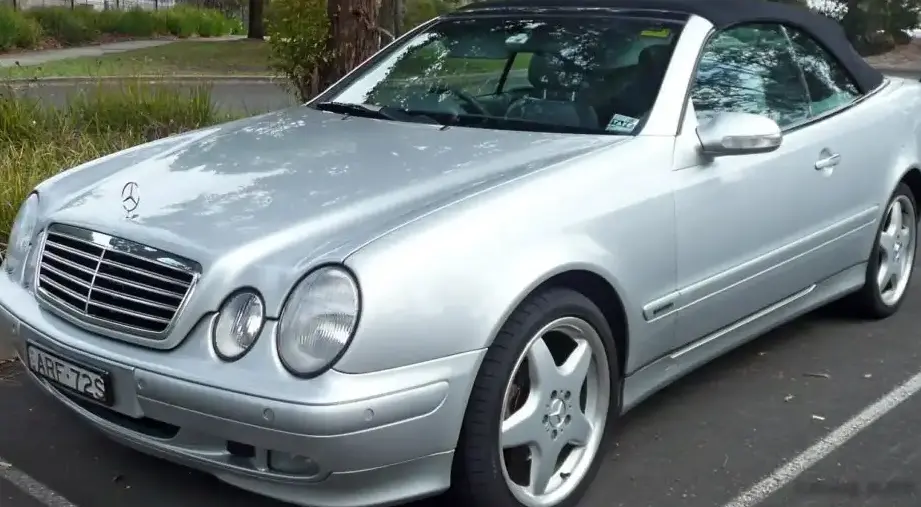
The Mercedes-Benz CLK 230 Kompressor, produced from August 1999 to June 2000, represents a significant iteration of the C208 CLK generation following its 1999 facelift. Positioned as a mid-range offering within the CLK lineup, it bridged the gap between the entry-level CLK 200 and the more potent CLK 320. This coupe aimed to deliver a blend of performance and luxury, appealing to buyers seeking a sporty yet refined driving experience. The CLK 230 Kompressor was primarily marketed in Europe and other international markets, offering a compelling alternative to rivals like the BMW 3 Series Coupe and Audi TT.
Technical Specifications
| Brand | Mercedes-Benz |
| Model | CLK |
| Generation | CLK (C208, facelift 1999) |
| Type (Engine) | CLK 230 Kompressor (193 Hp) |
| Start of production | August, 1999 |
| End of production | June, 2000 |
| Powertrain Architecture | Internal Combustion engine |
| Body type | Coupe |
| Seats | 4 |
| Doors | 2 |
| Fuel consumption (urban) | 14.1 l/100 km (16.7 US mpg, 20 UK mpg, 7.1 km/l) |
| Fuel consumption (extra urban) | 7.3 l/100 km (32.2 US mpg, 38.7 UK mpg, 13.7 km/l) |
| Fuel consumption (combined) | 9.8 l/100 km (24 US mpg, 28.8 UK mpg, 10.2 km/l) |
| Fuel Type | Petrol (Gasoline) |
| Acceleration 0 – 100 km/h | 8.4 sec |
| Acceleration 0 – 62 mph | 8.4 sec |
| Acceleration 0 – 60 mph | 8 sec |
| Maximum speed | 234 km/h (145.4 mph) |
| Weight-to-power ratio | 7.4 kg/Hp, 135.4 Hp/tonne |
| Weight-to-torque ratio | 5.1 kg/Nm, 196.5 Nm/tonne |
| Power | 193 Hp @ 5300 rpm |
| Power per litre | 84.1 Hp/l |
| Torque | 280 Nm @ 2500-4800 rpm (206.52 lb.-ft. @ 2500-4800 rpm) |
| Engine layout | Front, Longitudinal |
| Engine Model/Code | M 111.975 |
| Engine displacement | 2295 cm3 (140.05 cu. in.) |
| Number of cylinders | 4 |
| Engine configuration | Inline |
| Cylinder Bore | 90.9 mm (3.58 in.) |
| Piston Stroke | 88.4 mm (3.48 in.) |
| Compression ratio | 8.8:1 |
| Number of valves per cylinder | 4 |
| Fuel injection system | Multi-port manifold injection |
| Engine aspiration | Supercharger, Intercooler |
| Valvetrain | DOHC |
| Engine oil capacity | 5.5 l (5.81 US qt | 4.84 UK qt) |
| Coolant | 8 l (8.45 US qt | 7.04 UK qt) |
| Kerb Weight | 1425 kg (3141.59 lbs.) |
| Max. weight | 1850 kg (4078.55 lbs.) |
| Max load | 425 kg (936.96 lbs.) |
| Fuel tank capacity | 62 l (16.38 US gal | 13.64 UK gal) |
| Permitted trailer load with brakes (12%) | 1500 kg (3306.93 lbs.) |
| Permitted trailer load without brakes | 715 kg (1576.31 lbs.) |
| Length | 4567 mm (179.8 in.) |
| Width | 1722 mm (67.8 in.) |
| Height | 1371 mm (53.98 in.) |
| Wheelbase | 2690 mm (105.91 in.) |
| Front track | 1505 mm (59.25 in.) |
| Rear track | 1474 mm (58.03 in.) |
| Drag coefficient (Cd) | 0.31 |
| Minimum turning circle | 10.70 m (35.1 ft.) |
| Drivetrain Architecture | Rear wheel drive |
| Drive wheel | Rear wheel drive |
| Number of gears and type of gearbox | 5 gears, manual transmission |
| Front suspension | Double wishbone, Transverse stabilizer |
| Rear suspension | Independent multi-link spring suspension with stabilizer |
| Front brakes | Ventilated discs |
| Rear brakes | Disc |
| Assisting systems | ABS (Anti-lock braking system) |
| Steering type | Cone worm with recirculation balls |
| Power steering | Hydraulic Steering |
| Tires size | 205/55 R16 |
| Wheel rims size | 7J x 16 |
Powertrain & Engine Architecture
The heart of the CLK 230 Kompressor is the M111.975 2.3-liter inline-four cylinder engine. This engine is notable for its use of a mechanically driven supercharger (Kompressor in Mercedes terminology) and an intercooler. The supercharger, unlike a turbocharger, provides boost across a wider RPM range, resulting in more immediate throttle response. The engine utilizes multi-port fuel injection and a double overhead camshaft (DOHC) valvetrain with four valves per cylinder. This configuration contributes to its relatively high specific output of 84.1 horsepower per liter. The engine produces 193 horsepower at 5300 rpm and 280 Nm (206.52 lb-ft) of torque between 2500 and 4800 rpm. The standard transmission for this model was a 5-speed manual gearbox, providing direct control over the engine’s power. A 5-speed automatic transmission was also available, offering convenience at the expense of some performance and driver engagement.
Driving Characteristics
The CLK 230 Kompressor offered a noticeably more spirited driving experience than the base CLK 200. The supercharger eliminated much of the turbo lag associated with turbocharged engines, delivering a strong surge of power from relatively low engine speeds. While not as outright fast as the CLK 320 with its larger engine, the 230 Kompressor provided ample power for both city driving and highway cruising. The manual transmission allowed for precise gear selection and maximized acceleration, while the automatic transmission offered smooth shifts but felt less responsive. The gear ratios were tuned to balance acceleration and fuel economy, with the fifth gear providing a comfortable cruising speed on the highway. The rear-wheel-drive configuration contributed to a balanced chassis and predictable handling.
Equipment & Trim Levels
The CLK 230 Kompressor typically came equipped with a respectable level of standard features. These included automatic climate control, power windows and locks, a multi-function steering wheel, and a basic audio system. Interior upholstery was typically cloth, although leather was available as an option. Optional extras included a premium sound system, sunroof, heated seats, and automatic headlights. The dashboard layout was typical of Mercedes-Benz at the time, featuring a clean and functional design with wood trim accents. The overall interior ambiance aimed for a luxurious and comfortable feel.
Chassis & Braking
The CLK 230 Kompressor utilized a double wishbone suspension at the front and an independent multi-link suspension at the rear. This setup provided a good balance between ride comfort and handling precision. A transverse stabilizer bar was fitted to both axles to reduce body roll during cornering. The braking system consisted of ventilated discs at the front and solid discs at the rear. Anti-lock braking system (ABS) was standard, enhancing safety and control during emergency braking situations. The steering was a cone worm type with hydraulic power assistance, providing a reasonably direct and responsive feel.
Market Reception & Comparison
The CLK 230 Kompressor was generally well-received by automotive critics. It was praised for its responsive engine, comfortable ride, and stylish design. However, some reviewers noted that the interior, while well-built, lacked the cutting-edge technology found in some of its rivals. Compared to the CLK 200, the 230 Kompressor offered a significant performance upgrade, making it a more appealing option for drivers who prioritized driving enjoyment. Compared to the CLK 320, it offered a more affordable entry point into the CLK range, albeit with less power. Fuel economy was respectable for a coupe of its class, although not exceptional. Reliability was generally good, although the supercharger system required periodic maintenance.
Legacy
The CLK 230 Kompressor has proven to be a relatively durable and reliable vehicle over the long term. The M111 engine is known for its robustness, and with proper maintenance, it can provide many years of service. Today, the CLK 230 Kompressor represents an affordable entry point into Mercedes-Benz ownership. While not as sought-after as some of the more iconic CLK variants, it remains a stylish and capable coupe that offers a unique blend of performance, luxury, and practicality. Finding well-maintained examples can be challenging, as age and mileage take their toll, but a well-cared-for CLK 230 Kompressor can still provide a rewarding driving experience.