Technical Specifications
| Brand | Mercedes-Benz |
| Model | CLK |
| Generation | CLK (C209, facelift 2005) |
| Type (Engine) | CLK 220 CDI (150 Hp) Automatic |
| Start of production | 2005 |
| End of production | 2009 |
| Powertrain Architecture | Internal Combustion engine |
| Body type | Coupe |
| Seats | 4 |
| Doors | 2 |
| Fuel consumption (economy) – urban (NEDC) | 9-9.2 l/100 km (26.1 – 25.6 US mpg, 31.4 – 30.7 UK mpg, 11.1 – 10.9 km/l) |
| Fuel consumption (economy) – extra urban (NEDC) | 5.4-5.5 l/100 km (43.6 – 42.8 US mpg, 52.3 – 51.4 UK mpg, 18.5 – 18.2 km/l) |
| Fuel consumption (economy) – combined (NEDC) | 6.8-6.9 l/100 km (34.6 – 34.1 US mpg, 41.5 – 40.9 UK mpg, 14.7 – 14.5 km/l) |
| CO2 emissions (NEDC) | 178-181 g/km |
| Fuel Type | Diesel |
| Acceleration 0 – 100 km/h | 10.4 sec |
| Acceleration 0 – 62 mph | 10.4 sec |
| Acceleration 0 – 60 mph | 9.9 sec |
| Maximum speed | 217 km/h (134.84 mph) |
| Emission standard | Euro 4 |
| Weight-to-power ratio | 10.2 kg/Hp, 98.4 Hp/tonne |
| Weight-to-torque ratio | 4.5 kg/Nm, 223 Nm/tonne |
| Power | 150 Hp @ 4200 rpm |
| Power per litre | 69.8 Hp/l |
| Torque | 340 Nm @ 2000 rpm (250.77 lb.-ft. @ 2000 rpm) |
| Engine layout | Front, Longitudinal |
| Engine Model/Code | OM 646.963 |
| Engine displacement | 2148 cm3 (131.08 cu. in.) |
| Number of cylinders | 4 |
| Engine configuration | Inline |
| Cylinder Bore | 88 mm (3.46 in.) |
| Piston Stroke | 88.3 mm (3.48 in.) |
| Compression ratio | 18:1 |
| Number of valves per cylinder | 4 |
| Fuel injection system | Diesel Commonrail |
| Engine aspiration | Turbocharger, Intercooler |
| Valvetrain | DOHC |
| Engine oil capacity | 6.5 l (6.87 US qt | 5.72 UK qt) |
| Coolant | 7.5 l (7.93 US qt | 6.6 UK qt) |
| Kerb Weight | 1525 kg (3362.05 lbs.) |
| Max. weight | 2045 kg (4508.45 lbs.) |
| Max load | 520 kg (1146.4 lbs.) |
| Trunk (boot) space – minimum | 435 l (15.36 cu. ft.) |
| Fuel tank capacity | 62 l (16.38 US gal | 13.64 UK gal) |
| Max. roof load | 100 kg (220.46 lbs.) |
| Permitted trailer load with brakes (12%) | 1500 kg (3306.93 lbs.) |
| Permitted trailer load without brakes | 750 kg (1653.47 lbs.) |
| Permitted towbar download | 75 kg (165.35 lbs.) |
| Length | 4652 mm (183.15 in.) |
| Width | 1740 mm (68.5 in.) |
| Width including mirrors | 1991 mm (78.39 in.) |
| Height | 1413 mm (55.63 in.) |
| Wheelbase | 2715 mm (106.89 in.) |
| Front track | 1493 mm (58.78 in.) |
| Rear (Back) track | 1474 mm (58.03 in.) |
| Front overhang | 854 mm (33.62 in.) |
| Rear overhang | 1083 mm (42.64 in.) |
| Drag coefficient (Cd) | 0.28 |
| Minimum turning circle (turning diameter) | 10.76 m (35.3 ft.) |
| Drivetrain Architecture | The Internal combustion engine (ICE) drives the rear wheels of the vehicle. |
| Drive wheel | Rear wheel drive |
| Number of gears and type of gearbox | 5 gears, automatic transmission |
| Front suspension | Independent type McPherson, Transverse stabilizer |
| Rear suspension | Independent multi-link suspension, Transverse stabilizer |
| Front brakes | Ventilated discs |
| Rear brakes | Ventilated discs |
| Assisting systems | ABS (Anti-lock braking system) |
| Steering type | Steering rack and pinion |
| Power steering | Hydraulic Steering |
| Tires size | Front wheel tires: 205/55 R16; 225/45 R17 Rear wheel tires: 225/50 R16; 245/40 R17 |
| Wheel rims size | Front wheel rims: 7 J x 16; 7.5 J x 17 Rear wheel rims: 8 J x 16; 8.5 J x 17 |
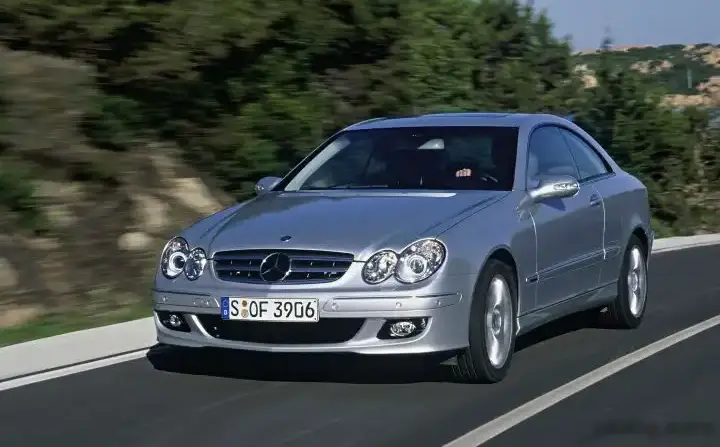
The Mercedes-Benz CLK 220 CDI Automatic, produced from 2005 to 2009 as part of the C209 facelift generation, represented a compelling blend of luxury, performance, and fuel efficiency within the Mercedes-Benz coupe lineup. Positioned as a mid-range offering, it catered to buyers seeking a refined driving experience with the added benefit of a diesel engine’s economy. This variant occupied a space between the more powerful CLK 320 and the entry-level CLK 200 Kompressor, appealing to those prioritizing torque and fuel consumption over outright horsepower. The C209 CLK series, built on the W203 C-Class platform, aimed to deliver a more sporting and stylish alternative to the traditional sedan, and the 220 CDI Automatic played a significant role in broadening its appeal.
Powertrain & Engine Architecture
The CLK 220 CDI was powered by the OM 646.963, a 2.1-liter inline-four cylinder diesel engine. This engine was a mainstay in the Mercedes-Benz lineup during the early 2000s, known for its robust construction and relatively simple design. It featured a common rail direct injection system, delivering fuel at extremely high pressures for improved combustion efficiency and reduced emissions. The engine also incorporated a turbocharger with an intercooler, boosting power output and providing a broader torque curve. The valvetrain employed a double overhead camshaft (DOHC) design with four valves per cylinder, optimizing gas flow and contributing to the engine’s performance. The 5-speed automatic transmission, a standard feature, was designed to provide smooth and comfortable gear changes, prioritizing refinement over outright sportiness. This transmission was electronically controlled, adapting to driving conditions and driver input.
Driving Characteristics
The CLK 220 CDI Automatic offered a distinctly different driving experience compared to its gasoline-powered siblings. While lacking the immediate responsiveness of the CLK 320, it compensated with a substantial 340 Nm (250.77 lb-ft) of torque available from just 2000 rpm. This made it a relaxed and effortless cruiser, particularly well-suited for long highway journeys. The automatic transmission, while smooth, wasn’t particularly quick to downshift, and the 0-60 mph time of around 9.9 seconds reflected this. Compared to the manual transmission versions, the automatic offered less driver engagement but greater convenience. The gear ratios were optimized for fuel efficiency and comfortable cruising, rather than aggressive acceleration. The engine was relatively quiet for a diesel, but the characteristic diesel clatter was still noticeable, especially during cold starts.
Equipment & Trim Levels
The CLK 220 CDI Automatic typically came equipped with a generous array of standard features. These included automatic climate control, power windows and mirrors, a multi-function steering wheel, and a high-quality audio system. Interior upholstery was typically a combination of fabric and leatherette, with full leather options available as an upgrade. Optional extras included a sunroof, heated seats, a navigation system, and upgraded audio systems. The dashboard layout was typical of Mercedes-Benz at the time, featuring a blend of analog gauges and a central display screen. The overall interior ambiance was one of understated luxury and refinement.
Chassis & Braking
The CLK 220 CDI utilized an independent suspension system at all four corners. The front suspension employed a McPherson strut design with a transverse stabilizer bar, while the rear featured a multi-link setup, also with a stabilizer bar. This configuration provided a comfortable ride and good handling characteristics. Braking duties were handled by ventilated disc brakes on all four wheels, coupled with an Anti-lock Braking System (ABS) for enhanced safety. The steering was a rack-and-pinion system with hydraulic power assistance, offering a balanced feel and precise control.
Market Reception & Comparison
The CLK 220 CDI Automatic was generally well-received by automotive critics. It was praised for its fuel efficiency, comfortable ride, and refined interior. However, some reviewers noted that the performance was not as exhilarating as that of the gasoline-powered models. Compared to the CLK 320, the 220 CDI offered significantly better fuel economy but less power. Against the CLK 200 Kompressor, it provided more torque and a more relaxed driving experience, but at a slightly higher price point. The 220 CDI appealed to buyers who prioritized practicality and economy without sacrificing luxury and style.
Legacy
The OM 646 engine, found in the CLK 220 CDI, has proven to be a remarkably durable and reliable powerplant. With proper maintenance, these engines can easily exceed 200,000 miles. The 5-speed automatic transmission is also generally reliable, although it may require servicing at higher mileages. In the used car market today, the CLK 220 CDI Automatic represents a good value proposition for buyers seeking a stylish and economical coupe. However, potential buyers should be aware of the potential for diesel particulate filter (DPF) issues, particularly on vehicles that have primarily been used for short trips. Overall, the CLK 220 CDI Automatic remains a well-regarded and capable vehicle, offering a compelling blend of luxury, performance, and fuel efficiency.