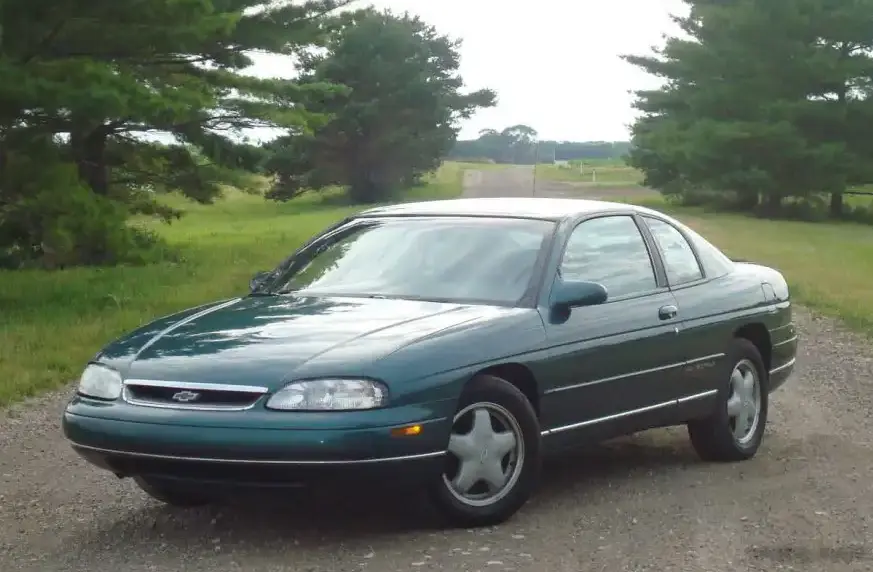
The Chevrolet Monte Carlo VI (1W) 3.8 i V6 SS, produced from 1999 to 2004, represented a significant iteration of Chevrolet’s long-running personal luxury coupe. This generation, built on the GM W-body platform, aimed to recapture the Monte Carlo’s traditional blend of style, comfort, and performance. The 3.8 i V6 SS trim, positioned as the performance-oriented variant, offered a substantial power upgrade over the base models, appealing to buyers seeking a more engaging driving experience. It occupied the top tier of the Monte Carlo lineup, offering a balance between sporty aesthetics and everyday usability.
Technical Specifications
| Brand | Chevrolet |
| Model | Monte Carlo |
| Generation | Monte Carlo VI (1W) |
| Type (Engine) | 3.8 i V6 SS (203 Hp) |
| Start of production | 1999 |
| End of production | 2004 |
| Powertrain Architecture | Internal Combustion engine |
| Body type | Coupe |
| Seats | 5 |
| Doors | 2 |
| Fuel consumption (urban) | 11.8 l/100 km (19.9 US mpg) |
| Fuel consumption (extra urban) | 7.8 l/100 km (30.2 US mpg) |
| Fuel consumption (combined) | 9.4 l/100 km (25 US mpg) |
| Fuel Type | Petrol (Gasoline) |
| Acceleration 0 – 100 km/h | 8.5 sec |
| Acceleration 0 – 62 mph | 8.5 sec |
| Acceleration 0 – 60 mph | 8.1 sec |
| Maximum speed | 200 km/h (124.27 mph) |
| Weight-to-power ratio | 7.7 kg/Hp |
| Weight-to-torque ratio | 5.1 kg/Nm |
| Power | 203 Hp @ 5200 rpm |
| Torque | 305 Nm @ 4000 rpm (224.96 lb.-ft. @ 4000 rpm) |
| Engine layout | Front, Transverse |
| Engine Model/Code | L36 |
| Engine displacement | 3791 cm3 (231.34 cu. in.) |
| Number of cylinders | 6 |
| Engine configuration | V-engine |
| Cylinder Bore | 96.52 mm (3.8 in.) |
| Piston Stroke | 86.36 mm (3.4 in.) |
| Compression ratio | 9.4:1 |
| Number of valves per cylinder | 2 |
| Fuel injection system | Multi-port manifold injection |
| Engine aspiration | Naturally aspirated engine |
| Engine oil capacity | 4.1 l (4.33 US qt | 3.61 UK qt) |
| Coolant capacity | 11 l (11.62 US qt | 9.68 UK qt) |
| Kerb Weight | 1565 kg (3450.23 lbs.) |
| Trunk (boot) space | 447 l (15.79 cu. ft.) |
| Fuel tank capacity | 64 l (16.91 US gal | 14.08 UK gal) |
| Length | 5027 mm (197.91 in.) |
| Width | 1847 mm (72.72 in.) |
| Height | 1402 mm (55.2 in.) |
| Wheelbase | 2807 mm (110.51 in.) |
| Front track | 1575 mm (62.01 in.) |
| Rear track | 1560 mm (61.42 in.) |
| Drivetrain Architecture | Front wheel drive |
| Number of gears | 4 |
| Gearbox type | Automatic transmission |
| Front suspension | Coil spring |
| Rear suspension | Coil spring |
| Front brakes | Ventilated discs |
| Rear brakes | Disc |
| Assisting systems | ABS (Anti-lock braking system) |
| Steering type | Steering rack and pinion |
| Power steering | Hydraulic Steering |
| Tires size | 225/60 R16 |
| Wheel rims size | 6.5J x 16 |
Powertrain & Engine Architecture
The heart of the Monte Carlo VI SS was the 3.8-liter (3791 cc) Series III L36 V6 engine. This engine, a staple of GM’s mid-size and full-size vehicles for years, featured a 90-degree V-configuration, two valves per cylinder, and a cast iron block with aluminum cylinder heads. The L36 utilized a multi-port fuel injection system, delivering precise fuel metering for improved efficiency and performance. The engine produced 203 horsepower at 5200 rpm and 224.96 lb-ft of torque at 4000 rpm. The engine’s design prioritized smooth operation and reliability over outright peak power. Paired with the L36 was a 4-speed 4T65E automatic transmission. This transmission was known for its smooth shifts and durability, although it wasn’t particularly geared for aggressive driving. The transmission’s gear ratios were optimized for comfortable cruising and reasonable acceleration.
Driving Characteristics
The 3.8L V6 with the 4-speed automatic provided a comfortable and capable driving experience. Acceleration from 0-60 mph took approximately 8.1 seconds, which was respectable for a front-wheel-drive coupe of its size. However, it wasn’t a particularly sporty performer. The automatic transmission, while smooth, lacked the responsiveness of a manual gearbox, and the relatively tall gear ratios prioritized fuel economy over rapid acceleration. The power delivery was linear, making it easy to modulate, but it lacked the punch of some of its competitors. The front-wheel-drive configuration contributed to a slight tendency towards understeer during cornering, but the suspension was tuned for a comfortable ride rather than sharp handling.
Equipment & Trim Levels
The Monte Carlo VI SS came standard with a number of features designed to enhance comfort and convenience. These included air conditioning, power windows and locks, a premium sound system, and cruise control. The interior typically featured cloth upholstery, although leather was available as an option. The SS trim also included unique exterior styling cues, such as a rear spoiler, body-colored side moldings, and alloy wheels. Optional extras included a sunroof, upgraded sound system with a CD changer, and traction control. The dashboard layout was fairly straightforward, with easy-to-read gauges and logically placed controls.
Chassis & Braking
The Monte Carlo VI utilized a front-wheel-drive chassis with independent coil spring suspension at all four corners. The front suspension featured MacPherson struts, while the rear suspension employed a multi-link design. This setup provided a comfortable ride, but wasn’t particularly sporty. The braking system consisted of ventilated discs at the front and solid discs at the rear. Anti-lock brakes (ABS) were standard equipment. The steering was rack-and-pinion with hydraulic power assist, providing light and easy steering feel. The standard tire size was 225/60R16, mounted on 6.5J x 16 inch alloy wheels.
Market Reception & Comparison
The Monte Carlo VI SS received mixed reviews from automotive critics. While praised for its comfortable ride and spacious interior, it was often criticized for its lack of sporty handling and somewhat uninspired styling. Compared to other coupes in its class, such as the Ford Mustang and the Honda Accord Coupe, the Monte Carlo SS offered a more comfortable and refined driving experience, but lacked the performance and handling prowess of its rivals. Fuel economy was generally considered to be average for its class, with combined fuel consumption around 25 US mpg. Reliability was generally good, although some owners reported issues with the automatic transmission and the cooling system.
Legacy
The Chevrolet Monte Carlo VI SS, particularly the 3.8L V6 automatic variant, remains a relatively affordable and accessible classic car in the used car market. The L36 engine is known for its durability and relatively low maintenance costs. While not a high-performance machine, it offers a comfortable and reliable driving experience, making it a popular choice for those seeking a stylish and practical coupe. Parts availability is generally good, as the L36 engine and the W-body platform were used in a wide range of GM vehicles. The Monte Carlo VI SS represents a final chapter in the Monte Carlo’s long history, offering a blend of traditional American styling and modern convenience.