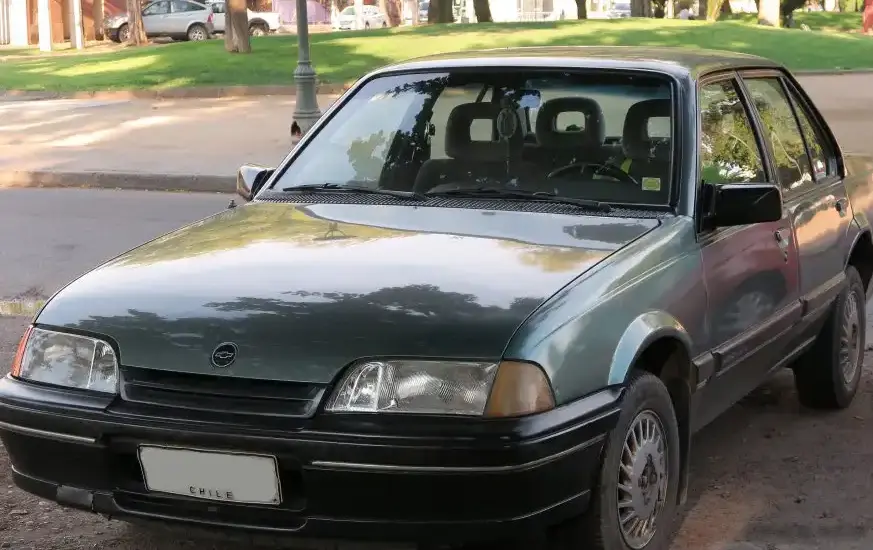
The Chevrolet Monza 2.0i (110 hp) was a significant variant of the Brazilian-market Chevrolet Monza, produced from 1982 to 1996. Positioned as a mid-range offering within the Monza lineup, it provided a balance between performance and affordability, appealing to a broader customer base than the base models while remaining more accessible than the higher-specification versions. The Monza itself was a crucial model for General Motors do Brasil (GM Brasil), representing a modern, domestically produced option in a market increasingly influenced by international designs. It was built on the GM4100 platform, a derivative of the Opel Ascona, and played a key role in establishing Chevrolet as a leading brand in Brazil.
Technical Specifications
| Brand | Chevrolet |
| Model | Monza |
| Generation | Monza (Brazil) |
| Type (Engine) | 2.0 i (110 Hp) |
| Start of production | 1982 |
| End of production | 1996 |
| Powertrain Architecture | Internal Combustion engine |
| Body type | Sedan |
| Seats | 5 |
| Doors | 3/5 |
| Fuel consumption (combined) | 8.4 l/100 km |
| Fuel consumption (US mpg) | 28 US mpg |
| Fuel consumption (UK mpg) | 33.6 UK mpg |
| Fuel consumption (km/l) | 11.9 km/l |
| Fuel Type | Petrol (Gasoline) |
| Acceleration 0 – 100 km/h | 10 sec |
| Acceleration 0 – 62 mph | 10 sec |
| Acceleration 0 – 60 mph | 9.5 sec |
| Maximum speed | 178 km/h (110.6 mph) |
| Weight-to-power ratio | 9.7 kg/Hp |
| Weight-to-torque ratio | 6.5 kg/Nm |
| Power | 110 Hp @ 5600 rpm |
| Power per litre | 55.1 Hp/l |
| Torque | 163 Nm @ 3200 rpm (120.22 lb.-ft. @ 3200 rpm) |
| Engine layout | Front, Transverse |
| Engine displacement | 1998 cm3 (121.93 cu. in.) |
| Number of cylinders | 4 |
| Engine configuration | Inline |
| Cylinder Bore | 86 mm (3.39 in.) |
| Piston Stroke | 86 mm (3.39 in.) |
| Compression ratio | 9.2:1 |
| Number of valves per cylinder | 2 |
| Fuel injection system | Single-point injection |
| Engine aspiration | Naturally aspirated engine |
| Valvetrain | OHC |
| Kerb Weight | 1062 kg (2341.31 lbs.) |
| Max. weight | 1537 kg (3388.5 lbs.) |
| Max load | 475 kg (1047.2 lbs.) |
| Trunk (boot) space – minimum | 510 l (18.01 cu. ft.) |
| Fuel tank capacity | 57 l (15.06 US gal | 12.54 UK gal) |
| Length | 4493 mm (176.89 in.) |
| Width | 1642 mm (64.65 in.) |
| Height | 1380 mm (54.33 in.) |
| Wheelbase | 2574 mm (101.34 in.) |
| Front track | 1406 mm (55.35 in.) |
| Rear (Back) track | 1406 mm (55.35 in.) |
| Drivetrain Architecture | The Internal combustion engine (ICE) drives the front wheels of the vehicle. |
| Drive wheel | Front wheel drive |
| Number of gears and type of gearbox | 5 gears, manual transmission |
| Front suspension | Spring Strut |
| Rear suspension | Coil spring |
| Front brakes | Ventilated discs |
| Rear brakes | Drum |
| Power steering | Hydraulic Steering |
| Tires size | 185/65 R13 S |
Powertrain & Engine Architecture
The heart of the Monza 2.0i was the Chevrolet 1998cc inline-four cylinder engine. This engine, often referred to by its internal codes, utilized a single-point fuel injection system, a common feature for the time, providing a balance between cost and efficiency. The engine featured an overhead camshaft (OHC) valvetrain, operating two valves per cylinder. The 9.2:1 compression ratio was a compromise designed for the quality of fuel available in Brazil. The engine produced 110 horsepower at 5600 rpm and 163 Nm (120.22 lb-ft) of torque at 3200 rpm. The engine was transversely mounted, driving the front wheels through a five-speed manual transmission. While an automatic transmission was offered on some Monza models, it was less common with the 2.0i engine, making the manual version the more prevalent configuration.
Driving Characteristics
The Monza 2.0i offered a noticeable step up in performance compared to the lower-displacement versions. The 0-60 mph time of around 9.5 seconds was respectable for the early 1980s and provided adequate acceleration for everyday driving and overtaking. The five-speed manual transmission allowed drivers to keep the engine in its optimal power band, maximizing performance. Compared to the more basic 1.6L or 1.8L models, the 2.0i felt more responsive and capable, particularly when fully loaded or tackling inclines. However, it didn’t possess the outright performance of the later, more powerful Monza models like those equipped with the 2.5L engine. The front-wheel-drive configuration provided predictable handling, although it wasn’t as engaging as rear-wheel-drive alternatives.
Equipment & Trim Levels
The Monza 2.0i typically came equipped with features considered standard for a mid-range vehicle of its era. This included cloth upholstery, a basic instrument cluster, and manual windows and locks. Air conditioning was often an optional extra, as were features like a radio/cassette player and upgraded interior trim. The trim level often dictated the exterior details, with chrome accents and wheel covers being common additions. The 2.0i often served as a base for buyers who wanted to add options, allowing for a degree of personalization. Higher trim levels might have included features like power windows and central locking, but these were less common on the 2.0i compared to the top-of-the-line models.
Chassis & Braking
The Monza utilized a relatively simple chassis design, featuring a MacPherson strut front suspension and a coil spring rear suspension. This setup provided a comfortable ride, although it wasn’t particularly sporty. The front brakes were ventilated discs, offering adequate stopping power, while the rear brakes were drums. Hydraulic power steering was standard, making the car easier to maneuver at low speeds. The suspension was tuned for a balance between comfort and handling, prioritizing ride quality over sharp cornering. Stabilizer bars were included, but their thickness varied depending on the specific trim level.
Market Reception & Comparison
The Monza 2.0i was generally well-received in the Brazilian market. Critics praised its spacious interior, comfortable ride, and relatively strong performance. It was seen as a practical and reliable family car, offering good value for money. Compared to its siblings, the 2.0i offered a sweet spot between the more affordable, but less powerful, 1.6L and 1.8L models, and the more expensive and performance-oriented 2.5L versions. Fuel economy was reasonable for the time, averaging around 28 US mpg. Reliability was generally good, although maintenance costs could be moderate due to the availability of parts and the complexity of the fuel injection system.
Legacy
The Chevrolet Monza, and particularly the 2.0i variant, holds a significant place in Brazilian automotive history. It was a popular and influential car that helped to modernize the domestic automotive industry. Today, well-maintained examples are sought after by collectors and enthusiasts. The 2.0i engine, while not particularly high-tech by modern standards, proved to be durable and relatively easy to maintain. Its simplicity contributes to its continued reliability in the used car market. Finding original, unmolested examples is becoming increasingly difficult, but the Monza 2.0i remains a fondly remembered and respected vehicle in Brazil.