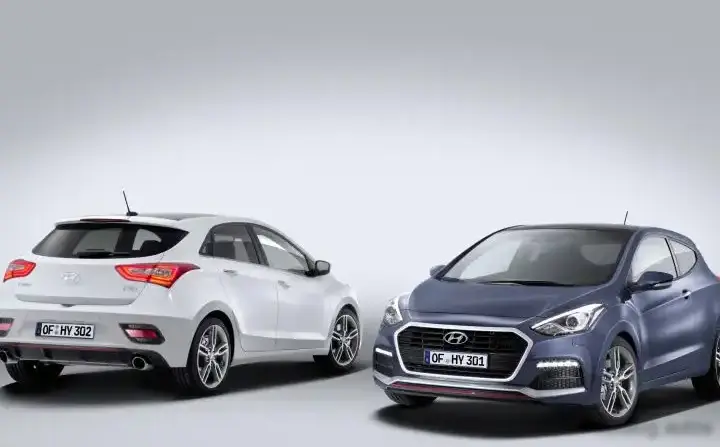
The Hyundai i30 II Coupe (facelift 2015) 1.6 CRDi 136 Hp DCT represents a compelling offering within the second-generation i30 family. Introduced as part of the facelift in 2015 and continuing through 2017, this variant combined a fuel-efficient diesel engine with the convenience of a dual-clutch transmission (DCT) in a sporty coupe body style. Positioned as a mid-range option, it aimed to balance performance, economy, and practicality for European buyers seeking a stylish and efficient compact car. This model was primarily sold in the European market, where diesel engines and compact coupes were popular choices.
Technical Specifications
| Brand | Hyundai |
| Model | i30 |
| Generation | i30 II Coupe (facelift 2015) |
| Type (Engine) | 1.6 CRDi (136 Hp) DCT |
| Start of production | 2015 |
| End of production | 2017 |
| Powertrain Architecture | Internal Combustion engine |
| Body type | Coupe |
| Seats | 5 |
| Doors | 3 |
| Fuel consumption (urban) | 4.6 l/100 km (51.1 US mpg, 61.4 UK mpg, 21.7 km/l) |
| Fuel consumption (extra urban) | 3.9 l/100 km (60.3 US mpg, 72.4 UK mpg, 25.6 km/l) |
| Fuel consumption (combined) | 4.2 l/100 km (56 US mpg, 67.3 UK mpg, 23.8 km/l) |
| CO2 emissions | 109 g/km |
| Fuel Type | Diesel |
| Acceleration 0 – 100 km/h | 10.2 sec |
| Acceleration 0 – 62 mph | 10.2 sec |
| Acceleration 0 – 60 mph | 9.7 sec |
| Maximum speed | 197 km/h (122.41 mph) |
| Emission standard | Euro 6 |
| Weight-to-power ratio | 9.6 kg/Hp, 104 Hp/tonne |
| Weight-to-torque ratio | 4.4 kg/Nm, 229.4 Nm/tonne |
| Power | 136 Hp @ 4000 rpm |
| Power per litre | 86 Hp/l |
| Torque | 300 Nm @ 1750-2500 rpm (221.27 lb.-ft. @ 1750-2500 rpm) |
| Engine layout | Front, Transverse |
| Engine Model/Code | D4FB |
| Engine displacement | 1582 cm3 (96.54 cu. in.) |
| Number of cylinders | 4 |
| Engine configuration | Inline |
| Cylinder Bore | 77.2 mm (3.04 in.) |
| Piston Stroke | 84.5 mm (3.33 in.) |
| Number of valves per cylinder | 4 |
| Fuel injection system | Diesel Commonrail |
| Engine aspiration | Turbocharger, Intercooler |
| Engine oil capacity | 5.3 l (5.6 US qt | 4.66 UK qt) |
| Coolant | 6.9 l (7.29 US qt | 6.07 UK qt) |
| Kerb Weight | 1308-1444 kg (2883.65 – 3183.48 lbs.) |
| Max. weight | 1940 kg (4276.97 lbs.) |
| Max load | 496-632 kg (1093.49 – 1393.32 lbs.) |
| Trunk (boot) space – minimum | 378 l (13.35 cu. ft.) |
| Trunk (boot) space – maximum | 1316 l (46.47 cu. ft.) |
| Fuel tank capacity | 53 l (14 US gal | 11.66 UK gal) |
| Max. roof load | 80 kg (176.37 lbs.) |
| Permitted trailer load with brakes (12%) | 1500 kg (3306.93 lbs.) |
| Permitted trailer load without brakes | 650 kg (1433 lbs.) |
| Permitted towbar download | 75 kg (165.35 lbs.) |
| Length | 4300 mm (169.29 in.) |
| Width | 1780 mm (70.08 in.) |
| Height | 1465-1470 mm (57.68 – 57.87 in.) |
| Wheelbase | 2650 mm (104.33 in.) |
| Front track | 1563-1569 mm (61.54 – 61.77 in.) |
| Rear (Back) track | 1571-1577 mm (61.85 – 62.09 in.) |
| Front overhang | 880 mm (34.65 in.) |
| Rear overhang | 770 mm (30.31 in.) |
| Ride height (ground clearance) | 135 mm (5.31 in.) |
| Minimum turning circle (turning diameter) | 10.6 m (34.78 ft.) |
| Drivetrain Architecture | The Internal combustion engine (ICE) drives the front wheels of the vehicle. |
| Drive wheel | Front wheel drive |
| Number of gears and type of gearbox | 7 gears, automatic transmission DCT |
| Front suspension | Independent, type McPherson with coil spring and anti-roll bar |
| Rear suspension | Independent multi-link suspension |
| Front brakes | Ventilated discs |
| Rear brakes | Disc |
| Assisting systems | ABS (Anti-lock braking system) |
| Steering type | Steering rack and pinion |
| Power steering | Electric Steering |
| Tires size | 205/55 R16; 225/45 R17 |
| Wheel rims size | 6.5J x 16; 7.0J x 17 |
INTRODUCTION
The Hyundai i30 II Coupe (facelift 2015) 1.6 CRDi 136 Hp DCT is a three-door coupe based on the second-generation i30 (codenamed GD). The facelift, introduced in 2015, brought revised styling, updated technology, and refined engine options. This particular variant, powered by a 1.6-liter turbocharged diesel engine paired with a seven-speed dual-clutch transmission, was designed to appeal to buyers seeking a blend of fuel efficiency, reasonable performance, and a more dynamic driving experience than the standard i30 hatchback. It slotted into the i30 Coupe lineup between the lower-powered diesel options and the more potent petrol variants.
Powertrain & Engine Architecture
At the heart of this i30 Coupe lies the Hyundai D4FB 1.6-liter four-cylinder diesel engine. This engine utilizes a common-rail direct injection system, delivering fuel at extremely high pressure for optimized combustion. A turbocharger with an intercooler further enhances power output and torque. The D4FB engine is known for its relatively quiet operation and good fuel economy. The 136 horsepower peak is achieved at 4,000 rpm, while the substantial 300 Nm (221 lb-ft) of torque is available from 1750 to 2500 rpm, providing strong low-end and mid-range acceleration. The engine also incorporates a diesel particulate filter (DPF) to meet stringent Euro 6 emission standards.
The seven-speed dual-clutch transmission (DCT) is a key component of this variant. DCTs offer faster and smoother gear changes compared to traditional automatic transmissions, contributing to a more engaging driving experience. The DCT in the i30 Coupe is designed for both efficiency and responsiveness, with quick shifts and minimal torque interruption. It allows for both fully automatic operation and manual gear selection via steering wheel-mounted paddles or the gear selector.
Driving Characteristics
The 1.6 CRDi 136 Hp DCT i30 Coupe delivers a comfortable and refined driving experience. The engine’s strong torque output makes it feel surprisingly punchy, especially in everyday driving situations. While not a sports car, the DCT provides quick and precise gear changes, allowing for brisk acceleration. The 0-60 mph time of around 9.7 seconds is respectable for a diesel-powered coupe in this class. The DCT’s programming prioritizes fuel efficiency, resulting in smooth upshifts and a tendency to be in higher gears at lower speeds. Compared to the manual transmission versions of the same engine, the DCT offers greater convenience, particularly in urban traffic. However, some drivers may find the DCT slightly less engaging than a traditional manual gearbox.
Equipment & Trim Levels
The i30 Coupe 1.6 CRDi DCT typically came well-equipped, even in base trim. Standard features often included air conditioning, power windows, central locking, a touchscreen infotainment system with Bluetooth connectivity, and alloy wheels. Higher trim levels added features such as a panoramic sunroof, leather upholstery, heated front seats, and a more advanced infotainment system with navigation. Safety features like ABS, ESP (Electronic Stability Program), and multiple airbags were standard across the range.
Chassis & Braking
The i30 Coupe utilizes a McPherson strut front suspension and a multi-link rear suspension, providing a good balance between ride comfort and handling. The suspension is tuned to offer a compliant ride without sacrificing too much body control. The steering is electrically assisted, providing a light and precise feel. Braking duties are handled by ventilated discs at the front and solid discs at the rear. ABS (Anti-lock Braking System) is standard, ensuring safe and controlled braking in various conditions.
Market Reception & Comparison
The Hyundai i30 II Coupe 1.6 CRDi DCT was generally well-received by automotive critics. It was praised for its fuel efficiency, comfortable ride, and well-equipped interior. The DCT transmission was also noted as a positive feature, enhancing the driving experience. Compared to the petrol-powered i30 Coupes, the diesel variant offered significantly better fuel economy. However, some critics found the engine slightly noisy compared to some of its rivals. Against competitors like the Volkswagen Scirocco, Peugeot RCZ, and Opel Astra GTC, the i30 Coupe offered a compelling value proposition, often undercutting its rivals in price while offering a comparable level of equipment and performance.
Legacy
The Hyundai i30 II Coupe 1.6 CRDi DCT has proven to be a reliable and durable vehicle. The D4FB engine, while not without its potential issues (like DPF clogging if not properly maintained), is generally considered robust. The DCT transmission, if serviced according to Hyundai’s recommendations, is also relatively reliable. In the used car market, these i30 Coupes represent a good value for buyers seeking an affordable, fuel-efficient, and stylish coupe. They continue to be popular choices for those looking for a practical and economical vehicle with a touch of sporty flair.