Technical Specifications
| Brand | Hyundai |
| Model | i30 |
| Generation | i30 II CW (facelift 2015) |
| Type (Engine) | 1.4 (100 Hp) blue |
| Start of production | 2015 |
| End of production | 2017 |
| Powertrain Architecture | Internal Combustion engine |
| Body type | Station wagon (estate) |
| Seats | 5 |
| Doors | 5 |
| Fuel consumption (urban) | 7.1-7.5 l/100 km (33.1 – 31.4 US mpg) |
| Fuel consumption (extra urban) | 4.7-4.9 l/100 km (50 – 48 US mpg) |
| Fuel consumption (combined) | 5.6-5.8 l/100 km (42 – 40.6 US mpg) |
| CO2 emissions | 129-135 g/km |
| Fuel Type | Petrol (Gasoline) |
| Acceleration 0 – 100 km/h | 13 sec |
| Acceleration 0 – 62 mph | 13 sec |
| Acceleration 0 – 60 mph | 12.4 sec |
| Maximum speed | 181 km/h (112.47 mph) |
| Emission standard | Euro 6 |
| Weight-to-power ratio | 12 kg/Hp |
| Weight-to-torque ratio | 9 kg/Nm |
| Power | 100 Hp @ 6000 rpm |
| Torque | 134 Nm @ 3500 rpm (98.83 lb.-ft. @ 3500 rpm) |
| Engine layout | Front, Transverse |
| Engine Model/Code | Kappa / G4LC |
| Engine displacement | 1368 cm3 (83.48 cu. in.) |
| Number of cylinders | 4 |
| Engine configuration | Inline |
| Cylinder Bore | 72 mm (2.83 in.) |
| Piston Stroke | 84 mm (3.31 in.) |
| Compression ratio | 10.5:1 |
| Number of valves per cylinder | 4 |
| Engine oil capacity | 3.6 l (3.8 US qt | 3.17 UK qt) |
| Coolant capacity | 6.4 l (6.76 US qt | 5.63 UK qt) |
| Kerb Weight | 1203-1353 kg (2652.16 – 2982.85 lbs.) |
| Max. weight | 1820 kg (4012.41 lbs.) |
| Max load | 467-617 kg (1029.56 – 1360.25 lbs.) |
| Trunk (boot) space – minimum | 528 l (18.65 cu. ft.) |
| Trunk (boot) space – maximum | 1642 l (57.99 cu. ft.) |
| Fuel tank capacity | 53 l (14 US gal | 11.66 UK gal) |
| Max. roof load | 80 kg (176.37 lbs.) |
| Permitted trailer load with brakes (12%) | 1200 kg (2645.55 lbs.) |
| Permitted trailer load without brakes | 600 kg (1322.77 lbs.) |
| Permitted towbar download | 60 kg (132.28 lbs.) |
| Length | 4485 mm (176.57 in.) |
| Width | 1780 mm (70.08 in.) |
| Height | 1495 mm (58.86 in.) |
| Wheelbase | 2650 mm (104.33 in.) |
| Front track | 1555-1569 mm (61.22 – 61.77 in.) |
| Rear track | 1563-1577 mm (61.54 – 62.09 in.) |
| Front overhang | 880 mm (34.65 in.) |
| Rear overhang | 955 mm (37.6 in.) |
| Ride height (ground clearance) | 135 mm (5.31 in.) |
| Minimum turning circle | 10.6 m (34.78 ft.) |
| Drivetrain | Front wheel drive |
| Number of gears and type of gearbox | 6 gears, manual transmission |
| Front suspension | Independent, type McPherson with coil spring and anti-roll bar |
| Rear suspension | Independent multi-link suspension |
| Front brakes | Ventilated discs |
| Rear brakes | Disc |
| Assisting systems | ABS (Anti-lock braking system) |
| Steering type | Steering rack and pinion |
| Power steering | Electric Steering |
| Tires size | 195/65 R15; 205/55 R16 |
| Wheel rims size | 6.0J x 15; 6.5J x 16 |
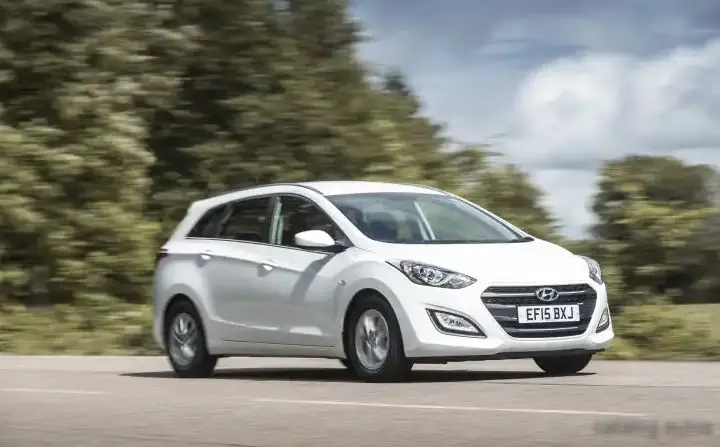
The Hyundai i30 II CW 1.4 Blue, launched during the 2015 facelift, built upon the success of the original i30, offering a practical and affordable option in the European C-segment. The second-generation i30 (launched in 2011) represented a significant step forward for Hyundai in terms of design, build quality, and overall refinement. The CW variant, specifically, catered to buyers needing the increased cargo capacity of a station wagon. The 1.4-liter engine and manual transmission combination positioned this model as the entry point to the i30 CW range, emphasizing fuel economy and low running costs. It was designed to compete with established rivals like the Volkswagen Golf Estate, Ford Focus Estate, and Skoda Octavia Combi.
Powertrain & Engine Architecture
At the heart of the i30 CW 1.4 Blue lies Hyundai’s Kappa 1.4-liter naturally aspirated four-cylinder engine, designated G4LC. This engine is a relatively simple design, featuring a dual overhead camshaft (DOHC) valvetrain with four valves per cylinder. It utilizes multi-point fuel injection, a common setup for this class of engine. The engine produces 100 horsepower at 6000 rpm and 134 Nm (98.83 lb-ft) of torque at 3500 rpm. The engine’s relatively low output is a result of its focus on efficiency rather than outright performance. The engine is transversely mounted at the front of the vehicle, driving the front wheels. The standard transmission for this variant was a six-speed manual gearbox, chosen for its fuel-saving characteristics. While an automatic transmission was available on other i30 models, it wasn’t offered with the 1.4-liter engine.
Driving Characteristics
The i30 CW 1.4 Blue’s driving experience is best described as comfortable and undemanding. With 100 hp, acceleration is not its strong suit; 0-62 mph takes around 13 seconds. The engine feels adequate for everyday driving, providing sufficient power for commuting and general transportation. The six-speed manual transmission is well-matched to the engine, allowing drivers to keep the engine in its optimal power band. Gear ratios are geared towards maximizing fuel economy, meaning the engine can feel strained when accelerating quickly or climbing hills. Compared to the more powerful 1.6-liter gasoline or 1.6-liter diesel variants, the 1.4-liter engine feels noticeably less responsive. However, the lighter engine weight contributes to slightly improved handling and a more nimble feel in corners.
Equipment & Trim Levels
The i30 CW 1.4 Blue typically came with a reasonable level of standard equipment, focusing on practicality and convenience. Standard features generally included air conditioning, electric front windows, a basic audio system with USB connectivity, and ABS brakes with Electronic Stability Control (ESC). Interior upholstery was typically cloth, with a functional and durable design. Optional extras included alloy wheels, a touchscreen infotainment system with navigation, rear parking sensors, and cruise control. Trim levels varied slightly depending on the specific market, but the 1.4 Blue generally represented the base trim, with more luxurious features reserved for higher-spec models.
Chassis & Braking
The i30 CW utilizes a McPherson strut front suspension and a multi-link rear suspension, providing a good balance between ride comfort and handling. The suspension is tuned for comfort, absorbing bumps and imperfections in the road effectively. Front brakes are ventilated discs, while rear brakes are solid discs, providing adequate stopping power for the vehicle’s weight and performance. The steering is electrically assisted, offering a light and easy driving experience. Stabilizer bars are fitted to both the front and rear axles to reduce body roll during cornering.
Market Reception & Comparison
The i30 CW 1.4 Blue was generally well-received by critics as a sensible and affordable option. Its fuel economy was a major selling point, with combined fuel consumption figures ranging from 5.6 to 5.8 liters per 100 kilometers (42-40.6 US mpg). Compared to the more powerful i30 variants, the 1.4-liter engine offered lower running costs but sacrificed performance. The 1.6-liter gasoline engine provided a noticeable performance boost, while the 1.6-liter diesel offered even better fuel economy and torque. However, the 1.4 Blue remained a popular choice for buyers prioritizing value and efficiency.
Legacy
The Hyundai i30 II CW 1.4 Blue has proven to be a reliable and durable vehicle in the used car market. The Kappa 1.4-liter engine is generally considered to be a robust and dependable unit, with relatively few common issues. Regular maintenance, including oil changes and timing belt replacements, is crucial for ensuring long-term reliability. Today, these i30 CWs represent an affordable and practical option for buyers seeking a spacious and economical station wagon. Their relatively low purchase price and good fuel economy continue to make them an attractive proposition.