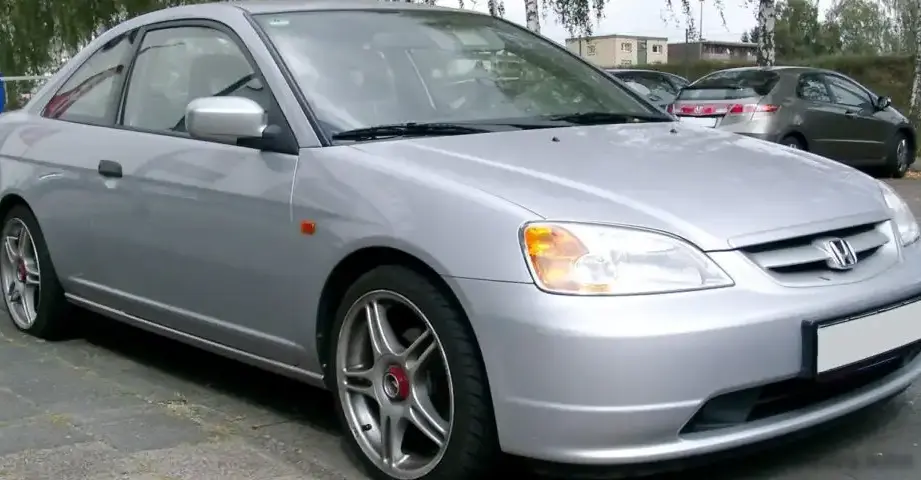
The Honda Civic VII Coupe 1.7i, produced from 2001 to 2006, represented a significant evolution in Honda’s popular compact car line. Part of the seventh generation Civic (2001-2005 in North America, extended to 2006 in some markets), this coupe variant offered a sporty, two-door alternative to the more practical sedan and hatchback models. The 1.7i trim, equipped with a 1.7-liter engine producing 125 horsepower, served as a popular entry point into the Civic Coupe range, balancing affordability with Honda’s reputation for reliability and fuel efficiency. It was positioned as a step up from the base DX model, offering more features and a slightly more powerful engine, but remained below the more performance-oriented Si trim.
Technical Specifications
| Brand | Honda |
| Model | Civic |
| Generation | Civic VII Coupe |
| Type (Engine) | 1.7i (125 Hp) |
| Start of production | 2001 |
| End of production | 2006 |
| Powertrain Architecture | Internal Combustion engine |
| Body type | Coupe |
| Seats | 5 |
| Doors | 2 |
| Fuel consumption (urban) | 9 l/100 km (26.1 US mpg) |
| Fuel consumption (extra urban) | 5.5 l/100 km (42.8 US mpg) |
| Fuel consumption (combined) | 6.8 l/100 km (34.6 US mpg) |
| Fuel Type | Petrol (Gasoline) |
| Acceleration 0 – 100 km/h | 9.6 sec |
| Acceleration 0 – 62 mph | 9.6 sec |
| Acceleration 0 – 60 mph | 9.1 sec |
| Maximum speed | 201 km/h (124.9 mph) |
| Weight-to-power ratio | 9.2 kg/Hp |
| Weight-to-torque ratio | 7.4 kg/Nm |
| Power | 125 Hp @ 6300 rpm |
| Torque | 154 Nm @ 4800 rpm (113.58 lb.-ft. @ 4800 rpm) |
| Engine layout | Front, Transverse |
| Engine Model/Code | D17A |
| Engine displacement | 1668 cm3 (101.79 cu. in.) |
| Number of cylinders | 4 |
| Engine configuration | Inline |
| Cylinder Bore | 75 mm (2.95 in.) |
| Piston Stroke | 94.4 mm (3.72 in.) |
| Compression ratio | 9.9:1 |
| Number of valves per cylinder | 4 |
| Fuel injection system | Multi-port manifold injection |
| Engine aspiration | Naturally aspirated |
| Valvetrain | SOHC |
| Engine oil capacity | 3.5 l (3.7 US qt | 3.08 UK qt) |
| Coolant capacity | 3.9 l (4.12 US qt | 3.43 UK qt) |
| Kerb Weight | 1145 kg (2524.29 lbs.) |
| Max. weight | 1590 kg (3505.35 lbs.) |
| Max load | 445 kg (981.06 lbs.) |
| Trunk (boot) space – minimum | 441 l (15.57 cu. ft.) |
| Fuel tank capacity | 50 l (13.21 US gal | 11 UK gal) |
| Length | 4438 mm (174.72 in.) |
| Width | 1695 mm (66.73 in.) |
| Height | 1399 mm (55.08 in.) |
| Wheelbase | 2620 mm (103.15 in.) |
| Front track | 1470 mm (57.87 in.) |
| Rear track | 1470 mm (57.87 in.) |
| Drivetrain Architecture | Front wheel drive |
| Number of gears | 5 |
| Gearbox type | Manual transmission |
| Front suspension | Spring Strut |
| Rear suspension | Transverse stabilizer |
| Front brakes | Ventilated discs |
| Rear brakes | Disc |
| Assisting systems | ABS (Anti-lock braking system) |
| Steering type | Steering rack and pinion |
| Tires size | 195/60 R15 |
Powertrain & Engine Architecture
The heart of the Civic VII Coupe 1.7i was the D17A engine, a 1.7-liter inline-four cylinder powerplant. This engine utilized a single overhead camshaft (SOHC) valvetrain and multi-point fuel injection. The D17A was known for its relatively simple design, contributing to its reliability. The engine’s 9.9:1 compression ratio was a compromise between performance and fuel efficiency. The 125 horsepower output, while not exceptionally high, was sufficient for everyday driving and provided adequate acceleration. The engine was primarily paired with a five-speed manual transmission, which was the most common configuration. An automatic transmission was also offered, though less frequently chosen. The transmission’s gear ratios were tuned for a balance of fuel economy and responsiveness, with a relatively tall fifth gear for highway cruising. The engine block itself was constructed from cast iron, contributing to its durability, while the cylinder head was aluminum, helping to reduce overall weight.
Driving Characteristics
The 1.7i Coupe offered a comfortable and predictable driving experience. Acceleration from a standstill to 60 mph took approximately 9.1 seconds, making it competitive with other compact coupes of the era. While not a sports car, the Civic’s light weight and responsive steering made it enjoyable to drive on winding roads. The five-speed manual transmission allowed drivers to maintain control over engine speed and maximize fuel efficiency. The gear ratios were well-spaced, providing adequate power for both city driving and highway passing maneuvers. Compared to the higher-performance Civic Si, the 1.7i lacked the same level of urgency and responsiveness, but it offered a more relaxed and fuel-efficient driving experience. The optional automatic transmission, while convenient, resulted in a noticeable decrease in acceleration and fuel economy. The suspension was tuned for comfort, absorbing bumps and imperfections in the road surface effectively.
Equipment & Trim Levels
The 1.7i trim level included standard features such as air conditioning, power windows and locks, and an AM/FM stereo. Interior upholstery was typically cloth, with a relatively simple dashboard layout. The instrument cluster was straightforward and easy to read. Optional extras included a sunroof, upgraded stereo system with a CD player, and alloy wheels. Power mirrors were also available as an option. The Civic Coupe 1.7i was generally well-equipped for its price point, offering a good balance of features and affordability. The interior design prioritized functionality and ease of use, with clearly labeled controls and comfortable seating. The overall aesthetic was clean and modern for its time.
Chassis & Braking
The Civic VII Coupe utilized a front-wheel-drive layout with independent front suspension and a multi-link rear suspension. The front suspension featured MacPherson struts, while the rear suspension employed a transverse stabilizer bar to reduce body roll. Braking duties were handled by ventilated disc brakes at the front and solid disc brakes at the rear. Anti-lock braking system (ABS) was standard, enhancing safety and control during emergency braking situations. The chassis was designed to provide a comfortable ride while maintaining good handling characteristics. The relatively lightweight construction of the Civic Coupe contributed to its agility and responsiveness. Steering was rack and pinion, providing precise and predictable handling.
Market Reception & Comparison
The Civic VII Coupe 1.7i was generally well-received by automotive critics. It was praised for its reliability, fuel efficiency, and comfortable ride. However, some critics noted that the engine lacked the power and refinement of some of its competitors, such as the Acura RSX. Compared to other trims in the Civic lineup, the 1.7i offered the best value for money, making it a popular choice for budget-conscious buyers. Its fuel economy of around 34.6 US mpg combined was a significant selling point, particularly in a time of rising gas prices. Compared to the Civic Si, the 1.7i was less expensive to insure and maintain. The 1.7i appealed to a broader audience than the Si, which was geared towards younger, more performance-oriented drivers.
Legacy
The Honda Civic VII Coupe 1.7i has proven to be a remarkably durable and reliable vehicle. Many examples are still on the road today, a testament to Honda’s engineering quality. The D17A engine is known for its longevity, and with proper maintenance, can easily exceed 200,000 miles. In the used car market, the Civic VII Coupe 1.7i remains a popular choice for those seeking an affordable, reliable, and fuel-efficient compact coupe. Its simple design and readily available parts make it relatively easy to maintain and repair. While not a collector’s item, it holds a nostalgic appeal for many enthusiasts who appreciate its practicality and dependability. The Civic VII generation, as a whole, solidified Honda’s reputation for building long-lasting and dependable vehicles.