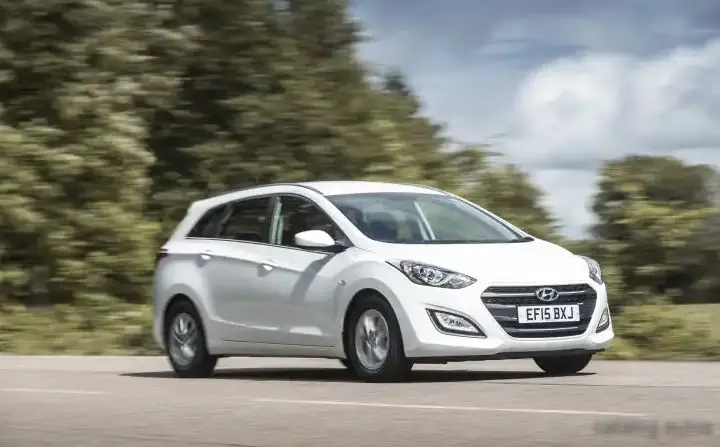
The Hyundai i30 II CW (facelift 2015) 1.6 GDI (135 Hp) DCT represents a specific configuration within the second generation of Hyundai’s popular i30 compact wagon. Produced from 2015 to 2017, this variant combined a 1.6-liter gasoline direct injection (GDI) engine with a seven-speed dual-clutch transmission (DCT). Positioned as a mid-range offering, it aimed to balance fuel efficiency with acceptable performance for everyday driving, appealing to buyers seeking a practical and modern estate car. This model falls within the AD platform family, shared with the Kia Ceed and other Hyundai models, and was a key part of Hyundai’s strategy to gain market share in the competitive European C-segment.
Technical Specifications
| Brand | Hyundai |
| Model | i30 |
| Generation | i30 II CW (facelift 2015) |
| Type (Engine) | 1.6 GDI (135 Hp) DCT |
| Start of production | 2015 |
| End of production | 2017 |
| Powertrain Architecture | Internal Combustion engine |
| Body type | Station wagon (estate) |
| Seats | 5 |
| Doors | 5 |
| Fuel consumption (urban) | 7.2 l/100 km (32.7 US mpg) |
| Fuel consumption (extra urban) | 4.9 l/100 km (48 US mpg) |
| Fuel consumption (combined) | 5.7 l/100 km (41.3 US mpg) |
| CO2 emissions | 132 g/km |
| Fuel Type | Petrol (Gasoline) |
| Acceleration 0 – 100 km/h | 11 sec |
| Acceleration 0 – 62 mph | 11 sec |
| Acceleration 0 – 60 mph | 10.5 sec |
| Maximum speed | 193 km/h (119.92 mph) |
| Emission standard | Euro 6 |
| Weight-to-power ratio | 9.3 kg/Hp |
| Weight-to-torque ratio | 7.6 kg/Nm |
| Power | 135 Hp @ 6300 rpm |
| Torque | 164 Nm @ 4850 rpm (120.96 lb.-ft. @ 4850 rpm) |
| Engine layout | Front, Transverse |
| Engine Model/Code | G4FD |
| Engine displacement | 1591 cm3 (97.09 cu. in.) |
| Number of cylinders | 4 |
| Engine configuration | Inline |
| Cylinder Bore | 77 mm (3.03 in.) |
| Piston Stroke | 85.44 mm (3.36 in.) |
| Compression ratio | 10.5:1 |
| Number of valves per cylinder | 4 |
| Fuel injection system | Direct injection |
| Engine aspiration | Naturally aspirated engine |
| Engine oil capacity | 3.6 l (3.8 US qt | 3.17 UK qt) |
| Coolant | 6.4 l (6.76 US qt | 5.63 UK qt) |
| Kerb Weight | 1254-1415 kg (2764.6 – 3119.54 lbs.) |
| Max. weight | 1850 kg (4078.55 lbs.) |
| Max load | 435-596 kg (959.01 – 1313.96 lbs.) |
| Trunk (boot) space – minimum | 528 l (18.65 cu. ft.) |
| Trunk (boot) space – maximum | 1642 l (57.99 cu. ft.) |
| Fuel tank capacity | 53 l (14 US gal | 11.66 UK gal) |
| Max. roof load | 80 kg (176.37 lbs.) |
| Permitted trailer load with brakes (12%) | 1400 kg (3086.47 lbs.) |
| Permitted trailer load without brakes | 600 kg (1322.77 lbs.) |
| Permitted towbar download | 60 kg (132.28 lbs.) |
| Length | 4485 mm (176.57 in.) |
| Width | 1780 mm (70.08 in.) |
| Height | 1500 mm (59.06 in.) |
| Wheelbase | 2650 mm (104.33 in.) |
| Front track | 1549 mm (60.98 in.) |
| Rear (Back) track | 1557 mm (61.3 in.) |
| Front overhang | 880 mm (34.65 in.) |
| Rear overhang | 955 mm (37.6 in.) |
| Ride height (ground clearance) | 140 mm (5.51 in.) |
| Minimum turning circle (turning diameter) | 10.6 m (34.78 ft.) |
| Drivetrain Architecture | Front wheel drive |
| Drive wheel | Front wheel drive |
| Number of gears and type of gearbox | 7 gears, automatic transmission DCT |
| Front suspension | Independent, type McPherson with coil spring and anti-roll bar |
| Rear suspension | Independent multi-link suspension |
| Front brakes | Ventilated discs |
| Rear brakes | Disc |
| Assisting systems | ABS (Anti-lock braking system) |
| Steering type | Steering rack and pinion |
| Power steering | Electric Steering |
| Tires size | 205/55 R 16; 225/45 R17 |
| Wheel rims size | 6.5 J x 16; 7.0J x 17 |
INTRODUCTION
The Hyundai i30 II CW (facelift 2015) 1.6 GDI (135 Hp) DCT is a station wagon variant of the second-generation i30, a compact car produced by the South Korean manufacturer Hyundai. Introduced as part of a mid-cycle refresh in 2015, the “CW” designation denotes the wagon body style (CW stands for Compact Wagon). This particular version, powered by a 1.6-liter GDI engine paired with a seven-speed dual-clutch transmission, was aimed at buyers prioritizing fuel economy and practicality. It served as a key model in Hyundai’s European lineup, competing with established rivals like the Volkswagen Golf Estate, Ford Focus Estate, and Skoda Octavia Combi. The facelift brought styling updates, improved interior materials, and enhanced technology compared to the pre-2015 models.
Powertrain & Engine Architecture
The heart of this i30 variant is the Hyundai G4FD 1.6-liter inline-four cylinder gasoline engine. This engine utilizes Gasoline Direct Injection (GDI) technology, where fuel is injected directly into the combustion chamber, improving efficiency and power output. The G4FD engine produces 135 horsepower at 6300 rpm and 164 Nm (120.96 lb-ft) of torque at 4850 rpm. It features a dual continuously variable valve timing (D-CVVT) system for optimized valve control across the engine’s operating range. The engine’s block is constructed from aluminum, contributing to weight reduction. Paired with this engine is a seven-speed dual-clutch transmission (DCT). This DCT offers quicker and smoother gear changes compared to a traditional automatic transmission, enhancing both performance and fuel economy. The DCT operates with two separate clutches, one for odd-numbered gears and one for even-numbered gears, allowing for pre-selection of the next gear.
Driving Characteristics
The 1.6 GDI with the DCT delivers a reasonably responsive driving experience, though it isn’t designed for outright performance. Acceleration from 0 to 100 km/h (0-62 mph) takes around 11 seconds. The DCT provides quick shifts, especially in Sport mode, but can sometimes exhibit slight hesitation at low speeds. The gear ratios are tuned for fuel efficiency, meaning the engine can feel slightly strained during aggressive acceleration or when fully loaded. Compared to the more powerful 1.6-liter turbocharged engine option or the diesel variants, this 1.6 GDI feels less potent. However, it offers a smoother and more refined driving experience than the base 1.4-liter engine. The steering is light and precise, making it easy to maneuver in urban environments. Overall, the driving experience is geared towards comfort and practicality rather than sporty handling.
Equipment & Trim Levels
The i30 II CW 1.6 GDI DCT typically came equipped with a respectable level of standard features. These included air conditioning, power windows, central locking, a touchscreen infotainment system with Bluetooth connectivity, and alloy wheels. Safety features such as ABS, ESC (Electronic Stability Control), and multiple airbags were also standard. Higher trim levels, such as Style or Premium, added features like automatic climate control, a larger touchscreen display with navigation, rear parking sensors, a reversing camera, and leather upholstery. Optional extras included a panoramic sunroof, heated seats, and advanced driver-assistance systems like lane departure warning and automatic emergency braking.
Chassis & Braking
The i30 II CW utilizes a McPherson strut front suspension and a multi-link rear suspension. This setup provides a good balance between ride comfort and handling. The suspension is tuned to prioritize comfort, absorbing bumps and imperfections in the road effectively. The front brakes are ventilated discs, while the rear brakes are solid discs. ABS (Anti-lock Braking System) and ESC (Electronic Stability Control) are standard safety features, providing enhanced braking performance and stability in challenging conditions. The steering is an electric power steering system, offering light and precise control.
Market Reception & Comparison
The Hyundai i30 II CW 1.6 GDI DCT was generally well-received by automotive critics. It was praised for its fuel efficiency, spacious interior, and comfortable ride. However, some reviewers noted that the engine lacked outright power and that the DCT could be slightly hesitant at low speeds. Compared to the diesel variants, the 1.6 GDI offered lower running costs in terms of fuel price but potentially higher maintenance costs due to the complexity of the GDI system. Against competitors like the Volkswagen Golf Estate and Ford Focus Estate, the i30 CW offered a competitive price point and a longer warranty, making it an attractive option for budget-conscious buyers.
Legacy
The Hyundai i30 II CW 1.6 GDI DCT has proven to be a relatively reliable vehicle in the used car market. The GDI engine, while offering efficiency benefits, can be prone to carbon buildup over time, requiring periodic cleaning. The DCT transmission is generally durable but may require fluid changes at recommended intervals. Overall, the i30 CW remains a practical and affordable option for buyers seeking a spacious and fuel-efficient estate car. Its combination of comfort, practicality, and value has contributed to its continued popularity in the used car market.