Technical Specifications
| Brand | Hyundai |
| Model | i30 |
| Generation | i30 II (facelift 2015) |
| Type (Engine) | 1.6 CRDi (136 Hp) DCT |
| Start of production | 2015 |
| End of production | 2017 |
| Powertrain Architecture | Internal Combustion engine |
| Body type | Hatchback |
| Seats | 5 |
| Doors | 5 |
| Fuel consumption (urban) | 5.1 l/100 km (46.1 US mpg) |
| Fuel consumption (extra urban) | 4 l/100 km (58.8 US mpg) |
| Fuel consumption (combined) | 4.4 l/100 km (53.5 US mpg) |
| CO2 emissions | 115 g/km |
| Fuel Type | Diesel |
| Acceleration 0 – 100 km/h | 10.6 sec |
| Acceleration 0 – 62 mph | 10.6 sec |
| Acceleration 0 – 60 mph | 10.1 sec |
| Maximum speed | 200 km/h (124.27 mph) |
| Emission standard | Euro 6 |
| Weight-to-power ratio | 10.7 kg/Hp |
| Weight-to-torque ratio | 4.9 kg/Nm |
| Power | 136 Hp @ 4000 rpm |
| Torque | 300 Nm @ 1750-2500 rpm (221.27 lb.-ft.) |
| Engine layout | Front, Transverse |
| Engine Model/Code | D4FB |
| Engine displacement | 1582 cm3 (96.54 cu. in.) |
| Number of cylinders | 4 |
| Engine configuration | Inline |
| Cylinder Bore | 77.2 mm (3.04 in.) |
| Piston Stroke | 84.5 mm (3.33 in.) |
| Compression ratio | 16:1 |
| Number of valves per cylinder | 4 |
| Fuel injection system | Diesel Commonrail |
| Engine aspiration | Turbocharger, Intercooler |
| Valvetrain | DOHC |
| Engine oil capacity | 5.3 l (5.6 US qt | 4.66 UK qt) |
| Coolant capacity | 6.9 l (7.29 US qt | 6.07 UK qt) |
| Kerb Weight | 1456 kg (3209.93 lbs.) |
| Max. weight | 1940 kg (4276.97 lbs.) |
| Max load | 484 kg (1067.04 lbs.) |
| Trunk (boot) space – minimum | 378 l (13.35 cu. ft.) |
| Trunk (boot) space – maximum | 1316 l (46.47 cu. ft.) |
| Fuel tank capacity | 53 l (14 US gal | 11.66 UK gal) |
| Max. roof load | 80 kg (176.37 lbs.) |
| Permitted trailer load with brakes (12%) | 1500 kg (3306.93 lbs.) |
| Permitted trailer load without brakes | 650 kg (1433 lbs.) |
| Permitted towbar download | 75 kg (165.35 lbs.) |
| Length | 4300 mm (169.29 in.) |
| Width | 1780 mm (70.08 in.) |
| Height | 1470 mm (57.87 in.) |
| Wheelbase | 2650 mm (104.33 in.) |
| Front track | 1549 mm (60.98 in.) |
| Rear track | 1557 mm (61.3 in.) |
| Minimum turning circle | 10.6 m (34.78 ft.) |
| Drivetrain | Front wheel drive |
| Number of gears | 7 |
| Gearbox type | Automatic transmission DCT |
| Front suspension | Independent, McPherson with coil spring and anti-roll bar |
| Rear suspension | Independent multi-link suspension |
| Front brakes | Ventilated discs |
| Rear brakes | Disc |
| Assisting systems | ABS (Anti-lock braking system) |
| Steering type | Steering rack and pinion |
| Power steering | Electric |
| Tires size | 225/45 R17 |
| Wheel rims size | 7.0J x 17 |
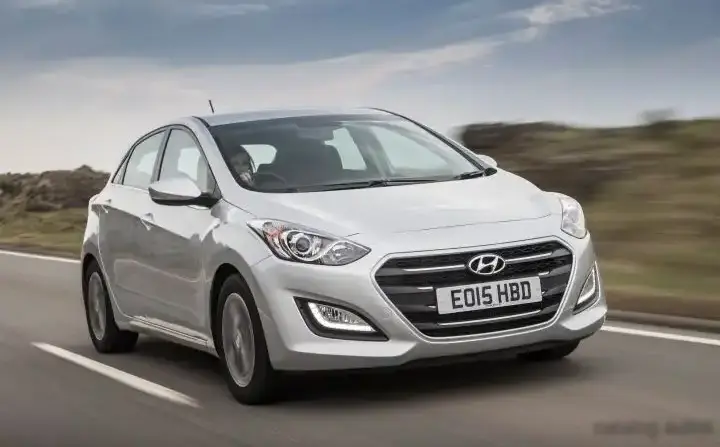
The Hyundai i30 II, launched in 2012 and facelifted in 2015, was a crucial model for Hyundai in Europe. The facelift brought revised styling, improved interior materials, and updated technology. The 1.6 CRDi 136 hp DCT variant was introduced as a modern and efficient option, targeting buyers who prioritized fuel economy and ease of driving. It sat within the i30 range between the lower-powered diesel options and the more performance-oriented petrol variants. Built on the PD platform (internally known as 1HX0), the i30 aimed to offer a compelling package of value, practicality, and a surprisingly refined driving experience.
Powertrain & Engine Architecture
At the heart of this i30 variant lies the Hyundai-Kia D4FB 1.6-liter four-cylinder diesel engine. This engine is a common-rail direct injection (CRDi) unit, utilizing a Bosch-supplied fuel injection system capable of delivering high injection pressures for optimized combustion. The D4FB features a double overhead camshaft (DOHC) design operating four valves per cylinder. A turbocharger with an intercooler is employed to boost power and torque, providing 136 horsepower at 4,000 rpm and a substantial 300 Nm (221 lb-ft) of torque between 1750 and 2500 rpm. The engine also incorporates a diesel particulate filter (DPF) to meet stringent Euro 6 emissions standards.
The “DCT” designation refers to the seven-speed dual-clutch transmission. This transmission, sourced from Hyundai’s collaboration with Getrag, offers quicker and smoother gear changes compared to a traditional automatic transmission. It operates by utilizing two separate clutches for odd and even gears, allowing for pre-selection of the next gear and minimizing interruption in power delivery. The DCT contributes significantly to the car’s fuel efficiency and provides a more engaging driving experience than a conventional torque-converter automatic.
Driving Characteristics
The 1.6 CRDi 136 hp DCT i30 delivers a comfortable and refined driving experience. While not overtly sporty, the engine provides ample torque for everyday driving situations, making overtaking and merging onto highways relatively effortless. The DCT transmission shifts smoothly and responsively, contributing to a seamless power delivery. Acceleration from 0 to 60 mph takes around 10.1 seconds, and the car reaches a top speed of 124 mph. Compared to the lower-powered diesel variants, this version offers noticeably more punch, while remaining more economical than the petrol engines. The DCT’s programming prioritizes fuel efficiency, meaning it will upshift quickly to maintain optimal engine speed. Manual override via the gear selector is available for drivers who prefer more control.
Equipment & Trim Levels
The 1.6 CRDi 136 hp DCT trim typically included a generous level of standard equipment. This often encompassed air conditioning, electric front and rear windows, a touchscreen infotainment system with Bluetooth connectivity, steering wheel-mounted audio controls, and alloy wheels. Safety features such as ABS, Electronic Stability Control (ESC), and multiple airbags were standard. Higher trim levels offered options like a panoramic sunroof, leather upholstery, heated front seats, and a rear parking camera. Interior upholstery was typically cloth, with higher trims offering partial leather options. The dashboard layout was functional and well-designed, with a focus on ergonomics.
Chassis & Braking
The i30 II utilizes a McPherson strut front suspension and a multi-link rear suspension, providing a good balance between ride comfort and handling. The suspension setup is tuned for everyday driving, prioritizing comfort over outright sportiness. The front brakes are ventilated discs, while the rear brakes are solid discs, providing adequate stopping power for the car’s weight and performance. Electric power steering provides light and precise steering feel. The i30’s chassis is relatively lightweight, contributing to its agility and fuel efficiency.
Market Reception & Comparison
The Hyundai i30 II 1.6 CRDi 136 hp DCT was generally well-received by automotive critics. It was praised for its fuel efficiency, comfortable ride, and well-equipped interior. The DCT transmission was also highlighted as a positive feature, offering a more engaging driving experience than traditional automatics. Compared to rivals like the Volkswagen Golf, Ford Focus, and Opel Astra, the i30 offered a compelling value proposition, often undercutting its competitors on price while offering a similar level of equipment. However, some critics noted that the engine could be slightly noisy under hard acceleration, and the interior materials, while improved, didn’t quite match the premium feel of some rivals.
Legacy
The Hyundai i30 II 1.6 CRDi 136 hp DCT has proven to be a reliable and durable vehicle. The D4FB engine, while not without its potential issues (such as DPF clogging if not properly maintained), is generally considered robust. The DCT transmission, when serviced according to Hyundai’s recommendations, is also relatively reliable. On the used car market, these i30s represent a good value for money, offering a practical and efficient mode of transportation. They continue to be popular choices for buyers seeking a well-rounded and affordable compact hatchback.