Technical Specifications
| Brand | Mercedes-Benz |
| Model | CLS |
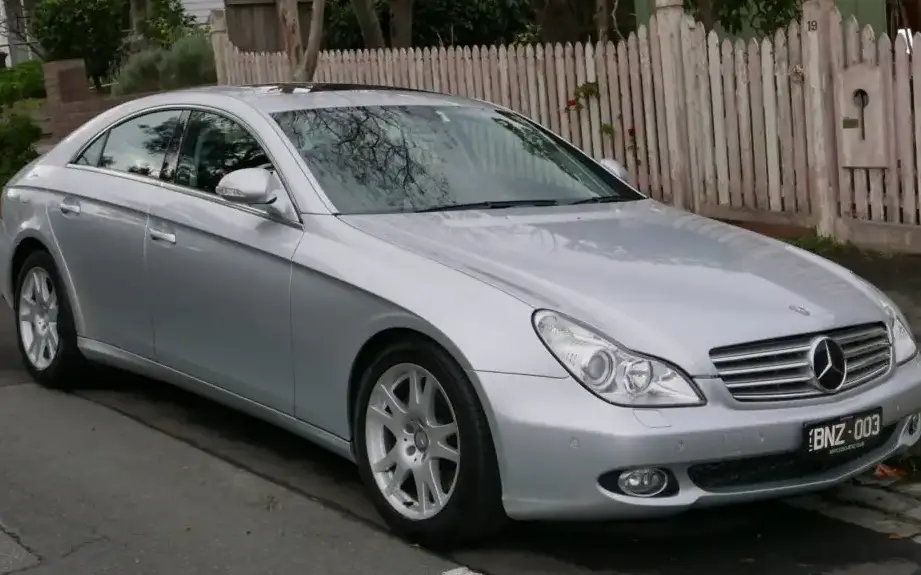
| Generation | CLS coupe (C219) |
| Type (Engine) | CLS 500 V8 (388 Hp) 7G-TRONIC |
| Start of production | May, 2006 |
| End of production | January, 2008 |
| Powertrain Architecture | Internal Combustion engine |
| Body type | Coupe |
| Seats | 4 |
| Doors | 4 |
| Fuel consumption (urban) | 17-17.2 l/100 km (13.8 – 13.7 US mpg, 16.6 – 16.4 UK mpg, 5.9 – 5.8 km/l) |
| Fuel consumption (extra urban) | 8.5-8.7 l/100 km (27.7 – 27 US mpg, 33.2 – 32.5 UK mpg, 11.8 – 11.5 km/l) |
| Fuel consumption (combined) | 11.6-11.8 l/100 km (20.3 – 19.9 US mpg, 24.4 – 23.9 UK mpg, 8.6 – 8.5 km/l) |
| CO2 emissions | 275-280 g/km |
| Fuel Type | Petrol (Gasoline) |
| Acceleration 0 – 100 km/h | 5.4 sec |
| Acceleration 0 – 62 mph | 5.4 sec |
| Acceleration 0 – 60 mph | 5.1 sec |
| Maximum speed | 250 km/h (155.34 mph) – Electronically limited |
| Emission standard | Euro 4 |
| Weight-to-power ratio | 4.5 kg/Hp, 220.5 Hp/tonne |
| Weight-to-torque ratio | 3.3 kg/Nm, 301.1 Nm/tonne |
| Power | 388 Hp @ 6000 rpm |
| Power per litre | 71 Hp/l |
| Torque | 530 Nm @ 2800-4800 rpm (390.91 lb.-ft. @ 2800-4800 rpm) |
| Maximum engine speed | 6500 rpm |
| Engine layout | Front, Longitudinal |
| Engine Model/Code | M 273.960 |
| Engine displacement | 5461 cm3 (333.25 cu. in.) |
| Number of cylinders | 8 |
| Engine configuration | V-engine |
| Cylinder Bore | 98 mm (3.86 in.) |
| Piston Stroke | 90.5 mm (3.56 in.) |
| Compression ratio | 10.7:1 |
| Number of valves per cylinder | 4 |
| Fuel injection system | Multi-port manifold injection |
| Engine aspiration | Naturally aspirated engine |
| Valvetrain | DOHC |
| Engine oil capacity | 8.5 l (8.98 US qt | 7.48 UK qt) |
| Coolant | 11.5 l (12.15 US qt | 10.12 UK qt) |
| Kerb Weight | 1760 kg (3880.14 lbs.) |
| Max. weight | 2300 kg (5070.63 lbs.) |
| Max load | 540 kg (1190.5 lbs.) |
| Trunk (boot) space – minimum | 495 l (17.48 cu. ft.) |
| Fuel tank capacity | 80 l (21.13 US gal | 17.6 UK gal) |
| Max. roof load | 100 kg (220.46 lbs.) |
| Length | 4913 mm (193.43 in.) |
| Width | 1873 mm (73.74 in.) |
| Width including mirrors | 2059 mm (81.06 in.) |
| Height | 1390 mm (54.72 in.) |
| Wheelbase | 2854 mm (112.36 in.) |
| Front track | 1593 mm (62.72 in.) |
| Rear (Back) track | 1603 mm (63.11 in.) |
| Front overhang | 894 mm (35.2 in.) |
| Rear overhang | 1165 mm (45.87 in.) |
| Ride height (ground clearance) | 144 mm (5.67 in.) |
| Drag coefficient (Cd) | 0.31 |
| Minimum turning circle | 11.5 m (37.73 ft.) |
| Approach angle | 16.4° |
| Departure angle | 16.2° |
| Ramp-over angle | 12.2° |
| Drivetrain Architecture | Rear wheel drive |
| Drive wheel | Rear wheel drive |
| Number of gears | 7 |
| Gearbox type | Automatic transmission G-TRONIC |
| Front suspension | Independent multi-link suspension, Transverse stabilizer, Air suspension |
| Rear suspension | Independent multi-link suspension, Air suspension, Transverse stabilizer |
| Front brakes | Ventilated discs, 350 mm |
| Rear brakes | Ventilated discs, 320 mm |
| Assisting systems | ABS (Anti-lock braking system) |
| Steering type | Steering rack and pinion |
| Power steering | Hydraulic Steering |
| Front tires | 245/40 R18; 255/35 R19 |
| Rear tires | 245/40 R18; 275/35 R18; 285/30 R19 |
| Front wheel rims | 8.5J x 18; 8.5J x 19 |
| Rear wheel rims | 8.5J x 18; 9.5J x 18; 9.5J x 19 |
The Mercedes-Benz CLS 500, produced between May 2006 and January 2008, represents a significant offering within the C219 CLS-Class generation. This model, characterized by its four-door coupe styling, aimed to blend the elegance of a coupe with the practicality of a sedan. Positioned as a premium variant, the CLS 500 featured a naturally aspirated 5.5-liter V8 engine paired with Mercedes’ 7G-TRONIC automatic transmission. It served as a flagship performance option within the initial C219 lineup, offering a more potent alternative to the CLS 350 and later, the diesel-powered CLS 320 CDI.
Powertrain & Engine Architecture
At the heart of the CLS 500 lies the M273.960 5.5-liter naturally aspirated V8 engine. This engine, a hallmark of Mercedes-Benz engineering during the mid-2000s, features a three-valve-per-cylinder design (two intake, one exhaust) and a relatively high 10.7:1 compression ratio. Fuel is delivered via multi-port fuel injection, and the engine benefits from a dual overhead camshaft (DOHC) valvetrain. The M273 engine is known for its smooth power delivery and distinctive exhaust note. Paired with the engine is the 7G-TRONIC automatic transmission, a seven-speed unit that offered quicker shifts and improved fuel efficiency compared to earlier Mercedes-Benz automatics. This transmission featured a torque converter lock-up clutch for enhanced efficiency during cruising.
Driving Characteristics
The CLS 500 delivered a refined yet potent driving experience. The 388 horsepower and 530 Nm (390.91 lb-ft) of torque provided brisk acceleration, with a 0-60 mph time of around 5.1 seconds. The 7G-TRONIC transmission contributed to smooth and seamless gear changes, although it wasn’t as aggressively tuned as some sport-focused transmissions. The CLS 500 prioritized grand touring comfort over outright track performance. The air suspension, standard on this model, further enhanced ride quality, absorbing bumps and providing a stable platform for high-speed cruising. Compared to the CLS 350, the 500 offered a noticeably more responsive throttle and significantly stronger acceleration. It lacked the low-end torque of the later CLS 320 CDI diesel, but provided a more linear and engaging power delivery.
Equipment & Trim Levels
The CLS 500 came generously equipped as standard. Interior features typically included leather upholstery, wood trim, power-adjustable front seats with memory function, a premium sound system, and automatic climate control. Standard safety features included ABS, traction control, stability control, and a comprehensive airbag system. Optional extras included a panoramic sunroof, upgraded leather packages, a rear-seat entertainment system, and advanced driver-assistance features like Distronic adaptive cruise control. The interior design mirrored that of the W211 E-Class, but with a more coupe-like and luxurious ambiance.
Chassis & Braking
The CLS 500 utilized a sophisticated chassis design derived from the W211 E-Class. It featured an independent multi-link suspension at all four corners, with air suspension on the rear axle as standard. This air suspension system allowed for adjustable ride height and damping, further enhancing comfort and handling. Braking duties were handled by ventilated disc brakes on all four wheels, providing ample stopping power. The front discs measured 350mm, while the rear discs were 320mm. ABS (Anti-lock Braking System) was standard, ensuring stable braking performance under various conditions.
Market Reception & Comparison
The CLS 500 was generally well-received by automotive critics, who praised its powerful engine, luxurious interior, and distinctive styling. However, some reviewers noted its relatively high fuel consumption and its price premium compared to the CLS 350. Compared to the CLS 320 CDI, the 500 offered more horsepower but significantly lower fuel economy. The CLS 500 competed with other luxury coupes such as the BMW 6 Series and the Audi A8, offering a unique blend of style, performance, and comfort.
Legacy
The M273 engine found in the CLS 500 is generally considered a reliable powerplant, although preventative maintenance is crucial, particularly regarding the valve stem seals, which can be prone to leaks over time. The 7G-TRONIC transmission is also generally durable, but requires regular fluid changes to ensure smooth operation. Today, the CLS 500 represents an attractive option in the used luxury coupe market, offering a compelling combination of performance, style, and comfort at a more accessible price point. Its distinctive design and powerful V8 engine continue to appeal to enthusiasts seeking a sophisticated and engaging driving experience.