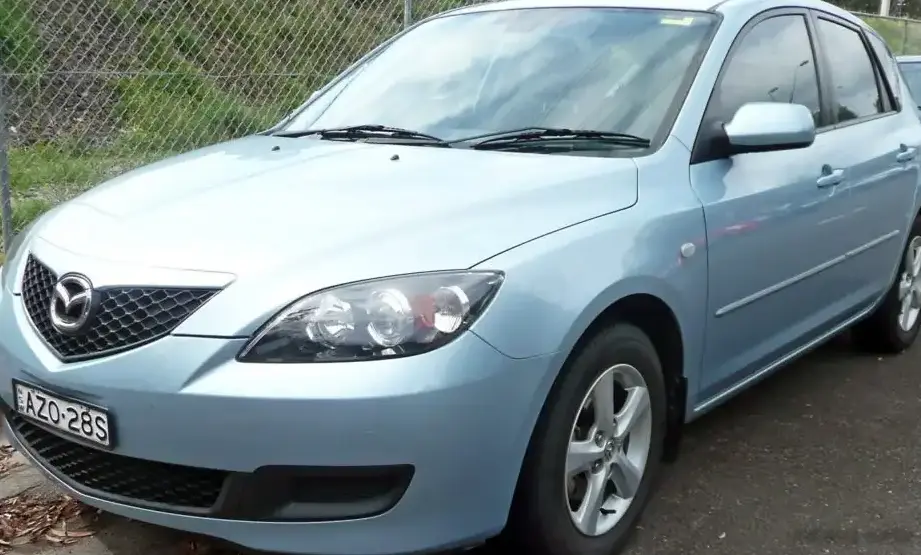
The Mazda 3 II Hatchback, specifically the 2.0 DISI (150 Hp) variant produced from 2011 to 2013, represents a significant refinement of the second-generation Mazda 3 (BL series). Introduced as part of the facelift, this model aimed to enhance both performance and fuel efficiency while maintaining the Mazda 3’s reputation for sporty handling and attractive styling. Positioned as a mid-range offering, it slotted between the more economical 1.6-liter engine options and the higher-performance 2.3-liter variants. This particular configuration was primarily sold in European and Asian markets, offering a balance of power and practicality for drivers seeking a more engaging driving experience than the base models.
Technical Specifications
| Brand | Mazda |
| Model | 3 |
| Generation | II Hatchback (BL, facelift 2011) |
| Type (Engine) | 2.0 DISI (150 Hp) |
| Start of production | 2011 |
| End of production | 2013 |
| Powertrain Architecture | Internal Combustion engine |
| Body type | Hatchback |
| Seats | 5 |
| Doors | 5 |
| Fuel consumption (urban) | 9.1 l/100 km (25.8 US mpg, 31 UK mpg, 11 km/l) |
| Fuel consumption (extra urban) | 5.3 l/100 km (44.4 US mpg, 53.3 UK mpg, 18.9 km/l) |
| Fuel consumption (combined) | 6.7 l/100 km (35.1 US mpg, 42.2 UK mpg, 14.9 km/l) |
| CO2 emissions | 157 g/km |
| Fuel Type | Petrol (Gasoline) |
| Acceleration 0 – 100 km/h | 10.4 sec |
| Acceleration 0 – 62 mph | 10.4 sec |
| Acceleration 0 – 60 mph | 9.9 sec |
| Maximum speed | 206 km/h (128 mph) |
| Emission standard | Euro 5 |
| Weight-to-power ratio | 8.5 kg/Hp, 117.2 Hp/tonne |
| Weight-to-torque ratio | 6.7 kg/Nm, 149.2 Nm/tonne |
| Power | 150 Hp @ 6200 rpm |
| Power per litre | 75 Hp/l |
| Torque | 191 Nm @ 4500 rpm (140.87 lb.-ft. @ 4500 rpm) |
| Engine layout | Front, Transverse |
| Engine Model/Code | LFZ2 |
| Engine displacement | 1999 cm3 (121.99 cu. in.) |
| Number of cylinders | 4 |
| Engine configuration | Inline |
| Cylinder Bore | 87.5 mm (3.44 in.) |
| Piston Stroke | 83.1 mm (3.27 in.) |
| Compression ratio | 11.2:1 |
| Number of valves per cylinder | 4 |
| Fuel injection system | Direct injection |
| Engine aspiration | Naturally aspirated engine |
| Valvetrain | DOHC |
| Engine oil capacity | 4.3 l (4.54 US qt | 3.78 UK qt) |
| Coolant | 7.5 l (7.93 US qt | 6.6 UK qt) |
| Kerb Weight | 1280 kg (2821.92 lbs.) |
| Max. weight | 1835 kg (4045.48 lbs.) |
| Max load | 555 kg (1223.57 lbs.) |
| Trunk (boot) space – minimum | 340 l (12.01 cu. ft.) |
| Trunk (boot) space – maximum | 1360 l (48.03 cu. ft.) |
| Fuel tank capacity | 55 l (14.53 US gal | 12.1 UK gal) |
| Permitted trailer load with brakes (12%) | 1000 kg (2204.62 lbs.) |
| Permitted trailer load without brakes | 550 kg (1212.54 lbs.) |
| Length | 4460 mm (175.59 in.) |
| Width | 1755 mm (69.09 in.) |
| Width including mirrors | 2002 mm (78.82 in.) |
| Height | 1470 mm (57.87 in.) |
| Wheelbase | 2640 mm (103.94 in.) |
| Front track | 1520 mm (59.84 in.) |
| Rear (Back) track | 1515 mm (59.65 in.) |
| Ride height (ground clearance) | 155 mm (6.1 in.) |
| Drag coefficient (Cd) | 0.29 |
| Minimum turning circle (turning diameter) | 10.4 m (34.12 ft.) |
| Drivetrain Architecture | The Internal combustion engine (ICE) drives the front wheels of the vehicle. |
| Drive wheel | Front wheel drive |
| Number of gears and type of gearbox | 6 gears, manual transmission |
| Front suspension | Independent, type McPherson with coil spring and anti-roll bar |
| Rear suspension | Independent multi-link suspension |
| Front brakes | Ventilated discs |
| Rear brakes | Disc |
| Assisting systems | ABS (Anti-lock braking system) |
| Steering type | Steering rack and pinion |
| Power steering | Electric Steering |
| Tires size | 205/50 R17 |
| Wheel rims size | 17 |
INTRODUCTION
The 2011-2013 Mazda 3 II Hatchback 2.0 DISI (150 Hp) represents a key iteration of Mazda’s popular compact car. Built on the BL platform, this facelifted model brought updated styling, improved fuel economy, and enhanced performance compared to the pre-facelift versions. The “DISI” designation stands for Direct Injection Spark Ignition, highlighting the engine’s advanced fuel delivery system. This variant was designed to appeal to buyers who desired a sporty and efficient hatchback with a more refined driving experience. It served as a crucial model in Mazda’s lineup, competing with rivals like the Volkswagen Golf, Ford Focus, and Honda Civic.
Powertrain & Engine Architecture
At the heart of the 2.0 DISI variant lies the LFZ2 engine, a 1999cc inline-four cylinder powerplant. This engine utilizes direct fuel injection, a technology that allows for more precise fuel delivery, resulting in improved combustion efficiency and increased power output. The engine also features a double overhead camshaft (DOHC) valvetrain with four valves per cylinder, optimizing airflow for enhanced performance. The compression ratio of 11.2:1 further contributes to the engine’s efficiency. The 6-speed manual transmission was standard, providing drivers with precise control over gear selection. This transmission was chosen for its ability to maximize the engine’s power band and provide a more engaging driving experience. The engine’s design prioritized a balance between power and fuel economy, making it suitable for both city driving and longer highway journeys.
Driving Characteristics
The 2.0 DISI 150 Hp variant of the Mazda 3 offered a noticeably more spirited driving experience compared to the lower-powered engine options. While not as overtly sporty as the 2.3-liter models, the 150 hp engine provided ample power for everyday driving and confident overtaking maneuvers. The 6-speed manual transmission allowed drivers to keep the engine in its optimal power band, resulting in responsive acceleration. The gear ratios were well-matched to the engine’s characteristics, providing a good balance between acceleration and fuel efficiency. The Mazda 3’s renowned handling characteristics were also present in this variant, thanks to its well-tuned suspension and precise steering. The car felt agile and composed in corners, making it enjoyable to drive on winding roads. Compared to the automatic transmission options, the manual version offered a more direct connection to the engine and a more engaging driving experience.
Equipment & Trim Levels
The 2.0 DISI variant typically came equipped with a respectable level of standard features. These included air conditioning, power windows and mirrors, a CD/MP3 stereo system, and alloy wheels. Higher trim levels offered additional features such as a sunroof, leather upholstery, automatic climate control, and a more advanced audio system. Safety features such as ABS, airbags, and stability control were standard across the range. Interior upholstery was typically cloth, with optional leather upgrades available. The dashboard layout was functional and well-designed, with easy-to-read gauges and intuitive controls. Optional extras included navigation systems, parking sensors, and upgraded sound systems.
Chassis & Braking
The Mazda 3 II Hatchback utilized an independent suspension system on both the front and rear axles. The front suspension employed a McPherson strut design with coil springs and an anti-roll bar, while the rear suspension featured a multi-link setup. This suspension configuration provided a good balance between ride comfort and handling precision. The braking system consisted of ventilated discs on the front wheels and solid discs on the rear wheels. ABS (Anti-lock Braking System) was standard, enhancing braking performance and stability in emergency situations. The chassis was designed to be lightweight and rigid, contributing to the car’s agile handling characteristics.
Market Reception & Comparison
The 2.0 DISI variant of the Mazda 3 was generally well-received by automotive critics. It was praised for its sporty handling, refined engine, and attractive styling. Reviewers noted that the direct injection system contributed to improved fuel economy and increased power output. Compared to the 1.6-liter models, the 2.0 DISI offered a significant performance upgrade, while remaining relatively fuel-efficient. Compared to the 2.3-liter variants, it provided a more balanced combination of performance and economy. Some critics noted that the interior could be a bit noisy at higher speeds, but overall, the Mazda 3 II Hatchback 2.0 DISI was considered a strong contender in the compact hatchback segment.
Legacy
The Mazda 3 II Hatchback 2.0 DISI (150 Hp) has proven to be a reliable and durable vehicle. The LFZ2 engine is known for its longevity, provided it is properly maintained. Common maintenance items include regular oil changes, timing belt replacements, and spark plug replacements. In the used car market, this variant remains a popular choice for buyers seeking a sporty and efficient hatchback. Its combination of performance, practicality, and reliability has ensured its continued appeal. While newer models have since been introduced, the 2011-2013 Mazda 3 II Hatchback 2.0 DISI remains a well-regarded and capable vehicle.