
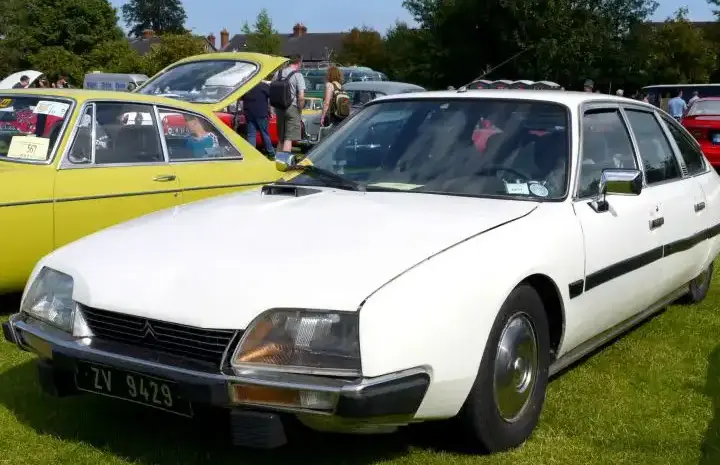
Technical Specifications
| Brand | Citroën |
| Model | CX |
| Generation | CX I |
| Type (Engine) | 2200 D (66 Hp) |
| Start of production | 1975 |
| End of production | 1978 |
| Powertrain Architecture | Internal Combustion engine |
| Body type | Hatchback |
| Seats | 5 |
| Doors | 5 |
| Fuel Type | Diesel |
| Acceleration 0 – 100 km/h | 20.1 sec |
| Acceleration 0 – 62 mph | 20.1 sec |
| Acceleration 0 – 60 mph | 19.1 sec |
| Maximum speed | 146 km/h (90.72 mph) |
| Weight-to-power ratio | 20.3 kg/Hp, 49.3 Hp/tonne |
| Weight-to-torque ratio | 10.6 kg/Nm, 94 Nm/tonne |
| Power | 66 Hp @ 4500 rpm |
| Power per litre | 30.3 Hp/l |
| Torque | 126 Nm @ 2750 rpm (92.93 lb.-ft. @ 2750 rpm) |
| Engine layout | Front, Transverse |
| Engine Model/Code | M22.621 |
| Engine displacement | 2175 cm3 (132.73 cu. in.) |
| Number of cylinders | 4 |
| Engine configuration | Inline |
| Cylinder Bore | 90 mm (3.54 in.) |
| Piston Stroke | 85.5 mm (3.37 in.) |
| Compression ratio | 22.25:1 |
| Number of valves per cylinder | 2 |
| Fuel injection system | Precombustion chamber injection |
| Engine aspiration | Naturally aspirated |
| Engine oil capacity | 4.7 l (4.97 US qt | 4.14 UK qt) |
| Kerb Weight | 1340 kg (2954.19 lbs) |
| Max. weight | 1825 kg (4023.44 lbs) |
| Max load | 485 kg (1069.24 lbs) |
| Trunk (boot) space – minimum | 325 l (11.48 cu. ft.) |
| Fuel tank capacity | 68 l (17.96 US gal | 14.96 UK gal) |
| Length | 4659 mm (183.43 in.) |
| Width | 1734 mm (68.27 in.) |
| Height | 1360 mm (53.54 in.) |
| Wheelbase | 2845 mm (112.01 in.) |
| Front track | 1474 mm (58.03 in.) |
| Rear (Back) track | 1360 mm (53.54 in.) |
| Front overhang | 1050 mm (41.34 in.) |
| Rear overhang | 764 mm (30.08 in.) |
| Ride height (ground clearance) | 155 mm (6.1 in.) |
| Drag coefficient (Cd) | 0.37 |
| Minimum turning circle | 11.80 m (38.71 ft.) |
| Drivetrain Architecture | The Internal combustion engine (ICE) drives the front wheels of the vehicle. |
| Drive wheel | Front wheel drive |
| Number of gears and type of gearbox | 4 gears, manual transmission |
| Front brakes | Ventilated discs |
| Rear brakes | Disc |
| Steering type | Steering rack and pinion |
The Citroën CX I 2200 D, manufactured from 1975 to 1978, was the initial diesel offering in the CX range, a vehicle designed to replace the long-running and beloved DS. The CX, internally designated as the GSA/GSA Break, represented a significant departure in styling and technology from its predecessor. While the DS was known for its hydropneumatic suspension and unique design, the CX aimed for a more modern, aerodynamic aesthetic. The 2200 D, utilizing the M22.621 engine, was positioned as the entry point into the CX lineup, offering a more affordable and fuel-efficient alternative to the gasoline-powered models. It was a key component in Citroën’s strategy to broaden the CX’s appeal to a wider customer base.
Powertrain & Engine Architecture
The heart of the CX 2200 D is the M22.621, a 2.2-liter inline-four diesel engine. This engine employed precombustion chamber injection, a system common in European diesel engines of the era. This system utilizes a small precombustion chamber connected to the main cylinder, where fuel is injected and ignited by the compression heat, then transferred to the main chamber for complete combustion. The engine produced 66 horsepower at 4500 rpm and 126 Nm (92.93 lb.-ft.) of torque at 2750 rpm. The engine’s relatively low compression ratio of 22.25:1 was typical for diesel engines of the time, balancing efficiency and durability. The engine was transversely mounted, contributing to the CX’s compact engine bay and improved packaging. The 2200 D was exclusively offered with a four-speed manual transmission, designed to efficiently deliver the engine’s torque to the front wheels.
Driving Characteristics
The CX 2200 D’s driving experience was defined by its emphasis on comfort and refinement, rather than outright performance. With only 66 horsepower, acceleration was leisurely, taking over 20 seconds to reach 62 mph. However, the engine’s torque characteristics provided adequate pulling power for everyday driving, especially at lower speeds. The four-speed manual transmission, while not particularly sporty, was well-matched to the engine’s powerband. The CX’s signature hydropneumatic suspension, even in its base form, provided an exceptionally smooth and comfortable ride, absorbing bumps and imperfections in the road with ease. Compared to the more powerful gasoline versions of the CX, the 2200 D offered a more relaxed and economical driving experience, prioritizing fuel efficiency and ride quality over spirited acceleration.
Equipment & Trim Levels
The CX 2200 D, as the entry-level model, featured a relatively basic level of equipment. Standard features included cloth upholstery, a simple dashboard layout, and basic instrumentation. Power steering was often included, a necessity given the car’s size and weight. Optional extras included upgraded upholstery, a sunroof, and more advanced audio systems. The interior design, while functional, lacked the luxurious appointments found in the higher-spec CX models. The focus was on providing a comfortable and practical cabin, rather than a lavish one. The exterior trim was also relatively understated, with minimal chrome accents and standard steel wheels with hubcaps.
Chassis & Braking
The CX I utilized a robust chassis designed to accommodate the hydropneumatic suspension system. The front suspension featured independent double wishbones, while the rear suspension employed a trailing arm design. The 2200 D was equipped with ventilated disc brakes at the front and disc brakes at the rear, providing adequate stopping power for its weight and performance. The steering system was a rack and pinion setup, offering precise and responsive steering feel. The car’s relatively long wheelbase (2845 mm / 112.01 in.) contributed to its stability and ride comfort. Stabilizer bars were fitted to both the front and rear axles to reduce body roll during cornering.
Market Reception & Comparison
The CX 2200 D was generally well-received by critics as a practical and economical option within the CX range. While its performance was not a standout feature, its fuel efficiency and comfortable ride were highly praised. Compared to the gasoline-powered CX models, the 2200 D offered a significantly lower purchase price and better fuel economy, making it an attractive option for budget-conscious buyers. However, some critics noted the engine’s lack of refinement and its relatively slow acceleration. Compared to other diesel-powered cars of the era, the CX 2200 D offered a unique combination of comfort, handling, and advanced technology, setting it apart from its competitors.
Legacy
The Citroën CX 2200 D, while not the most powerful or glamorous version of the CX, played an important role in establishing the model as a technologically advanced and comfortable family car. The M22.621 diesel engine proved to be relatively durable and reliable, and many examples are still on the road today. In the used car market, the CX 2200 D is often considered a good value, offering a unique driving experience and a distinctive design at an affordable price. Its hydropneumatic suspension, while requiring occasional maintenance, continues to provide a level of ride comfort that is rarely matched by modern cars. The CX 2200 D remains a testament to Citroën’s innovative engineering and its commitment to providing a comfortable and refined driving experience.
