
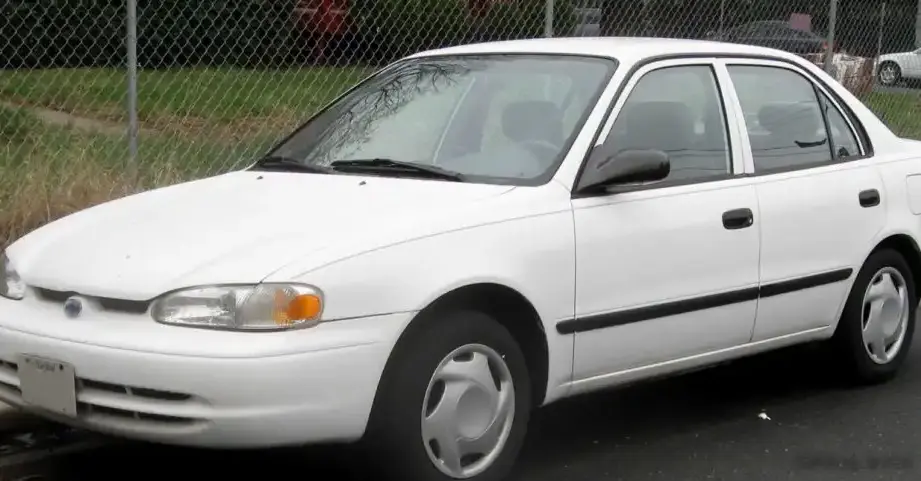
The Chevrolet Prizm 1.8 i 16V, produced between 1998 and 2001, represented a significant offering in the compact sedan segment for the American market. Essentially a rebadged Toyota Corolla, the Prizm was Chevrolet’s attempt to provide a reliable and affordable vehicle, leveraging Toyota’s manufacturing expertise. This particular 1.8-liter, 16-valve variant with 126 horsepower occupied a middle ground in the Prizm lineup, offering a balance between performance and fuel economy. It was positioned as a step up from the base model, appealing to buyers seeking a bit more power without the higher cost of potential future, limited-production trims.
Technical Specifications
| Brand | Chevrolet |
| Model | Prizm |
| Generation | Prizm |
| Type (Engine) | 1.8 i 16V (126 Hp) |
| Start of production | 1998 |
| End of production | 2001 |
| Powertrain Architecture | Internal Combustion engine |
| Body type | Sedan |
| Seats | 5 |
| Doors | 4 |
| Fuel consumption (urban) | 7.4 l/100 km (31.8 US mpg) |
| Fuel consumption (extra urban) | 5.7 l/100 km (41.3 US mpg) |
| Fuel consumption (combined) | 6.5 l/100 km (36.2 US mpg) |
| Fuel Type | Petrol (Gasoline) |
| Maximum speed | 190 km/h (118.06 mph) |
| Weight-to-power ratio | 8.7 kg/Hp |
| Weight-to-torque ratio | 6.4 kg/Nm |
| Power | 126 Hp @ 5800 rpm |
| Power per litre | 70.2 Hp/l |
| Torque | 170 Nm @ 4000 rpm (125.39 lb.-ft. @ 4000 rpm) |
| Engine layout | Front, Transverse |
| Engine Model/Code | LV6 |
| Engine displacement | 1794 cm3 (109.48 cu. in.) |
| Number of cylinders | 4 |
| Engine configuration | Inline |
| Cylinder Bore | 79 mm (3.11 in.) |
| Piston Stroke | 91.5 mm (3.6 in.) |
| Compression ratio | 10.1:1 |
| Number of valves per cylinder | 4 |
| Fuel injection system | Multi-port manifold injection |
| Engine aspiration | Naturally aspirated engine |
| Valvetrain | DOHC |
| Engine oil capacity | 3.7 l (3.91 US qt | 3.26 UK qt) |
| Coolant capacity | 6.2 l (6.55 US qt | 5.46 UK qt) |
| Kerb Weight | 1090 kg (2403.04 lbs.) |
| Trunk (boot) space (minimum) | 340 l (12.01 cu. ft.) |
| Fuel tank capacity | 50 l (13.21 US gal | 11 UK gal) |
| Length | 4430 mm (174.41 in.) |
| Width | 1695 mm (66.73 in.) |
| Height | 1365 mm (53.74 in.) |
| Wheelbase | 2465 mm (97.05 in.) |
| Front track | 1460 mm (57.48 in.) |
| Rear track | 1450 mm (57.09 in.) |
| Drivetrain Architecture | Front wheel drive |
| Number of gears and type of gearbox | 5 gears, manual transmission |
| Front suspension | Spring Strut |
| Rear suspension | Coil spring |
| Front brakes | Ventilated discs |
| Rear brakes | Drum |
| Assisting systems | ABS (Anti-lock braking system) |
| Steering type | Steering rack and pinion |
| Power steering | Hydraulic Steering |
| Tires size | 175/65 R14 |
Powertrain & Engine Architecture
The heart of the Prizm 1.8 i 16V was the LV6 engine, a 1.8-liter inline-four cylinder powerplant. This engine was sourced directly from Toyota and was a derivative of their well-regarded 7A-FE series. It featured a double overhead camshaft (DOHC) valvetrain operating 16 valves (four per cylinder), contributing to its relatively high output for its displacement. Fuel delivery was handled by a multi-port fuel injection system, optimizing combustion efficiency. The engine’s 10.1:1 compression ratio was a standard figure for the time, balancing performance and fuel economy. The five-speed manual transmission was the standard offering, providing drivers with direct control over the engine’s power. The transmission was known for its smooth shifting and durability, typical of Toyota-engineered components.
Driving Characteristics
The 1.8-liter engine in the Prizm provided adequate, though not exhilarating, performance. With 126 horsepower, acceleration was respectable for daily driving, but it wasn’t designed for sporty driving. The five-speed manual transmission allowed drivers to keep the engine in its optimal power band, making overtaking maneuvers manageable. Compared to the base engine Prizm, the 1.8L offered a noticeable improvement in responsiveness. However, it didn’t possess the punch of larger engines found in competing models. The gear ratios were tuned for fuel efficiency, meaning the engine could feel slightly strained at highway speeds when needing to accelerate quickly. The front-wheel-drive configuration provided predictable handling, but lacked the dynamic capabilities of rear-wheel-drive alternatives.
Equipment & Trim Levels
The Prizm 1.8 i 16V typically came standard with features considered essential for the time, including air conditioning, power steering, and an AM/FM radio. Interior upholstery was typically cloth, with a relatively simple and functional dashboard layout. Optional extras included a CD player, upgraded sound system, and power windows and locks. The trim level was generally considered a step above the base model, offering a slightly more refined interior and a few additional convenience features. It wasn’t a luxury trim, but it provided a comfortable and practical driving experience.
Chassis & Braking
The Prizm utilized a conventional front-wheel-drive chassis with a MacPherson strut front suspension and a coil spring rear suspension. This setup provided a comfortable ride, absorbing bumps and irregularities in the road surface effectively. The front brakes were ventilated discs, offering good stopping power, while the rear brakes were drums, a cost-saving measure common in this class of vehicle. Anti-lock braking system (ABS) was standard, enhancing safety by preventing wheel lockup during hard braking. The steering was rack and pinion, providing precise and responsive handling. Stabilizer bars were included to reduce body roll during cornering.
Market Reception & Comparison
The Chevrolet Prizm 1.8 i 16V was generally well-received by critics as a reliable and affordable compact sedan. Its fuel economy was a strong point, consistently achieving around 36 mpg in combined driving. However, its performance was often criticized as being somewhat lackluster compared to some of its competitors. Compared to the base engine Prizm, the 1.8L offered a significant improvement in driving experience. Reliability was a key selling point, benefiting from Toyota’s reputation for building durable vehicles. Maintenance costs were relatively low, thanks to the engine’s simple design and readily available parts.
Legacy
The Chevrolet Prizm, and specifically the 1.8 i 16V variant, has developed a reputation as a dependable and long-lasting vehicle. Many examples are still on the road today, a testament to their inherent reliability. In the used car market, these Prizms are often sought after by buyers looking for an affordable and practical transportation option. The LV6 engine is known for its durability, and with proper maintenance, can easily exceed 200,000 miles. While not a particularly exciting vehicle, the Prizm 1.8 i 16V served its purpose well, providing a reliable and economical mode of transportation for a generation of drivers.
