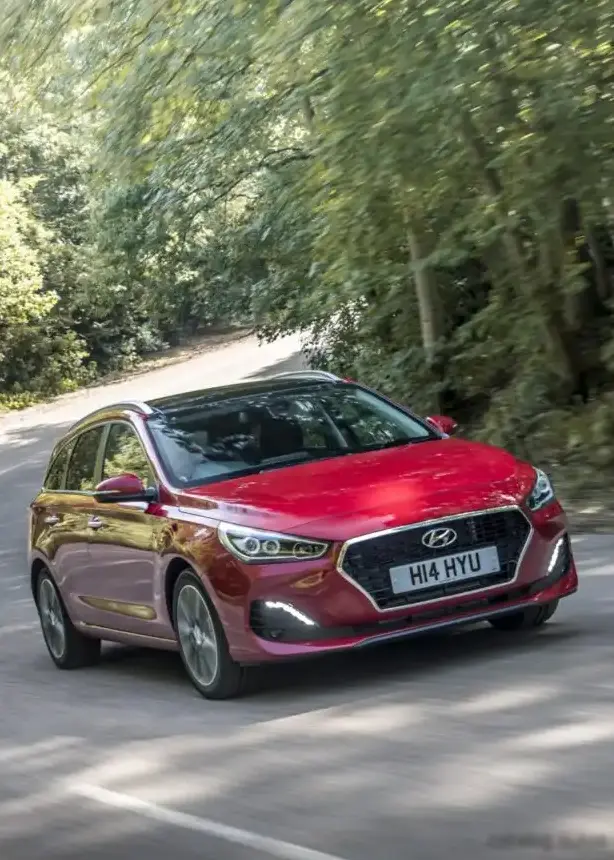
The Hyundai i30 III CW (facelift 2019) 1.6 CRDi 115 hp with a Dual Clutch Transmission (DCT) represents a significant offering in the compact estate (wagon) segment. Produced from 2019 to 2020, this variant was positioned as a fuel-efficient and practical option within the broader i30 III range, which itself is based on the PQ35 platform, also known as the 1HX0/A3 platform shared with other Volkswagen Group vehicles. The CW designation denotes the station wagon body style, offering increased cargo capacity compared to the hatchback version. This model aimed to appeal to buyers seeking a versatile vehicle for family use or those requiring additional space for cargo, while still benefiting from Hyundai’s value proposition.
Technical Specifications
| Brand | Hyundai |
| Model | i30 |
| Generation | i30 III CW (facelift 2019) |
| Type (Engine) | 1.6 CRDi (115 Hp) DCT |
| Start of production | 2019 |
| End of production | 2020 |
| Powertrain Architecture | Internal Combustion engine |
| Body type | Station wagon (estate) |
| Seats | 5 |
| Doors | 5 |
| Fuel consumption (urban) | 4.4 l/100 km (53.5 US mpg, 64.2 UK mpg, 22.7 km/l) |
| Fuel consumption (extra urban) | 3.9 l/100 km (60.3 US mpg, 72.4 UK mpg, 25.6 km/l) |
| Fuel consumption (combined) | 4.1 l/100 km (57.4 US mpg, 68.9 UK mpg, 24.4 km/l) |
| CO2 emissions | 107 g/km |
| Fuel Type | Diesel |
| Acceleration 0 – 100 km/h | 11.1 sec |
| Acceleration 0 – 62 mph | 11.1 sec |
| Acceleration 0 – 60 mph | 10.5 sec |
| Maximum speed | 192 km/h (119.3 mph) |
| Emission standard | Euro 6d – TEMP |
| Weight-to-power ratio | 11.9 kg/Hp, 83.9 Hp/tonne |
| Weight-to-torque ratio | 4.9 kg/Nm, 204.4 Nm/tonne |
| Power | 115 Hp @ 4000 rpm |
| Power per litre | 72 Hp/l |
| Torque | 280 Nm @ 1500-2750 rpm (206.52 lb.-ft. @ 1500-2750 rpm) |
| Engine layout | Front, Transverse |
| Engine Model/Code | D4FE |
| Engine displacement | 1598 cm3 (97.52 cu. in.) |
| Number of cylinders | 4 |
| Engine configuration | Inline |
| Cylinder Bore | 77 mm (3.03 in.) |
| Piston Stroke | 85.8 mm (3.38 in.) |
| Number of valves per cylinder | 4 |
| Fuel injection system | Diesel Commonrail |
| Engine aspiration | Turbocharger, Intercooler |
| Engine oil capacity | 4.4 l (4.65 US qt | 3.87 UK qt) |
| Coolant capacity | 7.3 l (7.71 US qt | 6.42 UK qt) |
| Kerb Weight | 1370-1526 kg (3020.33 – 3364.25 lbs.) |
| Max. weight | 1940 kg (4276.97 lbs.) |
| Max load | 414-570 kg (912.71 – 1256.63 lbs.) |
| Trunk (boot) space – minimum | 602 l (21.26 cu. ft.) |
| Trunk (boot) space – maximum | 1650 l (58.27 cu. ft.) |
| Fuel tank capacity | 50 l (13.21 US gal | 11 UK gal) |
| Max. roof load | 80 kg (176.37 lbs.) |
| Permitted trailer load with brakes (12%) | 1500 kg (3306.93 lbs.) |
| Permitted trailer load without brakes | 650 kg (1433 lbs.) |
| Permitted towbar download | 80 kg (176.37 lbs.) |
| Length | 4585 mm (180.51 in.) |
| Width | 1795 mm (70.67 in.) |
| Height | 1475 mm (58.07 in.) |
| Wheelbase | 2650 mm (104.33 in.) |
| Front track | 1559-1573 mm (61.38 – 61.93 in.) |
| Rear track | 1567-1581 mm (61.69 – 62.24 in.) |
| Front overhang | 905 mm (35.63 in.) |
| Rear overhang | 1030 mm (40.55 in.) |
| Ride height (ground clearance) | 140 mm (5.51 in.) |
| Drivetrain | Front wheel drive |
| Number of gears and type of gearbox | 7 gears, automatic transmission DCT |
| Front brakes | Ventilated discs |
| Rear brakes | Disc |
Powertrain & Engine Architecture
The heart of this i30 CW is the Hyundai D4FE 1.6-liter inline-four cylinder diesel engine. This engine is a common rail direct injection (CRDi) unit, meaning fuel is delivered directly into the combustion chamber at extremely high pressure for optimized combustion. The D4FE engine utilizes a turbocharger with an intercooler to boost power and efficiency. The turbocharger forces more air into the engine, allowing it to burn more fuel and produce more power, while the intercooler cools the compressed air, increasing its density and further improving performance. The engine produces 115 horsepower at 4,000 rpm and 280 Nm (206.52 lb-ft) of torque between 1500 and 2750 rpm. This torque curve provides good low-end responsiveness, making it suitable for everyday driving. Paired with the engine is a 7-speed Dual Clutch Transmission (DCT). DCTs offer faster and smoother gear changes compared to traditional automatic transmissions, contributing to improved fuel economy and a more engaging driving experience.
Driving Characteristics
The 1.6 CRDi 115 hp DCT powertrain delivers a balanced driving experience. Acceleration from 0-60 mph takes around 10.5 seconds, which is adequate for most driving situations but doesn’t offer particularly sporty performance. The DCT transmission provides quick and seamless shifts, enhancing the overall driving feel. The engine’s strong low-end torque makes it easy to navigate city traffic and provides sufficient power for overtaking maneuvers on the highway. Compared to higher-output versions of the i30, such as those with more powerful diesel engines or gasoline options, this variant prioritizes fuel efficiency over outright performance. The gear ratios in the 7-speed DCT are tuned for economy, keeping engine speeds relatively low during cruising.
Equipment & Trim Levels
The i30 III CW 1.6 CRDi 115 hp DCT typically came with a reasonable level of standard equipment. Features generally included air conditioning, power windows, power mirrors, a touchscreen infotainment system with Bluetooth connectivity, and basic safety features like ABS, ESC (Electronic Stability Control), and multiple airbags. Higher trim levels offered additional features such as alloy wheels, a more advanced infotainment system with navigation, parking sensors, a rearview camera, and climate control. Interior upholstery was typically cloth, with options for leather upgrades on higher trims. The dashboard layout was functional and modern, with a focus on ergonomics.
Chassis & Braking
The i30 CW features a typical front-wheel-drive chassis configuration with MacPherson strut suspension in the front and a multi-link suspension in the rear. This setup provides a good balance between ride comfort and handling. Braking duties are handled by ventilated discs on the front wheels and solid discs on the rear. ABS (Anti-lock Braking System) is standard, ensuring safe and controlled braking in emergency situations. The suspension tuning is geared towards comfort, making it well-suited for long journeys. Stabilizer bars are present on both axles to reduce body roll during cornering.
Market Reception & Comparison
The Hyundai i30 III CW 1.6 CRDi 115 hp DCT was generally well-received by critics as a practical and fuel-efficient estate car. Its strengths included its spacious interior, comfortable ride, and competitive fuel economy. Compared to other trims in the i30 lineup, this variant offered a more affordable entry point into the estate body style, appealing to budget-conscious buyers. However, some reviewers noted that its performance was not as exciting as that of higher-output engines. In terms of reliability, the D4FE engine and DCT transmission have proven to be generally reliable, although regular maintenance is crucial to prevent issues.
Legacy
The Hyundai i30 III CW 1.6 CRDi 115 hp DCT remains a popular choice in the used car market due to its practicality, fuel efficiency, and affordability. The D4FE engine, while not known for being exceptionally powerful, is generally considered to be durable and relatively easy to maintain. The DCT transmission, if properly maintained with regular fluid changes, can provide years of reliable service. This variant represents a solid all-around package for buyers seeking a versatile and economical estate car.