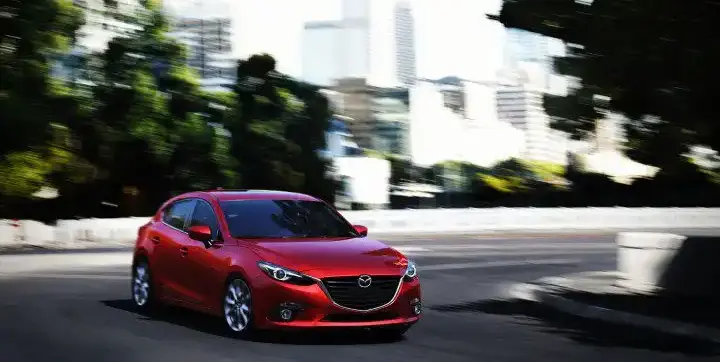
The Mazda 3 III Hatchback (BM) 2.0 SkyActiv-G, producing 120 horsepower, was a key variant in Mazda’s third-generation Mazda 3 lineup, produced from 2013 to 2016. This model represented a significant step forward for Mazda, embodying the company’s “KODO – Soul of Motion” design philosophy and incorporating the innovative SkyActiv technology suite. Positioned as a mid-range offering, it bridged the gap between the more economical 1.5-liter engine and the performance-oriented 2.5-liter variants. The BM generation Mazda 3 was primarily aimed at the European and Asian markets, offering a compelling blend of style, efficiency, and driving dynamics in the compact hatchback segment.
Technical Specifications
| Brand | Mazda |
| Model | 3 |
| Generation | 3 III Hatchback (BM) |
| Type (Engine) | 2.0 SkyActiv-G (120 Hp) |
| Start of production | 2013 |
| End of production | 2016 |
| Powertrain Architecture | Internal Combustion engine |
| Body type | Hatchback |
| Seats | 5 |
| Doors | 5 |
| Fuel consumption (urban) | 6.5 l/100 km (36.2 US mpg, 43.5 UK mpg, 15.4 km/l) |
| Fuel consumption (extra urban) | 4.3 l/100 km (54.7 US mpg, 65.7 UK mpg, 23.3 km/l) |
| Fuel consumption (combined) | 5.1 l/100 km (46.1 US mpg, 55.4 UK mpg, 19.6 km/l) |
| CO2 emissions | 119 g/km |
| Fuel Type | Petrol (Gasoline) |
| Acceleration 0 – 100 km/h | 8.9 sec |
| Acceleration 0 – 62 mph | 8.9 sec |
| Acceleration 0 – 60 mph | 8.5 sec |
| Maximum speed | 195 km/h (121.17 mph) |
| Emission standard | Euro 5 |
| Weight-to-power ratio | 10 kg/Hp, 99.6 Hp/tonne |
| Weight-to-torque ratio | 5.7 kg/Nm, 174.3 Nm/tonne |
| Power | 120 Hp @ 6000 rpm |
| Power per litre | 60.1 Hp/l |
| Torque | 210 Nm @ 4000 rpm (154.89 lb.-ft. @ 4000 rpm) |
| Engine layout | Front, Transverse |
| Engine displacement | 1998 cm3 (121.93 cu. in.) |
| Number of cylinders | 4 |
| Engine configuration | Inline |
| Cylinder Bore | 83.5 mm (3.29 in.) |
| Piston Stroke | 91.2 mm (3.59 in.) |
| Compression ratio | 14:1 |
| Number of valves per cylinder | 4 |
| Fuel injection system | Direct injection |
| Engine aspiration | Naturally aspirated engine |
| Valvetrain | DOHC |
| Engine oil capacity | 4.2 l (4.44 US qt | 3.7 UK qt) |
| Coolant | 6.5 l (6.87 US qt | 5.72 UK qt) |
| Kerb Weight | 1205 kg (2656.57 lbs.) |
| Max. weight | 1815 kg (4001.39 lbs.) |
| Max load | 610 kg (1344.82 lbs.) |
| Trunk (boot) space – minimum | 364 l (12.85 cu. ft.) |
| Trunk (boot) space – maximum | 1263 l (44.6 cu. ft.) |
| Fuel tank capacity | 51 l (13.47 US gal | 11.22 UK gal) |
| Permitted trailer load with brakes (12%) | 1600 kg (3527.4 lbs.) |
| Permitted trailer load without brakes | 600 kg (1322.77 lbs.) |
| Length | 4460 mm (175.59 in.) |
| Width | 1795 mm (70.67 in.) |
| Width including mirrors | 2053 mm (80.83 in.) |
| Height | 1450 mm (57.09 in.) |
| Wheelbase | 2700 mm (106.3 in.) |
| Front track | 1555 mm (61.22 in.) |
| Rear (Back) track | 1560 mm (61.42 in.) |
| Ride height (ground clearance) | 155 mm (6.1 in.) |
| Drag coefficient (Cd) | 0.28 |
| Minimum turning circle (turning diameter) | 10.6 m (34.78 ft.) |
| Drivetrain Architecture | The Internal combustion engine (ICE) drives the front wheels of the vehicle. |
| Drive wheel | Front wheel drive |
| Number of gears and type of gearbox | 6 gears, manual transmission |
| Front brakes | Ventilated discs |
| Rear brakes | Disc |
| Assisting systems | ABS (Anti-lock braking system) |
| Steering type | Steering rack and pinion |
| Power steering | Electric Steering |
| Tires size | 205/60 R16 |
| Wheel rims size | 16 |
Powertrain & Engine Architecture
At the heart of the Mazda 3 2.0 SkyActiv-G was the PE-VPH engine, a 1998cc inline-four cylinder gasoline engine. This engine was a cornerstone of Mazda’s SkyActiv technology, designed to maximize efficiency without sacrificing driving pleasure. Key features included a high compression ratio of 14:1 – unusually high for a gasoline engine at the time – achieved through precise fuel injection and combustion control. The engine utilized direct injection, optimizing fuel delivery and promoting cleaner combustion. The valvetrain employed a Dual Overhead Camshaft (DOHC) configuration with four valves per cylinder, enhancing volumetric efficiency. The engine’s block was constructed from aluminum to reduce weight. This particular variant was typically paired with a six-speed manual transmission, although a six-speed automatic transmission was also available. The automatic transmission was designed for smooth shifts and optimized gear ratios to balance performance and fuel economy.
Driving Characteristics
The 120 hp 2.0-liter SkyActiv-G engine, when coupled with the six-speed manual transmission, provided a reasonably engaging driving experience. Acceleration from 0-60 mph took around 8.5 seconds, and top speed was approximately 121 mph. While not a performance powerhouse, the engine delivered a linear powerband and respectable torque of 210 Nm (154.89 lb-ft). The automatic transmission, while offering convenience, did slightly diminish acceleration times and responsiveness compared to the manual. The SkyActiv chassis, known for its rigidity and well-tuned suspension, contributed to precise handling and a comfortable ride. The steering was responsive and provided good feedback, making the Mazda 3 enjoyable to drive on both city streets and winding roads.
Equipment & Trim Levels
The 2.0 SkyActiv-G variant of the Mazda 3 typically came equipped with a solid set of standard features. These included air conditioning, power windows and locks, a basic audio system with USB connectivity, and alloy wheels. Higher trim levels, such as the ‘Sport’ or ‘Touring’ models, added features like automatic climate control, a more advanced infotainment system with a larger touchscreen display, rear parking sensors, and cruise control. Interior upholstery was typically cloth, with options for leather seats on higher trims. Safety features included ABS, electronic stability control, and multiple airbags.
Chassis & Braking
The Mazda 3 BM utilized a MacPherson strut front suspension and a multi-link rear suspension, providing a good balance of ride comfort and handling precision. The chassis was designed to be lightweight yet rigid, contributing to the car’s agility. Braking duties were handled by ventilated discs at the front and solid discs at the rear. ABS (Anti-lock Braking System) was standard, enhancing braking performance and safety. The electric power steering system provided a responsive and precise steering feel.
Market Reception & Comparison
The Mazda 3 2.0 SkyActiv-G was generally well-received by automotive critics. It was praised for its stylish design, engaging driving dynamics, and fuel efficiency. Compared to its siblings, the 1.5-liter engine offered better fuel economy but lacked the 2.0-liter’s power, while the 2.5-liter engine provided more performance but at the cost of increased fuel consumption. The 1.8L automatic was often seen as a good all-rounder, offering a balance of practicality and driving enjoyment. Fuel economy figures of around 46.1 US mpg combined were competitive for its class. Reliability was generally good, with the SkyActiv engine proving to be durable and long-lasting.
Legacy
The Mazda 3 BM 2.0 SkyActiv-G has proven to be a reliable and well-regarded vehicle in the used car market. The SkyActiv engine has a reputation for longevity, and maintenance costs are generally reasonable. The car’s stylish design and engaging driving dynamics continue to appeal to buyers looking for a compact hatchback that offers more than just basic transportation. While not the fastest or most luxurious option in its class, the Mazda 3 2.0 SkyActiv-G remains a compelling choice for those seeking a well-rounded and enjoyable driving experience.