
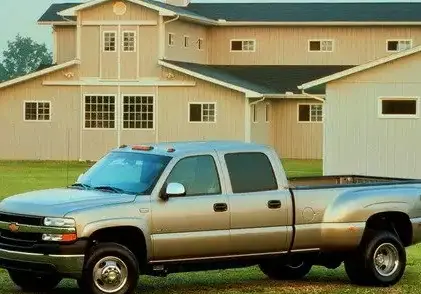
The Chevrolet Silverado 1500 Crew Cab, specifically the variant equipped with the 4.3-liter V6 engine producing 200 horsepower and a four-wheel-drive system, was a mainstay of Chevrolet’s full-size pickup truck lineup from 1998 through 2002. This generation, known internally as the Silverado 1500 I Crew Cab, represented a significant step forward in interior space and comfort for a full-size truck, offering a true four-door configuration that appealed to families and those needing passenger capacity alongside utility. Positioned as a mid-range offering, it provided a balance between affordability and capability, slotting below the more powerful V8 options and above the base four-cylinder models.
Technical Specifications
| Brand | Chevrolet |
| Model | Silverado 1500 |
| Generation | Silverado 1500 I Crew Cab |
| Type (Engine) | 4.3 (200 Hp) 4WD |
| Start of production | 1998 |
| End of production | 2002 |
| Powertrain Architecture | Internal Combustion engine |
| Body type | Pick-up |
| Seats | 4 |
| Doors | 5 |
| Fuel consumption (urban) | 15.7 l/100 km (15 US mpg, 18 UK mpg) |
| Fuel consumption (extra urban) | 11.7 l/100 km (20.1 US mpg, 24.1 UK mpg) |
| Fuel Type | Petrol (Gasoline) |
| Power | 200 Hp @ 4600 rpm |
| Power per litre | 46.6 Hp/l |
| Torque | 352 Nm @ 2800 rpm (259.62 lb.-ft. @ 2800 rpm) |
| Engine layout | Front, Longitudinal |
| Engine displacement | 4293 cm3 (261.97 cu. in.) |
| Number of cylinders | 6 |
| Engine configuration | V-engine |
| Cylinder Bore | 101.6 mm (4 in.) |
| Piston Stroke | 88.4 mm (3.48 in.) |
| Compression ratio | 9.1:1 |
| Number of valves per cylinder | 2 |
| Fuel injection system | Multi-port manifold injection |
| Engine aspiration | Naturally aspirated engine |
| Engine oil capacity | 4.3 l (4.54 US qt | 3.78 UK qt) |
| Coolant | 12.2 l (12.89 US qt | 10.73 UK qt) |
| Length | 6025 mm (237.2 in.) |
| Width | 1994 mm (78.5 in.) |
| Height | 1963 mm (77.28 in.) |
| Wheelbase | 3885 mm (152.95 in.) |
| Front track | 1899 mm (74.76 in.) |
| Rear track | 1676 mm (65.98 in.) |
| Drive wheel | All wheel drive (4×4) |
| Number of gears and type of gearbox | 5 gears, manual transmission |
| Front suspension | Torsion |
| Rear suspension | Leaf spring |
Powertrain & Engine Architecture
The heart of this Silverado variant is the 4.3L (262 cubic inch) V6 engine, designated as the L35. This engine is a member of Chevrolet’s small-block V6 family, known for its durability and relatively simple design. It features a 90-degree V-angle, a cast iron block, and aluminum cylinder heads. The engine utilizes a multi-port fuel injection system, delivering fuel directly to each intake port for improved efficiency and power delivery. The valvetrain consists of two valves per cylinder, operated by a single camshaft. The 200 horsepower output at 4600 rpm and 352 Nm (259.62 lb-ft) of torque at 2800 rpm provided adequate power for everyday driving and moderate towing capabilities. The five-speed manual transmission was the standard offering, providing drivers with full control over gear selection. While an automatic transmission was available, the manual was favored by those prioritizing fuel economy and a more engaging driving experience.
Driving Characteristics
The 4.3L V6-equipped Silverado 1500 Crew Cab offered a comfortable, albeit not particularly sporty, driving experience. Acceleration was adequate for typical driving situations, but it wasn’t designed for rapid acceleration or high-speed performance. The manual transmission, with its well-spaced gear ratios, allowed drivers to keep the engine in its optimal power band. Compared to the larger V8 engines available in the Silverado lineup, the 4.3L felt less powerful, especially when towing or hauling heavy loads. However, it offered a noticeable improvement in fuel economy. The four-wheel-drive system provided enhanced traction in slippery conditions, making it a capable choice for those living in areas with inclement weather or needing to navigate off-road terrain.
Equipment & Trim Levels
The Crew Cab configuration itself was a significant feature, offering a spacious interior with seating for up to six passengers. Standard equipment on the 4.3L 4WD model typically included air conditioning, a basic audio system, and cloth upholstery. Optional extras included power windows and locks, a premium sound system, and upgraded interior trim. The Silverado’s interior design was functional and durable, prioritizing practicality over luxury. The dashboard layout was straightforward and easy to use, with clearly labeled controls. The Crew Cab’s rear doors opened wide, providing easy access to the rear seats, a major selling point for families.
Chassis & Braking
The Silverado 1500 I Crew Cab utilized a body-on-frame construction, providing a robust and durable platform. The front suspension consisted of torsion bars, while the rear suspension employed leaf springs. This setup provided a comfortable ride quality, although it wasn’t as refined as some of the independent rear suspension systems found in later truck generations. The braking system featured disc brakes on the front wheels and drum brakes on the rear. While adequate for most driving situations, the rear drum brakes were a point of criticism compared to the all-disc brake setups offered on higher trim levels. The four-wheel-drive system employed a part-time transfer case, allowing drivers to switch between two-wheel drive and four-wheel drive as needed.
Market Reception & Comparison
The 4.3L V6-powered Silverado 1500 Crew Cab was generally well-received by critics and consumers alike. It was praised for its spacious interior, comfortable ride, and relatively affordable price. However, some reviewers noted that the 4.3L engine felt underpowered when compared to the V8 options. Fuel economy was a strong point, with the 4.3L offering a noticeable improvement over the larger engines. Compared to the Ford F-150 and Dodge Ram of the same era, the Silverado offered a competitive combination of features, performance, and value. The 4.3L engine was often seen as a good choice for those who primarily used their trucks for commuting and light-duty tasks.
Legacy
The 4.3L V6 engine proved to be a reliable and durable powerplant, with many examples still on the road today. While not known for its blistering performance, it offered a good balance of power, fuel economy, and longevity. The Silverado 1500 Crew Cab, in general, helped to popularize the four-door pickup truck configuration, paving the way for the larger and more luxurious crew cab trucks that are common today. In the used car market, these Silverados are often sought after by those looking for an affordable and capable truck with a proven track record. Maintenance is generally straightforward, and parts are readily available, making them a relatively easy vehicle to own and maintain. However, potential buyers should be aware of common issues such as corrosion and wear on suspension components.
