
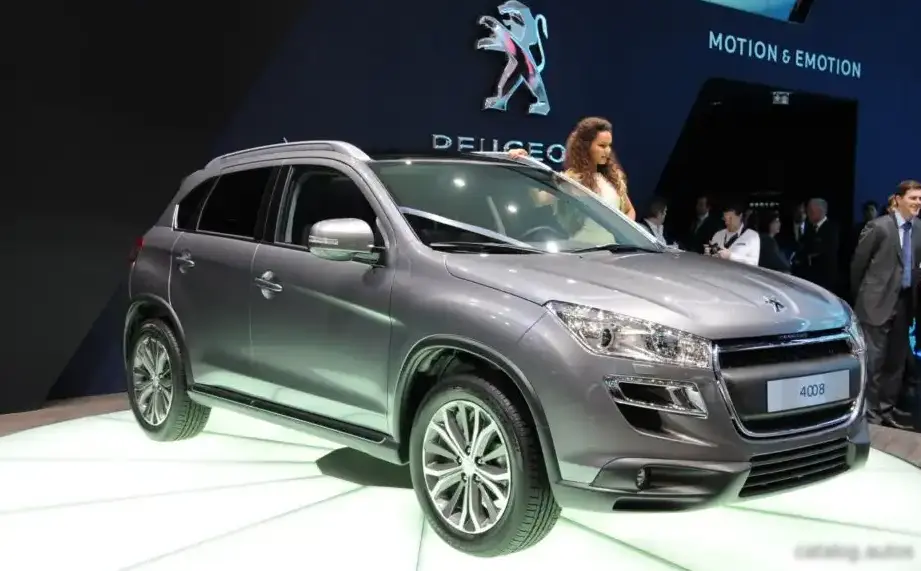
The Peugeot 4008 1.8 HDI STT (150 hp) FAP was a compact SUV produced by the French manufacturer Peugeot between 2012 and 2017. Part of the first generation 4008 series, it represented Peugeot’s entry into the increasingly popular crossover SUV segment. The 4008 was developed in collaboration with Mitsubishi, sharing its platform and many components with the Mitsubishi Outlander. This model was primarily aimed at the European market, offering a blend of practicality, fuel efficiency, and a slightly more premium feel than some of its direct competitors. The “STT” designation indicates the trim level, while “FAP” denotes the presence of a Diesel Particulate Filter, a key component for meeting Euro 5 emissions standards.
Technical Specifications
| Brand | Peugeot |
| Model | 4008 |
| Generation | 4008 |
| Type (Engine) | 1.8 HDI STT (150 Hp) FAP |
| Start of production | 2012 |
| End of production | 2017 |
| Powertrain Architecture | Internal Combustion engine |
| Body type | SUV |
| Seats | 5 |
| Doors | 5 |
| Fuel consumption (urban) | 6.8 l/100 km (34.6 US mpg, 41.5 UK mpg, 14.7 km/l) |
| Fuel consumption (extra urban) | 4.9 l/100 km (48 US mpg, 57.6 UK mpg, 20.4 km/l) |
| Fuel consumption (combined) | 5.6 l/100 km (42 US mpg, 50.4 UK mpg, 17.9 km/l) |
| Fuel Type | Diesel |
| Acceleration 0 – 100 km/h | 11.5 sec |
| Acceleration 0 – 62 mph | 11.5 sec |
| Acceleration 0 – 60 mph | 10.9 sec |
| Maximum speed | 198 km/h (123.03 mph) |
| Emission standard | Euro 5 |
| Weight-to-power ratio | 10 kg/Hp, 100.3 Hp/tonne |
| Weight-to-torque ratio | 5 kg/Nm, 200.7 Nm/tonne |
| Power | 150 Hp @ 4000 rpm |
| Power per litre | 83.4 Hp/l |
| Torque | 300 Nm @ 2000 rpm (221.27 lb.-ft. @ 2000 rpm) |
| Engine layout | Front, Transverse |
| Engine Model/Code | 6HZ (4N13) |
| Engine displacement | 1798 cm3 (109.72 cu. in.) |
| Number of cylinders | 4 |
| Engine configuration | Inline |
| Number of valves per cylinder | 4 |
| Fuel injection system | Diesel Commonrail |
| Engine aspiration | Turbocharger, Intercooler |
| Engine oil capacity | 5.3 l (5.6 US qt | 4.66 UK qt) |
| Coolant capacity | 7.5 l (7.93 US qt | 6.6 UK qt) |
| Kerb Weight | 1495 kg (3295.91 lbs) |
| Max. weight | 2060 kg (4541.52 lbs) |
| Max load | 565 kg (1245.61 lbs) |
| Trunk (boot) space – minimum | 416 l (14.69 cu. ft.) |
| Trunk (boot) space – maximum | 1196 l (42.24 cu. ft.) |
| Fuel tank capacity | 60 l (15.85 US gal | 13.2 UK gal) |
| Length | 4340 mm (170.87 in) |
| Width | 1840 mm (72.44 in) |
| Height | 1635 mm (64.37 in) |
| Wheelbase | 2670 mm (105.12 in) |
| Minimum turning circle | 10.6 m (34.78 ft) |
| Drive wheel | All wheel drive (4×4) |
| Number of gears | 6 |
| Gearbox type | Manual transmission |
| Front suspension | Independent type McPherson |
| Rear suspension | Independent multi-link suspension |
| Front brakes | Ventilated discs |
| Rear brakes | Disc |
| Assisting systems | ABS (Anti-lock braking system) |
| Steering type | Steering rack and pinion |
| Tires size | 225/55 R18 |
| Wheel rims size | 18 |
Powertrain & Engine Architecture
The 4008 1.8 HDI STT utilized a 1.8-liter, four-cylinder diesel engine, internally designated as the 6HZ (based on the Mitsubishi 4N13 engine). This engine was a common rail direct injection (CRDI) unit, benefiting from the precision and efficiency of this fuel delivery system. The common rail system allowed for multiple injections per combustion cycle, optimizing fuel burn and reducing noise, vibration, and harshness (NVH). A turbocharger with an intercooler was employed to boost power output, providing 150 horsepower at 4000 rpm and a substantial 300 Nm (221 lb-ft) of torque at just 2000 rpm. The engine featured four valves per cylinder, enhancing breathing and contributing to its overall performance. The 4008 1.8 HDI STT was exclusively offered with a six-speed manual transmission, providing drivers with full control over gear selection. This transmission was chosen to maximize fuel efficiency and provide a more engaging driving experience compared to an automatic option.
Driving Characteristics
The 1.8 HDI STT offered a balanced driving experience. While not a performance-oriented variant, the 300 Nm of torque provided ample pulling power for everyday driving and overtaking maneuvers. The six-speed manual transmission allowed drivers to keep the engine in its optimal power band, resulting in responsive acceleration. Acceleration from 0 to 100 km/h (0-62 mph) took approximately 11.5 seconds, which was competitive within its class. The all-wheel-drive system provided enhanced traction, particularly in adverse weather conditions, making it a capable vehicle for year-round use. Compared to higher-powered versions of the 4008, the 1.8 HDI STT prioritized fuel economy over outright speed. The manual transmission also offered a more connected feel to the driver than an automatic would have.
Equipment & Trim Levels
The “STT” trim level for the 4008 represented a mid-range offering. Standard equipment typically included air conditioning, a CD/MP3 stereo system, electric windows and mirrors, remote central locking, and alloy wheels. Safety features such as ABS, electronic brakeforce distribution (EBD), and multiple airbags were also standard. Optional extras could include a panoramic sunroof, leather upholstery, a navigation system, and rear parking sensors. The interior generally featured a dark color scheme with durable cloth upholstery. The dashboard layout was functional and straightforward, prioritizing ease of use.
Chassis & Braking
The 4008 utilized a McPherson strut front suspension and a multi-link rear suspension, providing a comfortable ride and good handling characteristics. The all-wheel-drive system employed a viscous coupling to distribute torque between the front and rear axles as needed. Braking duties were handled by ventilated discs at the front and solid discs at the rear. ABS (Anti-lock Braking System) was standard, enhancing braking performance and stability. The steering was a rack and pinion system, providing precise and responsive steering feel.
Market Reception & Comparison
The Peugeot 4008 1.8 HDI STT was generally well-received by automotive critics. It was praised for its fuel efficiency, comfortable ride, and spacious interior. However, some reviewers noted that the interior materials weren’t as premium as those found in some of its competitors. Compared to the petrol-powered versions of the 4008, the 1.8 HDI STT offered significantly better fuel economy and more torque. It also provided a more affordable alternative to higher-trim models with more powerful engines. Against rivals like the Nissan Qashqai and Kia Sportage, the 4008 offered a unique blend of French styling and Japanese engineering.
Legacy
The Peugeot 4008, and specifically the 1.8 HDI STT variant, has proven to be a relatively reliable vehicle in the used car market. The diesel engine, while requiring regular maintenance, is known for its durability. Common issues are typically related to the diesel particulate filter (DPF), particularly on vehicles that are primarily used for short journeys. The 4008’s all-wheel-drive system and practical interior continue to make it an appealing option for buyers seeking a versatile and fuel-efficient SUV. Today, the 4008 represents a significant step in Peugeot’s expansion into the crossover SUV segment, paving the way for future models like the 3008 and 5008.
