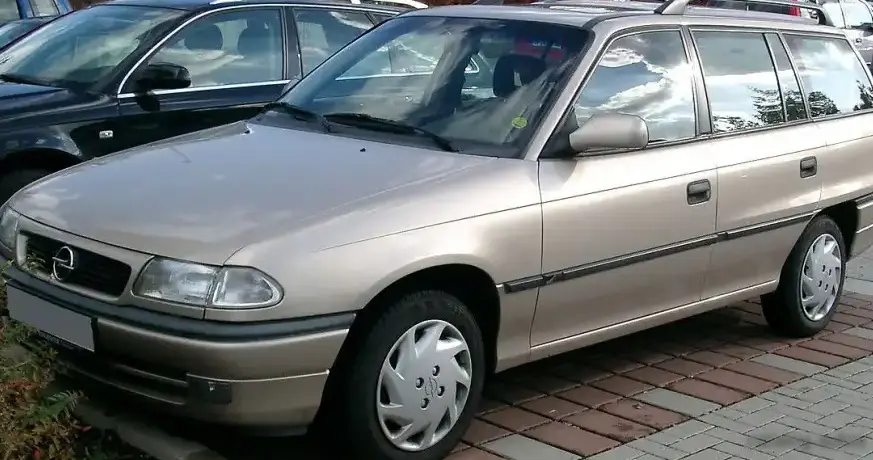
The Opel Astra F Caravan (facelift, 1994) 1.6i Ecotec, producing 71 horsepower, represents an entry-level variant within the broader Astra F range. Introduced in August 1994 and continuing through April 1995, this model served as a practical and economical choice for families and those prioritizing fuel efficiency within the European market. The facelift brought subtle styling updates to the Astra F, enhancing its appeal. This particular configuration – the 1.6-liter engine paired with a five-speed manual transmission – occupied the lower end of the performance spectrum for the Caravan, positioned below the more powerful 1.8 and 2.0-liter options.
Technical Specifications
| Brand | Opel |
| Model | Astra |
| Generation | Astra F Caravan (facelift 1994) |
| Type (Engine) | 1.6i Ecotec (71 Hp) |
| Start of production | August, 1994 |
| End of production | April, 1995 |
| Powertrain Architecture | Internal Combustion engine |
| Body type | Station wagon (estate) |
| Seats | 5 |
| Doors | 5 |
| Fuel consumption (urban) | 9.2 l/100 km (25.6 US mpg, 30.7 UK mpg, 10.9 km/l) |
| Fuel consumption (extra urban) | 6.3 l/100 km (37.3 US mpg, 44.8 UK mpg, 15.9 km/l) |
| Fuel consumption (combined) | 8.1 l/100 km (29 US mpg, 34.9 UK mpg, 12.3 km/l) |
| Fuel Type | Petrol (Gasoline) |
| Acceleration 0 – 100 km/h | 14.5 sec |
| Acceleration 0 – 62 mph | 14.5 sec |
| Acceleration 0 – 60 mph | 13.8 sec |
| Maximum speed | 165 km/h (102.53 mph) |
| Weight-to-power ratio | 14.9 kg/Hp, 67.3 Hp/tonne |
| Weight-to-torque ratio | 8.2 kg/Nm, 121.3 Nm/tonne |
| Power | 71 Hp @ 5000 rpm |
| Power per litre | 44.4 Hp/l |
| Torque | 128 Nm @ 2800 rpm (94.41 lb.-ft. @ 2800 rpm) |
| Engine layout | Front, Transverse |
| Engine Model/Code | X16SZ |
| Engine displacement | 1598 cm3 (97.52 cu. in.) |
| Number of cylinders | 4 |
| Engine configuration | Inline |
| Cylinder Bore | 79 mm (3.11 in.) |
| Piston Stroke | 81.5 mm (3.21 in.) |
| Compression ratio | 10:1 |
| Number of valves per cylinder | 2 |
| Fuel injection system | Single-point injection |
| Engine aspiration | Naturally aspirated engine |
| Valvetrain | SOHC |
| Engine oil capacity | 3.5 l (3.7 US qt | 3.08 UK qt) |
| Coolant | 5.6 l (5.92 US qt | 4.93 UK qt) |
| Kerb Weight | 1055 kg (2325.88 lbs.) |
| Max. weight | 1555 kg (3428.19 lbs.) |
| Max load | 500 kg (1102.31 lbs.) |
| Trunk (boot) space – minimum | 500 l (17.66 cu. ft.) |
| Trunk (boot) space – maximum | 1630 l (57.56 cu. ft.) |
| Fuel tank capacity | 50 l (13.21 US gal | 11 UK gal) |
| Length | 4278 mm (168.43 in.) |
| Width | 1696 mm (66.77 in.) |
| Width including mirrors | 1852 mm (72.91 in.) |
| Height | 1525 mm (60.04 in.) |
| Wheelbase | 2517 mm (99.09 in.) |
| Front track | 1430-1424 mm (56.3 – 56.06 in.) |
| Rear (Back) track | 1429-1423 mm (56.26 – 56.02 in.) |
| Ride height (ground clearance) | 135 mm (5.31 in.) |
| Drag coefficient (Cd) | 0.34 |
| Minimum turning circle | 10.5 m (34.45 ft.) |
| Drivetrain Architecture | ICE, Front wheel drive |
| Drive wheel | Front wheel drive |
| Number of gears | 5 gears, manual transmission |
| Front brakes | Disc |
| Rear brakes | Drum |
| Assisting systems | ABS (Anti-lock braking system) |
| Steering type | Steering rack and pinion |
| Tires size | 175/70 R13 82T; 175/65 R14 82T |
| Wheel rims size | 5.5J x 13 ET49; 5.5J x 14 ET49 |
INTRODUCTION
The Opel Astra F Caravan 1.6i Ecotec (71 hp) was a mainstay of the European family car market during its production run from 1994 to 1995. Part of the Astra F series, which spanned from 1991 to 1998, the Caravan body style offered increased practicality with its estate (station wagon) configuration. The facelift in 1994 brought minor cosmetic changes, including revised grilles and headlight designs. This 1.6-liter variant was designed to provide affordable transportation, prioritizing fuel economy and usability over outright performance. It was a common sight on European roads, serving as a workhorse for families and businesses alike.
Powertrain & Engine Architecture
The heart of this Astra variant is the Opel X16SZ engine, a 1.6-liter inline-four cylinder powerplant. This engine belongs to Opel’s ‘Ecotec’ family, which emphasized efficiency and reduced emissions. The X16SZ utilizes a single-point fuel injection system, where fuel is injected into the intake manifold rather than directly into the cylinders. This system, while simpler and less expensive than multi-point injection, contributed to the engine’s affordability. The engine features a single overhead camshaft (SOHC) valvetrain, operating two valves per cylinder. The five-speed manual transmission was the standard offering, providing a relatively long-geared setup geared towards fuel efficiency. The transmission’s ratios were optimized for cruising and minimizing engine revolutions at highway speeds.
Driving Characteristics
The 1.6i Ecotec with 71 horsepower delivers modest performance. Acceleration from 0-100 km/h (0-62 mph) takes approximately 14.5 seconds, and top speed is around 165 km/h (102.53 mph). The engine feels somewhat strained when accelerating hard, particularly when fully loaded. The long gearing of the five-speed manual transmission helps to improve fuel economy but can make overtaking maneuvers require careful planning. Compared to the 1.8-liter and 2.0-liter versions of the Astra F, this variant feels noticeably less powerful. However, the 1.6 offers a smoother and more predictable power delivery, making it easier to drive in everyday conditions. The manual transmission provides a more engaging driving experience than the optional automatic transmission available on higher-spec models.
Equipment & Trim Levels
The 1.6i Ecotec Caravan typically came with a fairly basic level of equipment. Standard features generally included power steering, central locking, and a basic stereo system. Interior upholstery was typically cloth, and the dashboard featured a simple, functional design. Optional extras included electric windows, a sunroof, and upgraded audio systems. The trim level was generally considered entry-level, focusing on providing essential features at an affordable price point. The interior plastics were durable but not particularly luxurious, reflecting the car’s price positioning.
Chassis & Braking
The Astra F Caravan’s chassis featured independent suspension at the front, utilizing MacPherson struts, and a semi-independent torsion beam suspension at the rear. The braking system consisted of disc brakes on the front wheels and drum brakes on the rear. ABS (Anti-lock Braking System) was often included as standard equipment, enhancing safety. The suspension setup provided a comfortable ride, although it wasn’t particularly sporty. The rear drum brakes were adequate for normal driving conditions but lacked the stopping power of disc brakes, especially under heavy braking.
Market Reception & Comparison
The Astra F Caravan 1.6i Ecotec was generally well-received as a practical and economical family car. Critics praised its fuel efficiency and spacious interior, but noted its lack of outright performance. Compared to the more powerful Astra variants, the 1.6 offered a lower purchase price and lower running costs. The 1.8-liter version provided a noticeable performance boost but came at a higher price. The 1.9 TDI diesel variant offered even better fuel economy but was more expensive to purchase and maintain. The 1.6i Ecotec appealed to buyers who prioritized affordability and practicality over performance.
Legacy
The Opel Astra F Caravan 1.6i Ecotec has proven to be a relatively reliable vehicle, with many examples still on the road today. The X16SZ engine is known for its durability, although regular maintenance is essential to prevent issues. Common problems include oil leaks and wear on the timing chain. The car’s simple design and readily available parts make it relatively easy and inexpensive to repair. In the used car market, these Astras are now considered classic vehicles, appealing to enthusiasts and those seeking affordable, practical transportation. While not a performance icon, the 1.6i Ecotec Caravan represents a significant part of automotive history, embodying the practical and economical family car of the 1990s.