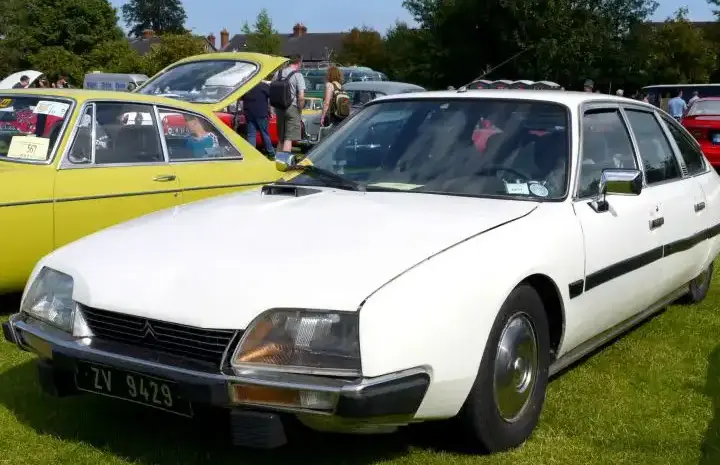
The Citroën CX II 2.5 TRD Turbo 2, produced between 1987 and 1989, represented a refined iteration of Citroën’s flagship executive car, the CX series. Positioned as a mid-range offering within the CX II lineup, this variant combined a turbocharged diesel engine with a five-speed manual transmission, aiming to deliver a balance of performance, fuel economy, and comfort. The CX II, building upon the innovative CX platform (introduced in 1974), continued Citroën’s tradition of advanced engineering, particularly in its hydropneumatic suspension system. This model was primarily marketed in Europe, where diesel engines were gaining popularity due to fuel efficiency and tax benefits. It served as a competitor to vehicles like the Peugeot 505, Renault 25, and BMW 5 Series.
Technical Specifications
| Brand | Citroen |
| Model | CX |
| Generation | CX II |
| Type (Engine) | 2.5 TRD Turbo 2 (106 Hp) |
| Start of production | 1987 |
| End of production | 1989 |
| Powertrain Architecture | Internal Combustion engine |
| Body type | Hatchback |
| Seats | 5 |
| Doors | 5 |
| Fuel consumption (urban) | 8.6 l/100 km (27.4 US mpg) |
| Fuel consumption (extra urban) | 5.6 l/100 km (42 US mpg) |
| Fuel consumption (combined) | 7.2 l/100 km (32.7 US mpg) |
| Fuel Type | Diesel |
| Acceleration 0 – 100 km/h | 13.1 sec |
| Acceleration 0 – 62 mph | 13.1 sec |
| Acceleration 0 – 60 mph | 12.4 sec |
| Maximum speed | 184 km/h (114.33 mph) |
| Weight-to-power ratio | 12.8 kg/Hp |
| Weight-to-torque ratio | 5.3 kg/Nm |
| Power | 106 Hp @ 3900 rpm |
| Power per litre | 42.4 Hp/l |
| Torque | 258 Nm @ 2250 rpm (190.29 lb.-ft. @ 2250 rpm) |
| Engine layout | Front, Transverse |
| Engine displacement | 2500 cm3 (152.56 cu. in.) |
| Number of cylinders | 4 |
| Engine configuration | Inline |
| Cylinder Bore | 93 mm (3.66 in.) |
| Piston Stroke | 92 mm (3.62 in.) |
| Compression ratio | 21:1 |
| Number of valves per cylinder | 2 |
| Fuel injection system | Precombustion chamber injection |
| Engine aspiration | Turbocharger |
| Kerb Weight | 1360 kg (2998.29 lbs.) |
| Max. weight | 1905 kg (4199.81 lbs.) |
| Max load | 545 kg (1201.52 lbs.) |
| Trunk (boot) space – minimum | 485 l (17.13 cu. ft.) |
| Trunk (boot) space – maximum | 507 l (17.9 cu. ft.) |
| Fuel tank capacity | 68 l (17.96 US gal) |
| Length | 4650 mm (183.07 in.) |
| Width | 1770 mm (69.69 in.) |
| Height | 1360 mm (53.54 in.) |
| Wheelbase | 2845 mm (112.01 in.) |
| Front track | 1520 mm (59.84 in.) |
| Rear track | 1370 mm (53.94 in.) |
| Drag coefficient (Cd) | 0.35 |
| Minimum turning circle | 12.5 m (41.01 ft.) |
| Drivetrain Architecture | Front wheel drive |
| Number of gears | 5 |
| Gearbox type | Manual transmission |
| Front suspension | Hydro-pneumatic element |
| Rear suspension | Hydro-pneumatic element |
| Front brakes | Ventilated discs |
| Rear brakes | Disc |
| Steering type | Steering rack and pinion |
| Power steering | Hydraulic |
| Tires size | 195/70 R14 |
| Wheel rims size | 5.5J x 14 |
Powertrain & Engine Architecture
The heart of the CX II 2.5 TRD Turbo 2 is the XU5J2 engine, a 2.5-liter inline-four cylinder diesel. This engine utilizes precombustion chamber injection, a system common in European diesels of the era, which improves combustion efficiency and reduces noise compared to direct injection. The turbocharger, a key component, significantly boosts power output, bringing it to 106 horsepower at 3900 rpm and 258 Nm (190 lb-ft) of torque at 2250 rpm. The five-speed manual transmission, a BE3 type, was chosen to handle the engine’s torque and provide a more engaging driving experience than the available automatic option. The transmission’s gear ratios were tuned for a balance between acceleration and fuel economy, with a relatively long fifth gear for efficient cruising on motorways.
Driving Characteristics
The CX II 2.5 TRD Turbo 2 offered a unique driving experience largely defined by Citroën’s hydropneumatic suspension. This system provided an exceptionally smooth and comfortable ride, absorbing bumps and imperfections in the road with remarkable ease. The turbocharged diesel engine, while not exceptionally powerful, delivered strong low-end torque, making it well-suited for everyday driving and overtaking maneuvers. Acceleration to 60 mph took around 12.4 seconds, and the car could reach a top speed of 114 mph. Compared to the naturally aspirated 2.5-liter diesel, the Turbo 2 offered a noticeable performance improvement. However, it didn’t match the responsiveness of the more expensive and powerful V6 gasoline variants. The manual transmission allowed for greater driver control, unlike the optional three-speed automatic which could feel sluggish.
Equipment & Trim Levels
The CX II 2.5 TRD Turbo 2 was generally well-equipped for its time. Standard features included central locking, electric windows, and a basic stereo system. Interior upholstery was typically cloth, with options for leather available at an extra cost. The dashboard layout was characteristically Citroën, featuring a unique combination of analog gauges and switches. Optional extras included air conditioning, a sunroof, and upgraded sound systems. The trim level sat in the middle of the CX II range, offering a good balance of features and affordability. It was a step up from the base models but lacked the luxury appointments of the Prestige or GTI trims.
Chassis & Braking
The CX II featured a robust chassis designed to handle the stresses of its advanced suspension system. The front suspension utilized Citroën’s signature hydropneumatic technology, providing self-leveling and adjustable ride height. The rear suspension also employed hydropneumatic elements, although with a simpler design. Braking duties were handled by ventilated discs at the front and solid discs at the rear, providing adequate stopping power for the car’s weight and performance. Power-assisted steering was standard, making the car relatively easy to maneuver, despite its size. Stabilizer bars were fitted to both the front and rear axles to reduce body roll during cornering.
Market Reception & Comparison
The CX II 2.5 TRD Turbo 2 was generally well-received by automotive critics. It was praised for its comfortable ride, fuel efficiency, and strong torque. However, some critics noted its relatively slow acceleration and the complexity of its hydropneumatic suspension system, which could be expensive to maintain. Compared to the naturally aspirated diesel CX models, the Turbo 2 offered a significant performance boost, but at a higher price point. Against competitors like the Peugeot 505 and Renault 25, the CX II stood out for its unique suspension and distinctive styling. Fuel economy was a strong point, achieving around 32.7 US mpg on combined cycles.
Legacy
The Citroën CX II 2.5 TRD Turbo 2, while not a high-volume seller, remains a respected classic car. The XU5J2 engine, when properly maintained, is known for its durability. However, the hydropneumatic suspension system requires specialized knowledge and can be prone to leaks and failures if neglected. Today, these cars are sought after by enthusiasts who appreciate their unique engineering and comfortable ride. Finding well-maintained examples can be challenging, and parts availability can be limited, but the CX II 2.5 TRD Turbo 2 continues to offer a distinctive and rewarding driving experience for those willing to invest in its upkeep.