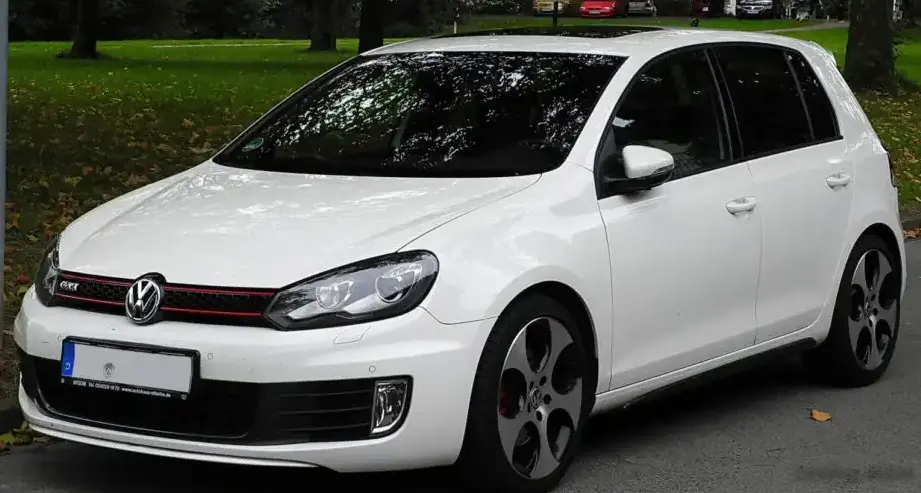
The Volkswagen Golf VI GTI 2.0 TSI (210 hp) DSG, produced from 2009 to 2012, represents a significant iteration of Volkswagen’s iconic hot hatchback. Positioned as the performance flagship of the Golf VI range, it built upon the success of previous GTI models, offering a blend of everyday usability and engaging driving dynamics. This variant was a key component of the Mk6 Golf lineup, which itself was based on the A5 platform (internally designated as the 1K platform). The GTI, in particular, aimed to deliver a more refined and technologically advanced experience compared to its predecessors, appealing to enthusiasts seeking a premium hot hatch.
Technical Specifications
| Brand | Volkswagen |
| Model | Golf |
| Generation | Golf VI (5-door) |
| Type (Engine) | GTI 2.0 TSI (210 Hp) DSG |
| Start of production | 2009 |
| End of production | 2012 |
| Powertrain Architecture | Internal Combustion engine |
| Body type | Hatchback |
| Seats | 5 |
| Doors | 5 |
| Fuel consumption (economy) – urban (NEDC) | 10 l/100 km (23.5 US mpg, 28.2 UK mpg, 10 km/l) |
| Fuel consumption (economy) – extra urban (NEDC) | 5.9 l/100 km (39.9 US mpg, 47.9 UK mpg, 16.9 km/l) |
| Fuel consumption (economy) – combined (NEDC) | 7.4 l/100 km (31.8 US mpg, 38.2 UK mpg, 13.5 km/l) |
| CO2 emissions (NEDC) | 173 g/km |
| Fuel Type | Petrol (Gasoline) |
| Acceleration 0 – 100 km/h | 6.9 sec |
| Acceleration 0 – 62 mph | 6.9 sec |
| Acceleration 0 – 60 mph | 6.6 sec |
| Maximum speed | 238 km/h (147.89 mph) |
| Emission standard | Euro 5 |
| Weight-to-power ratio | 6.4 kg/Hp, 156.8 Hp/tonne |
| Weight-to-torque ratio | 4.8 kg/Nm, 209.1 Nm/tonne |
| Power | 210 Hp @ 5300-6200 rpm |
| Power per litre | 105.8 Hp/l |
| Torque | 280 Nm @ 1700-5200 rpm (206.52 lb.-ft. @ 1700-5200 rpm) |
| Engine layout | Front, Transverse |
| Engine Model/Code | CCZB |
| Engine displacement | 1984 cm3 (121.07 cu. in.) |
| Number of cylinders | 4 |
| Engine configuration | Inline |
| Cylinder Bore | 82.5 mm (3.25 in.) |
| Piston Stroke | 92.8 mm (3.65 in.) |
| Compression ratio | 9.6:1 |
| Number of valves per cylinder | 4 |
| Fuel injection system | Direct injection |
| Engine aspiration | Turbocharger, Intercooler |
| Valvetrain | DOHC |
| Engine oil capacity | 4.7 l (4.97 US qt | 4.14 UK qt) |
| Kerb Weight | 1339 kg (2951.99 lbs.) |
| Max. weight | 1890 kg (4166.74 lbs.) |
| Max load | 551 kg (1214.75 lbs.) |
| Trunk (boot) space – minimum | 350 l (12.36 cu. ft.) |
| Trunk (boot) space – maximum | 1305 l (46.09 cu. ft.) |
| Fuel tank capacity | 55 l (14.53 US gal | 12.1 UK gal) |
| Max. roof load | 75 kg (165.35 lbs.) |
| Permitted trailer load with brakes (12%) | 1400 kg (3086.47 lbs.) |
| Permitted trailer load without brakes | 700 kg (1543.24 lbs.) |
| Permitted towbar download | 75 kg (165.35 lbs.) |
| Length | 4213 mm (165.87 in.) |
| Width | 1786 mm (70.31 in.) |
| Width including mirrors | 2048 mm (80.63 in.) |
| Height | 1469 mm (57.83 in.) |
| Wheelbase | 2578 mm (101.5 in.) |
| Front track | 1533 mm (60.35 in.) |
| Rear (Back) track | 1514 mm (59.61 in.) |
| Ride height (ground clearance) | 140 mm (5.51 in.) |
| Minimum turning circle (turning diameter) | 10.9 m (35.76 ft.) |
| Approach angle | 11.2° |
| Departure angle | 14° |
| Ramp-over (brakeover) angle | 9° |
| Drivetrain Architecture | The Internal combustion engine (ICE) drives the front wheels of the vehicle. |
| Drive wheel | Front wheel drive |
| Number of gears and type of gearbox | 6 gears, automatic transmission DSG |
| Front suspension | Independent type McPherson, Transverse stabilizer |
| Rear suspension | Independent multi-link suspension, Transverse stabilizer |
| Front brakes | Ventilated discs |
| Rear brakes | Disc |
| Assisting systems | ABS (Anti-lock braking system) |
| Steering type | Steering rack and pinion |
| Power steering | Electric Steering |
| Tires size | 225/45 R 17 |
| Wheel rims size | 7.5 J x 17 |
INTRODUCTION
The Golf VI GTI 2.0 TSI DSG, produced between 2009 and 2012, was a cornerstone of Volkswagen’s hot hatch lineage. It represented the sixth generation of the Golf, and the GTI variant continued to be a benchmark in the compact performance segment. This model utilized the A5 platform, offering improvements in refinement, technology, and build quality over its predecessor. The 2.0-liter turbocharged engine paired with the dual-clutch DSG transmission aimed to provide a compelling combination of performance and efficiency, making it a popular choice for drivers seeking a sporty yet practical vehicle. It sat at the top of the non-R Golf VI range, offering a significant performance upgrade over the standard Golf models.
Powertrain & Engine Architecture
At the heart of the Golf VI GTI DSG lies the CCZB engine code, a 2.0-liter inline-four cylinder gasoline engine. This engine is a direct-injection, turbocharged powerplant, benefiting from advancements in fuel delivery and forced induction technology. The direct injection system, coupled with the turbocharger and intercooler, allowed for increased power output and improved fuel efficiency. The engine produced 210 horsepower at 5300-6200 rpm and 280 Nm (206.52 lb-ft) of torque between 1700 and 5200 rpm. The dual-clutch DSG (Direct-Shift Gearbox) transmission, a six-speed unit in this application, provided rapid and seamless gear changes, enhancing both acceleration and driving enjoyment. The DSG transmission utilizes two separate clutches, allowing for pre-selection of the next gear, resulting in virtually no interruption in power delivery. The engine also featured a DOHC (Double Overhead Camshaft) valvetrain with four valves per cylinder, optimizing airflow for improved performance.
Driving Characteristics
The Golf VI GTI DSG offered a noticeably different driving experience compared to the standard Golf models and even the manual transmission GTI variants. The DSG transmission contributed to quicker acceleration, with a 0-60 mph time of approximately 6.6 seconds. While the manual transmission offered a more engaging experience for some drivers, the DSG provided convenience and efficiency, particularly in urban driving conditions. The gear ratios were optimized for both acceleration and fuel economy, with a relatively short first gear for quick launches and a taller sixth gear for relaxed highway cruising. The turbocharger provided a noticeable boost in power, delivering strong acceleration throughout the rev range. The GTI’s suspension, featuring McPherson struts at the front and a multi-link setup at the rear, provided a comfortable yet controlled ride, minimizing body roll during cornering.
Equipment & Trim Levels
The GTI trim level came standard with a comprehensive list of features. Interior appointments included sport seats upholstered in the classic GTI plaid fabric, a leather-wrapped steering wheel, and aluminum pedal caps. Standard equipment also included automatic climate control, a touchscreen infotainment system, and alloy wheels. Optional extras included features such as a sunroof, navigation system, and upgraded sound system. The exterior styling was distinguished by GTI-specific front and rear bumpers, a rear spoiler, and red brake calipers. The interior dashboard configuration was typical of the Golf VI, with a focus on functionality and ergonomics.
Chassis & Braking
The Golf VI GTI featured a robust chassis designed to handle the increased power output. The front suspension utilized McPherson struts with a transverse stabilizer bar, while the rear suspension employed an independent multi-link setup, also with a transverse stabilizer bar. This configuration provided a good balance between ride comfort and handling precision. The braking system consisted of ventilated discs at the front and solid discs at the rear, providing ample stopping power. ABS (Anti-lock Braking System) was standard, enhancing safety and control during emergency braking situations. The GTI also benefited from a slightly lowered ride height compared to the standard Golf, further improving handling characteristics.
Market Reception & Comparison
The Golf VI GTI DSG was generally well-received by automotive critics, who praised its blend of performance, refinement, and practicality. It was often compared to rivals such as the Ford Focus ST and the Renault Mégane RS. Compared to the standard Golf models, the GTI offered a significant performance upgrade, while maintaining a reasonable level of fuel economy. The DSG transmission was a point of contention for some enthusiasts, who preferred the engagement of a manual gearbox, but it was widely acknowledged as a capable and efficient transmission. The GTI’s reliability was generally good, although some owners reported issues with the DSG transmission, particularly early units. Fuel economy figures of around 31.8 US mpg combined were competitive for a hot hatch of its class.
Legacy
The Golf VI GTI 2.0 TSI DSG remains a popular choice in the used car market today. Its combination of performance, practicality, and build quality has ensured its enduring appeal. The CCZB engine, while not without its potential issues (such as carbon buildup on the intake valves), is generally considered to be a reliable unit when properly maintained. The DSG transmission, while requiring regular servicing, can provide years of trouble-free operation. The Golf VI GTI represents a high point in the evolution of the Golf GTI, offering a refined and engaging driving experience that continues to attract enthusiasts.