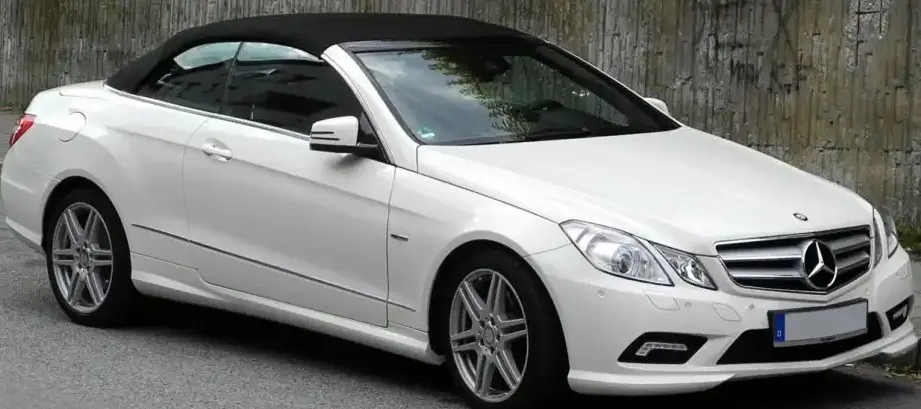
The Mercedes-Benz E-Class Cabriolet (A207) E 250 CDI BlueEFFICIENCY, produced from April 2011 to March 2013, represented a compelling blend of luxury, efficiency, and open-air motoring within the broader E-Class Cabrio range. Positioned as a mid-range offering, it slotted between the more affordable E 220 CDI and the higher-performance E 350 CDI models. This variant was primarily aimed at European markets, where diesel engines and convertible body styles were particularly popular. The A207 generation E-Class Cabriolet built upon the success of its predecessor (the CLK-Class Cabriolet) and offered a more sophisticated and technologically advanced package, competing with rivals like the BMW 3 Series Convertible and Audi A5 Cabriolet.
Technical Specifications
| Brand | Mercedes-Benz |
| Model | E-Class |
| Generation | E-Class Cabrio (A207) |
| Type (Engine) | E 250 CDI BlueEFFICIENCY (204 Hp) Start & Stop |
| Start of production | April, 2011 |
| End of production | March, 2013 |
| Powertrain Architecture | Internal Combustion engine |
| Body type | Cabriolet |
| Seats | 4 |
| Doors | 2 |
| Fuel consumption (urban) | 6.4-6.7 l/100 km (36.8 – 35.1 US mpg, 44.1 – 42.2 UK mpg, 15.6 – 14.9 km/l) |
| Fuel consumption (extra urban) | 4.4-4.7 l/100 km (53.5 – 50 US mpg, 64.2 – 60.1 UK mpg, 22.7 – 21.3 km/l) |
| Fuel consumption (combined) | 5.1-5.4 l/100 km (46.1 – 43.6 US mpg, 55.4 – 52.3 UK mpg, 19.6 – 18.5 km/l) |
| CO2 emissions | 135-142 g/km |
| Fuel Type | Diesel |
| Acceleration 0 – 100 km/h | 7.8 sec |
| Acceleration 0 – 62 mph | 7.8 sec |
| Acceleration 0 – 60 mph | 7.4 sec |
| Maximum speed | 245 km/h (152.24 mph) |
| Emission standard | Euro 5 |
| Weight-to-power ratio | 8.6 kg/Hp, 116.6 Hp/tonne |
| Weight-to-torque ratio | 3.5 kg/Nm, 285.7 Nm/tonne |
| Power | 204 Hp @ 4200 rpm |
| Power per litre | 95.2 Hp/l |
| Torque | 500 Nm @ 1600-1800 rpm (368.78 lb.-ft. @ 1600-1800 rpm) |
| Engine layout | Front, Longitudinal |
| Engine Model/Code | OM 651.911 |
| Engine displacement | 2143 cm3 (130.77 cu. in.) |
| Number of cylinders | 4 |
| Engine configuration | Inline |
| Cylinder Bore | 83 mm (3.27 in.) |
| Piston Stroke | 99 mm (3.9 in.) |
| Compression ratio | 16.2:1 |
| Number of valves per cylinder | 4 |
| Fuel injection system | Diesel Commonrail |
| Engine aspiration | BiTurbo, Intercooler |
| Valvetrain | DOHC |
| Engine oil capacity | 6.5 l (6.87 US qt | 5.72 UK qt) |
| Kerb Weight | 1750 kg (3858.09 lbs.) |
| Max. weight | 2295 kg (5059.61 lbs.) |
| Max load | 545 kg (1201.52 lbs.) |
| Trunk (boot) space – minimum | 300 l (10.59 cu. ft.) |
| Trunk (boot) space – maximum | 390 l (13.77 cu. ft.) |
| Fuel tank capacity | 66 l (17.44 US gal | 14.52 UK gal) |
| Permitted trailer load with brakes (12%) | 1800 kg (3968.32 lbs.) |
| Permitted trailer load without brakes | 750 kg (1653.47 lbs.) |
| Permitted towbar download | 75 kg (165.35 lbs.) |
| Length | 4698 mm (184.96 in.) |
| Width | 1786 mm (70.31 in.) |
| Width including mirrors | 2015 mm (79.33 in.) |
| Height | 1398 mm (55.04 in.) |
| Wheelbase | 2760 mm (108.66 in.) |
| Front track | 1538 mm (60.55 in.) |
| Rear track | 1544 mm (60.79 in.) |
| Front overhang | 855 mm (33.66 in.) |
| Rear overhang | 1083 mm (42.64 in.) |
| Drag coefficient (Cd) | 0.29 |
| Minimum turning circle | 11 m (36.09 ft.) |
| Drivetrain Architecture | Rear wheel drive |
| Number of gears | 6 gears, manual transmission |
| Front suspension | Coil spring, Independent multi-link suspension, Transverse stabilizer |
| Rear suspension | Independent multi-link spring suspension with stabilizer |
| Front brakes | Ventilated discs, 295 mm |
| Rear brakes | Disc, 300 mm |
| Front tires | 235/45 R17; 235/40 R18; 235/35 R19 |
| Rear tires | 235/45 R17; 255/40 R17; 255/35 R18; 255/30 R19 |
Powertrain & Engine Architecture
The E 250 CDI BlueEFFICIENCY was powered by the OM 651.911, a 2.1-liter inline-four diesel engine. This engine was a cornerstone of Mercedes-Benz’s diesel offerings during this period, known for its robust construction and fuel efficiency. The ‘BlueEFFICIENCY’ designation indicated the inclusion of various fuel-saving technologies, including start-stop functionality. The engine featured a sophisticated common-rail direct injection system, delivering fuel at extremely high pressures for optimized combustion. A bi-turbocharger setup, utilizing a small and a large turbocharger, minimized turbo lag and provided a broad torque curve. The engine also incorporated an intercooler to further enhance performance. The 6-speed manual transmission was standard, providing precise gear changes and contributing to the car’s overall efficiency.
Driving Characteristics
The E 250 CDI Cabriolet offered a comfortable and refined driving experience. While not overtly sporty, the 204 horsepower and 368 lb-ft of torque provided ample power for everyday driving and overtaking maneuvers. Acceleration from 0-60 mph took around 7.4 seconds, which was respectable for a relatively heavy convertible. The manual transmission allowed for driver engagement, but the long gearing emphasized fuel economy over outright performance. The torque delivery was strong from low engine speeds, making it easy to navigate city traffic and maintain comfortable cruising speeds on the highway. Compared to the more powerful E 350 CDI, the E 250 CDI felt less urgent in its acceleration, but it offered a more balanced and economical driving experience.
Equipment & Trim Levels
The E 250 CDI BlueEFFICIENCY Cabriolet came standard with a generous array of features, including leather upholstery, automatic climate control, a multi-function steering wheel, and a high-quality audio system. Optional extras included features like the AIRCAP system (which reduced turbulence in the cabin at higher speeds), the AIRSCARF system (which provided warm air around the neck and shoulders), and a premium sound system. Interior trim options allowed for personalization, with a range of wood and aluminum finishes available. The standard dashboard configuration was typical of the A207 E-Class, featuring a blend of analog gauges and a central infotainment screen.
Chassis & Braking
The A207 E-Class Cabriolet utilized a robust chassis designed to provide both comfort and handling. The front suspension featured coil springs and an independent multi-link setup with a transverse stabilizer bar, while the rear suspension employed an independent multi-link spring suspension, also with a stabilizer bar. This configuration provided a good balance between ride comfort and body control. The braking system consisted of ventilated discs at the front and solid discs at the rear. Anti-lock braking system (ABS) was standard, ensuring safe and controlled stopping power. The steering was a hydraulic power-assisted rack and pinion system, offering precise and responsive steering feel.
Market Reception & Comparison
The E 250 CDI BlueEFFICIENCY Cabriolet was generally well-received by automotive critics. It was praised for its fuel efficiency, comfortable ride, and refined interior. However, some reviewers noted that the performance was not as exhilarating as that of the more powerful E 350 CDI. Compared to the E 220 CDI, the E 250 CDI offered a noticeable increase in power and torque, making it a more versatile option for drivers who frequently undertook longer journeys. Its fuel economy was comparable to other diesel-powered convertibles in its class, and its reliability was generally considered to be good.
Legacy
The OM 651 engine family, including the 2.1-liter variant found in the E 250 CDI, has proven to be remarkably durable and reliable. These engines are known for their longevity and relatively low maintenance costs. In the used car market, the A207 E-Class Cabriolet E 250 CDI remains a popular choice for buyers seeking a stylish and economical convertible. While older examples may require some maintenance, the robust engine and well-built chassis ensure that these cars can provide many years of enjoyable motoring. The combination of luxury, efficiency, and open-air driving experience continues to make this variant a desirable option for discerning car enthusiasts.