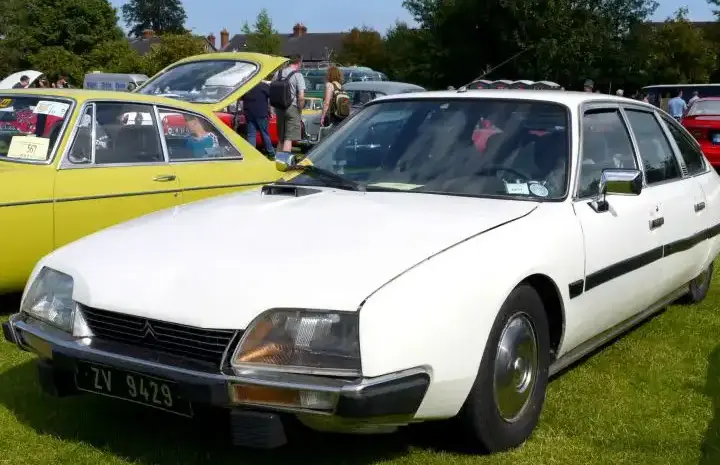
The Citroën CX II Break 25 TRD Turbo 2, produced between 1987 and 1991, represents a unique offering within the second generation (CX II) of Citroën’s innovative CX line. This variant, a diesel-powered station wagon (estate), was positioned as a practical and relatively efficient option for buyers seeking a spacious and comfortable vehicle. It sat within the CX Break range, offering a balance between performance and economy, appealing to families and those requiring substantial cargo capacity. The CX II Break 25 TRD Turbo 2 was primarily sold in European markets, where large, comfortable station wagons were highly valued.
Technical Specifications
| Brand | Citroen |
| Model | CX |
| Generation | CX II Break |
| Type (Engine) | 25 TRD Turbo 2 (120 Hp) |
| Start of production | 1987 |
| End of production | 1991 |
| Powertrain Architecture | Internal Combustion engine |
| Body type | Station wagon (estate) |
| Seats | 5 |
| Doors | 5 |
| Fuel consumption (urban) | 8.5 l/100 km (27.7 US mpg) |
| Fuel consumption (extra urban) | 5.4 l/100 km (43.6 US mpg) |
| Fuel consumption (combined) | 7.1 l/100 km (33.1 US mpg) |
| Fuel Type | Diesel |
| Acceleration 0 – 100 km/h | 12.6 sec |
| Acceleration 0 – 62 mph | 12.6 sec |
| Acceleration 0 – 60 mph | 12 sec |
| Maximum speed | 188 km/h (116.82 mph) |
| Weight-to-power ratio | 12.3 kg/Hp |
| Weight-to-torque ratio | 5.8 kg/Nm |
| Power | 120 Hp @ 3900 rpm |
| Torque | 256 Nm @ 2000 rpm (188.82 lb.-ft. @ 2000 rpm) |
| Engine layout | Front, Transverse |
| Engine Model/Code | M25-669 |
| Engine displacement | 2500 cm3 (152.56 cu. in.) |
| Number of cylinders | 4 |
| Engine configuration | Inline |
| Cylinder Bore | 93 mm (3.66 in.) |
| Piston Stroke | 92 mm (3.62 in.) |
| Compression ratio | 21.25:1 |
| Number of valves per cylinder | 2 |
| Fuel injection system | Precombustion chamber injection |
| Engine aspiration | Turbocharger |
| Engine oil capacity | 6 l (6.34 US qt | 5.28 UK qt) |
| Coolant capacity | 13 l (13.74 US qt | 11.44 UK qt) |
| Kerb Weight | 1480 kg (3262.84 lbs.) |
| Max. weight | 2200 kg (4850.17 lbs.) |
| Max load | 720 kg (1587.33 lbs.) |
| Trunk (boot) space – minimum | 485 l (17.13 cu. ft.) |
| Trunk (boot) space – maximum | 1163 l (41.07 cu. ft.) |
| Fuel tank capacity | 68 l (17.96 US gal | 14.96 UK gal) |
| Max. roof load | 80 kg (176.37 lbs.) |
| Permitted towbar download | 100 kg (220.46 lbs.) |
| Length | 4929 mm (194.06 in.) |
| Width | 1770 mm (69.69 in.) |
| Height | 1475 mm (58.07 in.) |
| Wheelbase | 3095 mm (121.85 in.) |
| Front track | 1522 mm (59.92 in.) |
| Rear track | 1398 mm (55.04 in.) |
| Drag coefficient (Cd) | 0.37 |
| Minimum turning circle | 13.40 m (43.96 ft.) |
| Drivetrain Architecture | Front wheel drive |
| Number of gears | 5 |
| Gearbox type | Manual transmission |
| Front suspension | Hydro-pneumatic element |
| Rear suspension | Hydro-pneumatic element |
| Front brakes | Ventilated discs |
| Rear brakes | Disc |
| Steering type | Steering rack and pinion |
| Power steering | Hydraulic |
| Tires size | 195/70 R14 |
| Wheel rims size | 5.5J x 14 |
Powertrain & Engine Architecture
The heart of the CX II Break 25 TRD Turbo 2 is the M25-669, a 2.5-liter inline-four diesel engine. This engine utilizes precombustion chamber injection, a system common in older diesel designs, where a small chamber within the cylinder head houses a glow plug and assists in initiating combustion. The addition of a turbocharger significantly boosted power output to 120 horsepower at 3900 rpm and 256 Nm (188.82 lb.-ft.) of torque at 2000 rpm. This engine was known for its relatively smooth operation for a diesel of its era, though it lacked the refinement of more modern common-rail diesel engines. The engine is transversely mounted, driving the front wheels. The five-speed manual transmission was the only gearbox option available with this engine configuration.
Driving Characteristics
The 25 TRD Turbo 2 offered a respectable driving experience for a large station wagon. While not particularly quick – 0-60 mph took around 12 seconds – the turbocharger provided a useful boost of power for overtaking and highway cruising. The gear ratios in the five-speed manual transmission were well-chosen to maximize fuel efficiency and provide adequate acceleration. Compared to the naturally aspirated diesel versions, the turbo variant offered a noticeable improvement in performance. However, it didn’t match the responsiveness of the gasoline-powered CX models. The CX’s signature hydropneumatic suspension provided an exceptionally comfortable ride, absorbing bumps and imperfections in the road with ease. Steering was light and precise, contributing to a relaxed driving experience.
Equipment & Trim Levels
The CX II Break 25 TRD Turbo 2 was generally well-equipped for its time. Standard features typically included power steering, central locking, and a basic stereo system. Interior upholstery was usually cloth, with options for upgraded velour or leather. The dashboard layout was typical of Citroëns of the period, featuring a combination of analog gauges and switches. Optional extras included air conditioning, electric windows, and a sunroof. The Break (estate) body style itself offered a significant amount of practicality, with a large cargo area that could be expanded by folding down the rear seats.
Chassis & Braking
The CX II Break utilized Citroën’s renowned hydropneumatic suspension system, which provided a self-leveling ride and exceptional comfort. The front suspension employed independent hydropneumatic elements, while the rear also featured a hydropneumatic setup. Braking was handled by ventilated discs at the front and solid discs at the rear. The hydraulic braking system, integrated with the hydropneumatic suspension, offered good stopping power and a progressive feel. The steering system was a rack and pinion type with hydraulic assistance, providing light and precise steering.
Market Reception & Comparison
The CX II Break 25 TRD Turbo 2 was generally well-received by automotive critics, who praised its comfortable ride, spacious interior, and relatively fuel-efficient diesel engine. However, some critics noted its somewhat dated design and lack of outright performance compared to gasoline-powered rivals. Compared to other CX Break variants, the 25 TRD Turbo 2 offered a good balance between performance and economy. The naturally aspirated diesel models were more fuel-efficient but lacked the turbocharger’s power boost, while the gasoline-powered versions were quicker but consumed more fuel.
Legacy
The Citroën CX II Break 25 TRD Turbo 2, while not a high-volume seller, remains a fondly remembered vehicle among enthusiasts. The M25-669 diesel engine, while not known for its longevity, is generally reliable if properly maintained. Today, these vehicles are relatively rare and sought after by collectors and Citroën aficionados. The hydropneumatic suspension system requires specialized knowledge and maintenance, which can be a challenge for owners. However, the CX’s unique blend of comfort, practicality, and innovative technology continues to appeal to those seeking a classic French automobile.