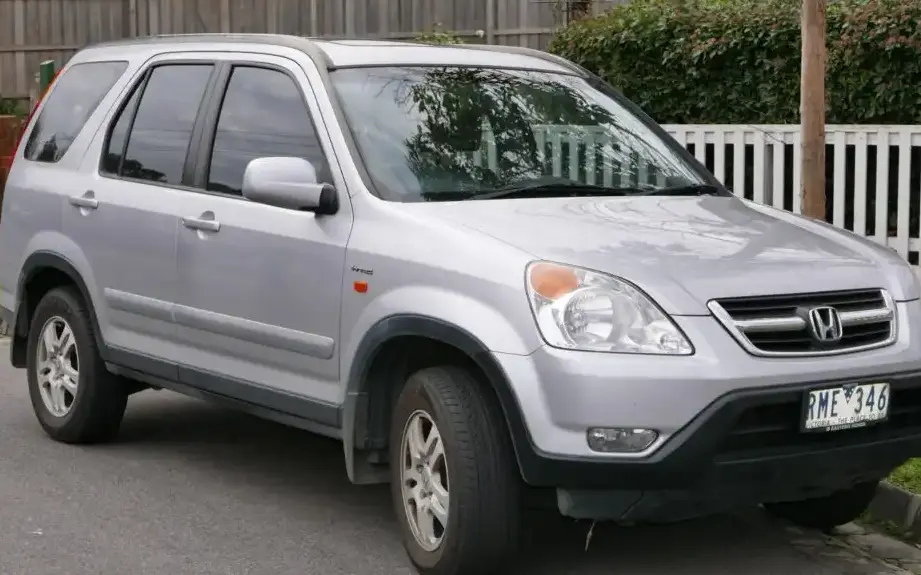
The Honda CR-V II, produced between 2002 and 2006, represented the second generation of Honda’s popular compact SUV. This generation, internally designated as the RD series, built upon the success of the first CR-V, offering increased space, refinement, and a more powerful engine option. The 2.0 16V (150 Hp) Automatic variant occupied a central position in the CR-V II lineup, providing a balance between performance, fuel economy, and affordability. It served as a key model for Honda in the North American market, where the CR-V quickly gained traction as a practical and reliable family vehicle.
Technical Specifications
| Brand | Honda |
| Model | CR-V |
| Generation | CR-V II |
| Type (Engine) | 2.0 16V (150 Hp) Automatic |
| Start of production | 2002 |
| End of production | 2006 |
| Powertrain Architecture | Internal Combustion engine |
| Body type | SUV |
| Seats | 5 |
| Doors | 5 |
| Fuel consumption (urban) | 12.2 l/100 km (19.3 US mpg) |
| Fuel consumption (extra urban) | 7.6 l/100 km (30.9 US mpg) |
| Fuel consumption (combined) | 9.9 l/100 km (23.8 US mpg) |
| Fuel Type | Petrol (Gasoline) |
| Acceleration 0 – 100 km/h | 11.9 sec |
| Acceleration 0 – 62 mph | 11.9 sec |
| Acceleration 0 – 60 mph | 11.3 sec |
| Maximum speed | 167 km/h (103.77 mph) |
| Weight-to-power ratio | 9.9 kg/Hp |
| Weight-to-torque ratio | 7.7 kg/Nm |
| Power | 150 Hp @ 5500 rpm |
| Torque | 192 Nm @ 4000 rpm (141.61 lb.-ft. @ 4000 rpm) |
| Engine layout | Front, Transverse |
| Engine Model/Code | K20A4 |
| Engine displacement | 1998 cm3 (121.93 cu. in.) |
| Number of cylinders | 4 |
| Engine configuration | Inline |
| Cylinder Bore | 86 mm (3.39 in.) |
| Piston Stroke | 86 mm (3.39 in.) |
| Compression ratio | 9.8:1 |
| Number of valves per cylinder | 4 |
| Fuel injection system | Multi-port manifold injection |
| Engine aspiration | Naturally aspirated engine |
| Valvetrain | DOHC |
| Engine oil capacity | 4.2 l (4.44 US qt | 3.7 UK qt) |
| Coolant capacity | 5.3 l (5.6 US qt | 4.66 UK qt) |
| Kerb Weight | 1485 kg (3273.86 lbs.) |
| Max. weight | 1910 kg (4210.83 lbs.) |
| Max load | 425 kg (936.96 lbs.) |
| Trunk (boot) space – minimum | 525 l (18.54 cu. ft.) |
| Trunk (boot) space – maximum | 952 l (33.62 cu. ft.) |
| Fuel tank capacity | 58 l (15.32 US gal | 12.76 UK gal) |
| Length | 4555 mm (179.33 in.) |
| Width | 1780 mm (70.08 in.) |
| Height | 1710 mm (67.32 in.) |
| Wheelbase | 2620 mm (103.15 in.) |
| Front track | 1533 mm (60.35 in.) |
| Rear (Back) track | 1538 mm (60.55 in.) |
| Drive wheel | All wheel drive (4×4) |
| Number of gears | 4 |
| Gearbox type | automatic transmission |
| Front suspension | Spring Strut |
| Rear suspension | Coil spring |
| Front brakes | Ventilated discs |
| Rear brakes | Disc |
| Assisting systems | ABS (Anti-lock braking system) |
| Steering type | Steering rack and pinion |
| Power steering | Hydraulic Steering |
| Tires size | 205/70 R15 |
| Wheel rims size | 6J x 15 |
Introduction
The 2.0 16V Automatic CR-V II, produced from 2002 to 2006, was a significant offering in Honda’s lineup. It was built on the 1HX0/A3 platform, shared with the Honda Stream and the Acura RSX. This generation of CR-V moved away from the more utilitarian styling of the first generation, adopting a more rounded and modern aesthetic. The 2.0L engine and automatic transmission combination was designed to appeal to buyers prioritizing ease of use and comfort over outright performance, making it a popular choice for families and commuters. It sat in the middle of the CR-V range, with the base model offering a slightly smaller engine and the higher trims featuring more luxurious appointments.
Powertrain & Engine Architecture
The heart of the CR-V II 2.0 16V Automatic is the K20A4 engine, a 1998cc inline-four cylinder powerplant. This engine utilizes a single overhead camshaft (SOHC) design for each cylinder bank, operating with four valves per cylinder (16V total). The K20A4 featured multi-point fuel injection, delivering fuel directly into the intake ports. This system, combined with a compression ratio of 9.8:1, allowed for a good balance of power and fuel efficiency. The engine produced 150 horsepower at 5500 rpm and 192 Nm (141.61 lb-ft) of torque at 4000 rpm. Paired with the engine was a four-speed automatic transmission, providing smooth and convenient gear changes. This transmission was designed for durability and reliability, prioritizing comfortable driving over sporty responsiveness. The transmission’s gear ratios were optimized for everyday driving conditions, with a focus on fuel economy and smooth acceleration.
Driving Characteristics
The 2.0L Automatic CR-V II offered a comfortable and predictable driving experience. While not particularly sporty, the engine provided adequate power for most driving situations. Acceleration from 0-60 mph took approximately 11.3 seconds, and the vehicle had a top speed of around 103.77 mph. The automatic transmission, while smooth, could feel somewhat sluggish during quick acceleration or when attempting to pass on the highway. Compared to the five-speed manual transmission option, the automatic resulted in a slight decrease in fuel economy and a less engaging driving experience. However, the automatic’s ease of use made it a more attractive option for many buyers, particularly those who frequently drove in congested traffic.
Equipment & Trim Levels
The 2.0 16V Automatic CR-V II typically came standard with features such as air conditioning, power windows and locks, a CD player, and an anti-lock braking system (ABS). Interior upholstery was typically cloth, with a relatively simple and functional dashboard layout. Optional extras included a sunroof, alloy wheels, and a premium sound system. Higher trim levels, such as the EX, added features like leather upholstery, heated front seats, and a more sophisticated audio system. The overall interior design prioritized practicality and durability over luxury, reflecting the CR-V’s intended role as a family-oriented vehicle.
Chassis & Braking
The CR-V II utilized a MacPherson strut front suspension and a multi-link coil spring rear suspension. This setup provided a comfortable ride quality, absorbing bumps and irregularities in the road effectively. The vehicle’s all-wheel-drive system, Honda’s Real Time 4WD, automatically engaged the rear wheels when it detected a loss of traction, enhancing stability and control in slippery conditions. Braking duties were handled by ventilated discs at the front and solid discs at the rear. The ABS system helped to prevent wheel lockup during hard braking, improving stopping distances and maintaining steering control.
Market Reception & Comparison
The 2.0 16V Automatic CR-V II was generally well-received by automotive critics. It was praised for its spacious interior, comfortable ride, and strong reliability. However, some reviewers noted that the engine could feel underpowered, particularly when fully loaded or driving uphill. Compared to other compact SUVs of the time, such as the Toyota RAV4 and the Subaru Forester, the CR-V offered a competitive combination of features, fuel economy, and reliability. The automatic transmission, while convenient, was often criticized for its lack of responsiveness compared to the manual transmission. Fuel economy was respectable for its class, averaging around 23.8 US mpg in combined driving.
Legacy
The K20A4 engine, when properly maintained, proved to be remarkably durable and reliable. The four-speed automatic transmission also demonstrated good longevity. Today, well-maintained CR-V II models with the 2.0L engine and automatic transmission can still be found on the used car market, often with relatively high mileage. These vehicles continue to appeal to buyers seeking a practical, affordable, and reliable SUV. Common maintenance issues include occasional oil leaks and the need to replace the catalytic converter. However, parts availability is generally good, and the CR-V II remains a popular choice for those seeking a dependable and versatile vehicle.