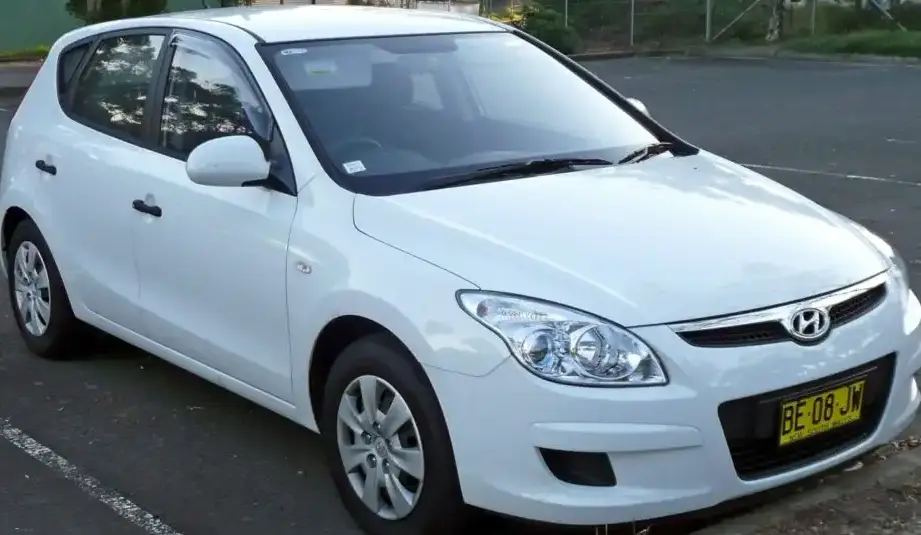
Technical Specifications
| Brand | Hyundai |
| Model | i30 |
| Generation | i30 III Fastback (facelift 2024) |
| Type (Engine) | 1.5 T-GDI (140 Hp) Mild Hybrid |
| Start of production | June, 2024 |
| Powertrain Architecture | MHEV (Mild Hybrid Electric Vehicle) |
| Body type | Fastback |
| Seats | 5 |
| Doors | 5 |
| Fuel consumption at Low speed (WLTP) | 7.6 l/100 km (30.9 US mpg) |
| Fuel consumption at Medium speed (WLTP) | 6.3 l/100 km (37.3 US mpg) |
| Fuel consumption at high speed (WLTP) | 5.6 l/100 km (42 US mpg) |
| Fuel consumption at very high speed (WLTP) | 6.6 l/100 km (35.6 US mpg) |
| Combined fuel consumption (WLTP) | 6.4 l/100 km (36.8 US mpg) |
| CO2 emissions (WLTP) | 144 g/km |
| Fuel Type | Petrol (Gasoline) |
| Acceleration 0 – 100 km/h | 9.8 sec |
| Acceleration 0 – 62 mph | 9.8 sec |
| Acceleration 0 – 60 mph | 9.3 sec |
| Maximum speed | 197 km/h (122.41 mph) |
| Emission standard | Euro 6e |
| Weight-to-power ratio | 9.3 kg/Hp |
| Weight-to-torque ratio | 5.1 kg/Nm |
| Battery voltage | 48 V |
| Power | 140 Hp @ 5500 rpm |
| Torque | 253 Nm @ 1500-3000 rpm (186.6 lb.-ft. @ 1500-3000 rpm) |
| Engine layout | Front, Transverse |
| Engine Model/Code | G4LK |
| Engine displacement | 1482 cm3 (90.44 cu. in.) |
| Number of cylinders | 4 |
| Engine configuration | Inline |
| Cylinder Bore | 71.6 mm (2.82 in.) |
| Piston Stroke | 92 mm (3.62 in.) |
| Compression ratio | 10.5:1 |
| Number of valves per cylinder | 4 |
| Fuel injection system | Direct injection |
| Engine aspiration | Turbocharger, Intercooler |
| Valvetrain | DOHC |
| Engine oil capacity | 4.2 l (4.44 US qt | 3.7 UK qt) |
| Coolant | 6.6 l (6.97 US qt | 5.81 UK qt) |
| Kerb Weight | 1300-1427 kg (2866.01 – 3146 lbs.) |
| Max. weight | 1850 kg (4078.55 lbs.) |
| Max load | 423-550 kg (932.56 – 1212.54 lbs.) |
| Trunk (boot) space – minimum | 450 l (15.89 cu. ft.) |
| Trunk (boot) space – maximum | 1351 l (47.71 cu. ft.) |
| Fuel tank capacity | 50 l (13.21 US gal | 11 UK gal) |
| Max. roof load | 80 kg (176.37 lbs.) |
| Permitted trailer load with brakes (12%) | 1010 kg (2226.67 lbs.) |
| Permitted trailer load without brakes | 510 kg (1124.36 lbs.) |
| Length | 4455 mm (175.39 in.) |
| Width | 1795 mm (70.67 in.) |
| Height | 1425 mm (56.1 in.) |
| Wheelbase | 2650 mm (104.33 in.) |
| Front track | 1555-1565 mm (61.22 – 61.61 in.) |
| Rear (Back) track | 1563-1576 mm (61.54 – 62.05 in.) |
| Front overhang | 905 mm (35.63 in.) |
| Rear overhang | 900 mm (35.43 in.) |
| Ride height (ground clearance) | 135 mm (5.31 in.) |
| Minimum turning circle (turning diameter) | 10.6 m (34.78 ft.) |
| Drivetrain Architecture | Front wheel drive. MHEV. ICE and electric motor drive the front wheels. |
| Drive wheel | Front wheel drive |
| Number of gears and type of gearbox | 6 gears, manual transmission |
| Front suspension | Independent type McPherson |
| Rear suspension | Independent multi-link suspension |
| Front brakes | Ventilated discs |
| Rear brakes | Disc |
| Assisting systems | ABS (Anti-lock braking system) |
| Steering type | Steering rack and pinion |
| Power steering | Electric Steering |
| Tires size | 205/55 R16; 225/45 R17; 225/40 R18 |
| Wheel rims size | 6.5J x 16; 7.0J x 17; 7.5J x 18 |
The Hyundai i30 III Fastback, specifically the 1.5 T-GDI (140 hp) Mild Hybrid variant introduced with the 2024 facelift, represents a key offering in Hyundai’s European and global compact car lineup. Production commenced in June 2024, building upon the established third-generation i30 (codenamed PD) which debuted in 2017. This Fastback body style, characterized by its sloping roofline, aims to provide a more dynamic and coupe-like aesthetic compared to the traditional five-door hatchback. The 1.5 T-GDI Mild Hybrid trim occupies a middle ground within the i30 range, balancing fuel efficiency with a reasonable level of performance, targeting buyers seeking a practical yet stylish daily driver.
Powertrain & Engine Architecture
The heart of this i30 variant is the Hyundai G4LK 1.5-liter turbocharged four-cylinder engine. This engine is part of Hyundai-Kia’s “Smartstream” engine family, designed for improved efficiency and reduced emissions. The G4LK utilizes direct injection, a single-scroll turbocharger, and an intercooler to deliver 140 horsepower at 5,500 rpm and 253 Nm (186.6 lb-ft) of torque between 1,500 and 3,000 rpm. The ‘Mild Hybrid’ designation indicates the inclusion of a 48V electrical system and a small electric motor/generator. This system assists the engine during acceleration, allowing for engine-off coasting and regenerative braking, contributing to fuel savings. The engine employs a Dual Continuously Variable Valve Timing (D-CVVT) system for optimized valve control. The engine is transversely mounted, driving the front wheels. The transmission is a 6-speed manual gearbox.
Driving Characteristics
The 1.5 T-GDI Mild Hybrid i30 Fastback offers a balanced driving experience. While not overtly sporty, the 140 hp engine provides adequate power for everyday driving situations. Acceleration from 0-60 mph takes approximately 9.3 seconds, and the car reaches a top speed of 197 km/h (122.41 mph). The turbocharger provides a noticeable boost in mid-range power, making overtaking maneuvers relatively effortless. The 6-speed manual transmission is well-matched to the engine’s characteristics, offering precise shifts. Compared to higher-output i30 variants, such as those with more powerful gasoline engines, this version prioritizes fuel economy over outright performance. The mild hybrid system is largely unobtrusive, providing a subtle boost during acceleration and contributing to smoother engine restarts.
Equipment & Trim Levels
The 1.5 T-GDI Mild Hybrid trim typically includes a generous level of standard equipment. This often encompasses features such as a touchscreen infotainment system with Apple CarPlay and Android Auto compatibility, a rearview camera, automatic headlights, air conditioning, and a suite of safety technologies including lane keeping assist, forward collision avoidance assist, and driver attention warning. Higher trim levels add features like a larger touchscreen, navigation system, heated seats, a panoramic sunroof, and premium audio system. Interior upholstery is typically cloth, with options for leather upgrades. The dashboard layout is modern and driver-focused, with a clean and intuitive design.
Chassis & Braking
The i30 Fastback utilizes a front independent McPherson strut suspension and a rear independent multi-link suspension. This setup provides a comfortable ride quality while maintaining good handling characteristics. Stabilizer bars are fitted to both the front and rear axles to reduce body roll during cornering. The braking system consists of ventilated discs at the front and solid discs at the rear, coupled with an Anti-lock Braking System (ABS). The steering is electrically assisted, providing a light and responsive feel.
Market Reception & Comparison
The Hyundai i30 III Fastback 1.5 T-GDI Mild Hybrid has been generally well-received by automotive critics. It’s praised for its fuel efficiency, comfortable ride, and well-equipped interior. Compared to other trims in the i30 lineup, this variant offers a compelling balance between cost and features. It provides better fuel economy than the more powerful gasoline engines, while offering a more engaging driving experience than the diesel options. Reliability has been generally good, with few reported issues specific to this powertrain.
Legacy
The G4LK 1.5 T-GDI engine has become a mainstay in Hyundai and Kia models, known for its reliability and efficiency. The mild hybrid system, while not as impactful as a full hybrid, contributes to reduced emissions and improved fuel economy. In the used car market, the i30 Fastback 1.5 T-GDI Mild Hybrid is expected to hold its value reasonably well, thanks to its practicality, fuel efficiency, and Hyundai’s reputation for build quality. Long-term reliability is anticipated to be good, provided the vehicle receives regular maintenance.