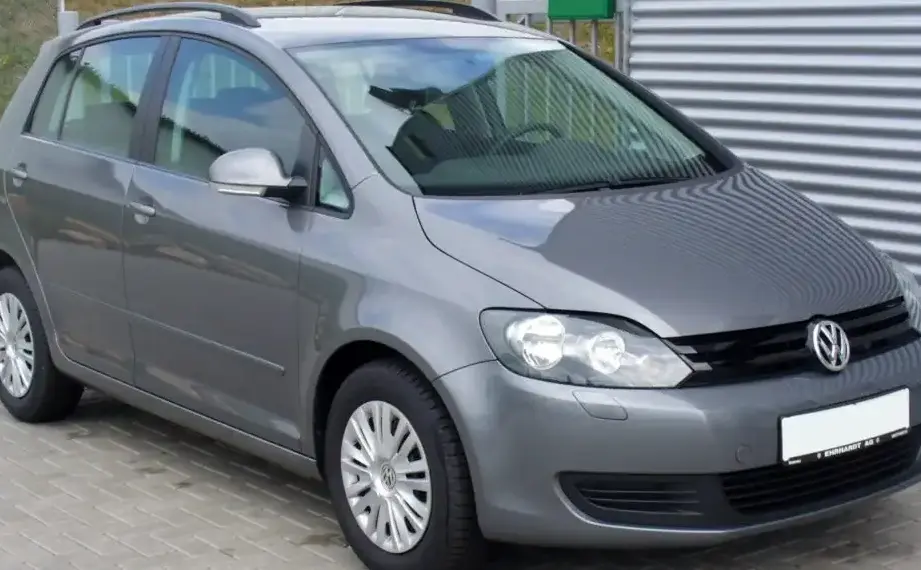
The Volkswagen Golf VI Plus 1.4 TSI (160 hp) DSG, produced from December 2008 to January 2014, represented a unique offering within the Golf VI range. Positioned as a compact MPV (Multi-Purpose Vehicle), the Golf Plus extended the standard Golf’s wheelbase and height, providing increased interior space and versatility. This variant, equipped with the 1.4-liter TSI engine and a 7-speed dual-clutch gearbox (DSG), aimed to balance fuel efficiency with respectable performance, targeting families and individuals seeking a practical yet refined vehicle. It was a key model in Volkswagen’s strategy to offer a broader range of body styles based on the popular Golf platform, primarily marketed in Europe.
Technical Specifications
| Brand | Volkswagen |
| Model | Golf |
| Generation | Golf VI Plus |
| Type (Engine) | 1.4 TSI (160 Hp) DSG |
| Start of production | December, 2008 |
| End of production | January, 2014 |
| Powertrain Architecture | Internal Combustion engine |
| Body type | Minivan |
| Seats | 5 |
| Doors | 5 |
| Fuel consumption (urban) | 7.9 l/100 km (29.8 US mpg, 35.8 UK mpg, 12.7 km/l) |
| Fuel consumption (extra urban) | 5.4 l/100 km (43.6 US mpg, 52.3 UK mpg, 18.5 km/l) |
| Fuel consumption (combined) | 6.3 l/100 km (37.3 US mpg, 44.8 UK mpg, 15.9 km/l) |
| Fuel Type | Petrol (Gasoline) |
| Acceleration 0 – 100 km/h | 8.5 sec |
| Acceleration 0 – 62 mph | 8.5 sec |
| Acceleration 0 – 60 mph | 8.1 sec |
| Maximum speed | 214 km/h (132.97 mph) |
| Weight-to-power ratio | 9.4 kg/Hp, 106.7 Hp/tonne |
| Weight-to-torque ratio | 6.2 kg/Nm, 160.1 Nm/tonne |
| Power | 160 Hp @ 5800 rpm |
| Power per litre | 115.1 Hp/l |
| Torque | 240 Nm @ 1500-4500 rpm (177.01 lb.-ft. @ 1500-4500 rpm) |
| Engine layout | Front, Transverse |
| Engine Model/Code | CAVD, CTHD, CTKA |
| Engine displacement | 1390 cm3 (84.82 cu. in.) |
| Number of cylinders | 4 |
| Engine configuration | Inline |
| Fuel injection system | Direct injection |
| Engine aspiration | Turbocharging and Supercharger, Intercooler |
| Engine oil capacity | 3.6 l (3.8 US qt | 3.17 UK qt) |
| Kerb Weight | 1499 kg (3304.73 lbs) |
| Max. weight | 2010 kg (4431.29 lbs) |
| Max load | 511 kg (1126.56 lbs) |
| Trunk (boot) space – minimum | 395 l (13.95 cu. ft.) |
| Trunk (boot) space – maximum | 1450 l (51.21 cu. ft.) |
| Fuel tank capacity | 55 l (14.53 US gal | 12.1 UK gal) |
| Length | 4204 mm (165.51 in) |
| Width | 1759 mm (69.25 in) |
| Height | 1592 mm (62.68 in) |
| Wheelbase | 2578 mm (101.5 in) |
| Front track | 1541 mm (60.67 in) |
| Rear (Back) track | 1517 mm (59.72 in) |
| Minimum turning circle | 10.8 m (35.43 ft) |
| Drivetrain Architecture | The Internal combustion engine (ICE) drives the front wheels of the vehicle. |
| Drive wheel | Front wheel drive |
| Number of gears and type of gearbox | 7 gears, automatic transmission DSG |
INTRODUCTION
The Golf VI Plus, launched in 2008, was Volkswagen’s attempt to capitalize on the growing demand for compact MPVs in Europe. Building upon the success of the Golf Mk6 (Golf VI), the Plus variant offered increased practicality through a longer wheelbase (+95mm) and a higher roofline (+95mm). This resulted in a more spacious cabin and a larger cargo area compared to the standard Golf hatchback. The 1.4 TSI 160 hp DSG model was a significant trim level, offering a balance between performance and economy, and was positioned as a mid-range option within the Plus lineup. It sat above the lower-powered diesel and petrol variants, but below the more expensive and performance-oriented trims.
Powertrain & Engine Architecture
The heart of the Golf VI Plus 1.4 TSI was the EA111 engine family, specifically the CAVD, CTHD, or CTKA engine code depending on the production year and market. This 1.4-liter inline-four engine was notable for its combination of turbocharging and supercharging – a relatively uncommon setup. The supercharger provided immediate boost at low engine speeds, eliminating turbo lag and improving responsiveness during initial acceleration. As engine speed increased, the turbocharger took over, delivering sustained power throughout the rev range. This dual-charging system, coupled with direct fuel injection, allowed the engine to produce 160 horsepower at 5800 rpm and 240 Nm (177 lb-ft) of torque between 1500 and 4500 rpm. The engine utilized a timing chain for durability. The DSG (Direct-Shift Gearbox) was a 7-speed dual-clutch transmission, offering quick and smooth gear changes, contributing to both performance and fuel efficiency. The DSG’s gear ratios were optimized for both acceleration and cruising, providing a comfortable driving experience.
Driving Characteristics
The 1.4 TSI 160 hp DSG variant of the Golf Plus offered a surprisingly lively driving experience. The combined effect of the turbo and supercharger resulted in strong low-end torque, making it easy to navigate city traffic and execute overtaking maneuvers. While not as overtly sporty as the Golf GTI, the Plus 1.4 TSI provided ample power for everyday driving. The DSG transmission shifted quickly and seamlessly, enhancing the overall driving experience. Compared to the 1.6-liter petrol or diesel variants, the 1.4 TSI offered significantly more performance. However, it didn’t quite match the punch of the more powerful 2.0-liter TSI engine found in higher-spec Golf Plus models. The longer wheelbase of the Plus, while improving interior space, did result in slightly less agile handling compared to the standard Golf hatchback.
Equipment & Trim Levels
The Golf VI Plus 1.4 TSI DSG typically came equipped with a reasonable level of standard features. These included air conditioning, electric front windows, power-adjustable mirrors, a CD/MP3 stereo system, and ABS brakes. Higher trim levels, often denoted by additions like “Trendline” or “Comfortline,” added features such as alloy wheels, automatic climate control, a multi-function steering wheel, and parking sensors. Optional extras included a panoramic sunroof, navigation system, and leather upholstery. Interior upholstery was typically cloth, with higher trims offering partial leather options. The dashboard layout was similar to the standard Golf VI, with a functional and ergonomic design.
Chassis & Braking
The Golf VI Plus utilized a MacPherson strut front suspension and a multi-link rear suspension, providing a comfortable and controlled ride. The suspension was tuned to prioritize comfort over outright sportiness, reflecting the vehicle’s role as a family-oriented MPV. Braking systems varied depending on the trim level and market. Base models typically featured disc brakes on the front wheels and drum brakes on the rear. Higher-spec models often included disc brakes all around. ABS (Anti-lock Braking System) was standard across the range. Stabilizer bars were fitted to both the front and rear axles to reduce body roll during cornering. The steering was a power-assisted rack and pinion system, providing precise and responsive steering feel.
Market Reception & Comparison
The Golf VI Plus 1.4 TSI DSG received generally positive reviews from automotive critics. It was praised for its spacious interior, versatile cargo area, and refined driving experience. The 1.4 TSI engine was lauded for its responsiveness and fuel efficiency, although some critics noted that it could feel strained when fully loaded. Compared to rivals such as the Renault Scenic and Citroën C4 Picasso, the Golf Plus was often seen as offering a more premium feel and a more engaging driving experience. Fuel economy figures of around 37.3 US mpg combined were competitive for the segment. Reliability was generally good, although some owners reported minor issues with the DSG transmission, particularly early production units.
Legacy
The Golf VI Plus 1.4 TSI DSG remains a relatively common sight on European roads today. The EA111 1.4 TSI engine, while known for its complexity, has proven to be reasonably durable with regular maintenance. The DSG transmission, if properly serviced, can also provide years of reliable operation. In the used car market, the Golf Plus 1.4 TSI DSG represents a good value proposition for buyers seeking a practical, fuel-efficient, and well-equipped compact MPV. However, potential buyers should be aware of the potential for DSG transmission issues and ensure that the vehicle has a full service history. The Golf Plus, and this variant in particular, demonstrated Volkswagen’s ability to adapt the successful Golf formula to meet changing consumer needs and preferences.