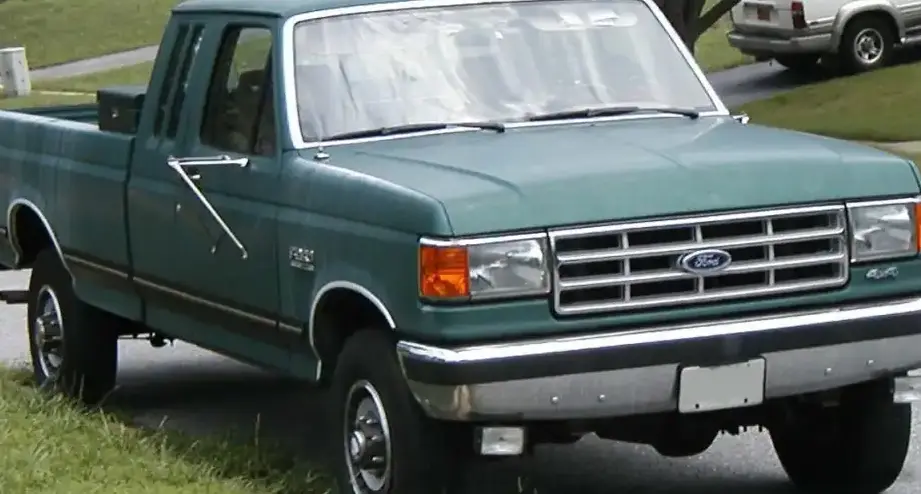
The Ford F-Series F-250 VIII SuperCab HD, equipped with the 7.5-liter 460 cubic inch V8 engine producing 230 horsepower and a four-wheel drive system, represents a significant iteration of Ford’s long-running and immensely popular F-Series pickup truck line. Produced from 1988 through 1991, this variant occupied a crucial position in the heavy-duty truck market, catering to buyers needing substantial towing and hauling capacity. It falls within the eighth generation (1987-1991) of the F-Series, known for its modernized styling and improved features compared to its predecessors. The “SuperCab” designation indicates an extended cab configuration, offering additional passenger space beyond the standard cab.
Technical Specifications
| Brand | Ford |
| Model | F-Series F-250 |
| Generation | F-Series F-250 VIII SuperCab HD |
| Type (Engine) | 7.5 460 V8 (230 Hp) 4×4 |
| Start of production | 1988 |
| End of production | 1991 |
| Powertrain Architecture | Internal Combustion engine |
| Body type | Pick-up |
| Seats | 6 |
| Doors | 2 |
| Fuel Type | Petrol (Gasoline) |
| Power | 230 Hp @ 3600 rpm |
| Power per litre | 30.5 Hp/l |
| Torque | 529 Nm @ 2200 rpm / 390.17 lb.-ft. @ 2200 rpm |
| Engine layout | Front, Longitudinal |
| Engine displacement | 7538 cm3 / 460 cu. in. |
| Number of cylinders | 8 |
| Engine configuration | V-engine |
| Piston Stroke | 97.79 mm / 3.85 in. |
| Compression ratio | 8.5:1 |
| Fuel injection system | Multi-port manifold injection |
| Engine aspiration | Naturally aspirated engine |
| Max. weight | 3992 kg / 8800.85 lbs |
| Fuel tank capacity | 141 l / 37.25 US gal | 31.02 UK gal |
| Length | 5895 mm / 232.09 in. |
| Width | 1778 mm / 70 in. |
| Height | 1956 mm / 77.01 in. |
| Wheelbase | 3937 mm / 155 in. |
| Wading depth | 914 mm / 35.98 in. |
| Drivetrain Architecture | The Internal combustion engine (ICE) drives the rear wheels permanently, and the front wheels are driven through an electrically or mechanically operated clutch if necessary. |
| Drive wheel | All wheel drive (4×4) |
| Number of gears and type of gearbox | 5 gears, manual transmission |
| Front suspension | Leaf spring |
| Rear suspension | Leaf spring |
| Front brakes | Disc |
| Rear brakes | Drum |
| Power steering | Electric Steering |
| Tires size | 235/85 R16 |
| Wheel rims size | 16 |
Powertrain & Engine Architecture
The heart of this F-250 is Ford’s 7.5-liter (460 cubic inch) 385-series V8 engine. This engine, designated internally as the 460, had been a mainstay of Ford’s truck and large car lineup for decades, undergoing numerous refinements over its lifespan. The 1988-1991 version featured multi-port fuel injection, a significant upgrade from the earlier carburetor setups, improving fuel efficiency and throttle response. The engine utilizes a cast iron block and cylinder heads, known for their durability. The valvetrain consists of a hydraulic lifter camshaft, contributing to quieter operation and reduced maintenance. The 230 horsepower output, while respectable for the time, was somewhat conservative compared to later iterations of the 460, reflecting increasing emissions regulations. The engine’s torque output of 390 lb-ft was the key to its capability, providing ample pulling power for heavy loads. The standard transmission for this model year was a five-speed manual, designed to handle the engine’s substantial torque.
Driving Characteristics
The F-250 with the 460 V8 and manual transmission offered a robust, work-oriented driving experience. Acceleration was adequate, but not particularly brisk, with the focus being on low-end torque for towing and hauling. The five-speed manual transmission provided a good range of gears, allowing the driver to keep the engine in its optimal power band. The gearing was relatively low, prioritizing pulling power over fuel economy. Compared to lighter-duty F-150 models, the F-250 felt considerably more substantial, with a firmer ride due to its heavier-duty suspension. While not a performance truck, the 460 V8 provided a satisfying rumble and a sense of confidence when tackling demanding tasks. The four-wheel drive system, engaged manually, provided enhanced traction in slippery conditions.
Equipment & Trim Levels
The F-250 SuperCab HD was positioned as a mid-range offering within the F-250 lineup. Standard equipment typically included a basic interior with vinyl upholstery, a functional dashboard layout, and manual windows and locks. The SuperCab configuration added a rear bench seat, increasing passenger capacity. Optional extras included air conditioning, an upgraded sound system, power windows and locks, and a tilt steering wheel. The exterior typically featured minimal chrome trim, reflecting its work-truck orientation. Buyers could choose from a range of paint colors, but the emphasis was on practicality rather than luxury.
Chassis & Braking
The F-250’s chassis was built for durability and heavy-duty use. It featured a robust ladder frame construction, designed to withstand significant stress. The front suspension utilized leaf springs, providing a firm and stable ride. The rear suspension also employed leaf springs, further enhancing load-carrying capacity. Braking duties were handled by disc brakes at the front and drum brakes at the rear. Power steering was standard, making maneuvering the large truck easier. The tires, typically 235/85R16, were designed for both on-road and off-road use, providing good traction in a variety of conditions.
Market Reception & Comparison
The 1988-1991 Ford F-250 SuperCab HD with the 460 V8 and manual transmission was well-received by buyers needing a capable and reliable heavy-duty truck. Critics praised its robust construction, ample towing capacity, and relatively simple mechanical design. Compared to the smaller F-150, the F-250 offered significantly greater payload and towing capacity. Compared to the diesel-powered F-250 models, the 460 V8 offered lower initial cost but typically lower fuel economy and less low-end torque. Reliability was generally good, although the 460 V8 was known to be somewhat thirsty and could be prone to overheating if not properly maintained.
Legacy
The Ford F-250 VIII SuperCab HD with the 460 V8 remains a popular choice among collectors and enthusiasts today. The 460 engine, while not the most fuel-efficient, is known for its durability and relatively simple maintenance requirements. Parts availability is generally good, making it easier to keep these trucks on the road. The SuperCab configuration adds to its appeal, providing a rare combination of work-truck capability and passenger space. Well-maintained examples command a reasonable price in the used car market, reflecting their enduring popularity and reputation for reliability. The 460 V8, while superseded by more modern engines, remains a beloved powerplant among Ford truck enthusiasts, representing a bygone era of American automotive engineering.