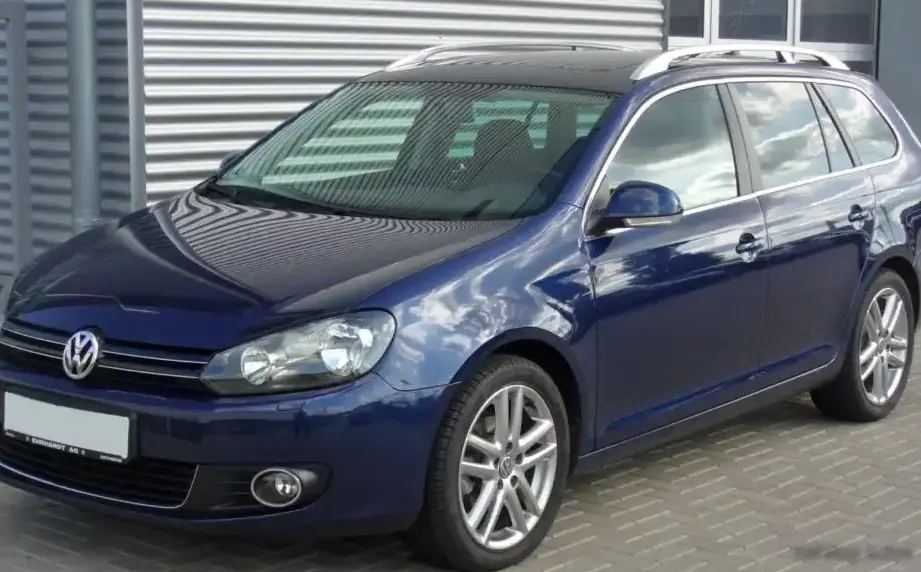
The Volkswagen Golf VI Variant 1.4 TSI (122 hp) DSG represents a compelling blend of practicality, efficiency, and technology within the sixth generation of Volkswagen’s iconic Golf lineup. Produced from 2009 to 2013, this variant – a station wagon (estate) – occupied a significant middle ground in the Golf VI range, offering a more spacious alternative to the hatchback while maintaining a focus on fuel economy and everyday usability. It was positioned as a family-oriented option, appealing to buyers who needed the extra cargo capacity without sacrificing the Golf’s renowned driving experience. This model is built on the A6 platform, also known as the PQ35 platform.
Technical Specifications
| Brand | Volkswagen |
| Model | Golf |
| Generation | Golf VI Variant |
| Type (Engine) | 1.4 TSI (122 Hp) DSG |
| Start of production | 2009 |
| End of production | 2013 |
| Powertrain Architecture | Internal Combustion engine |
| Body type | Station wagon (estate) |
| Seats | 5 |
| Doors | 5 |
| Fuel consumption (urban) | 7.7 l/100 km (30.5 US mpg) |
| Fuel consumption (extra urban) | 5.1 l/100 km (46.1 US mpg) |
| Fuel consumption (combined) | 6 l/100 km (39.2 US mpg) |
| CO2 emissions | 139 g/km |
| Fuel Type | Petrol (Gasoline) |
| Acceleration 0 – 100 km/h | 9.9 sec |
| Acceleration 0 – 62 mph | 9.9 sec |
| Acceleration 0 – 60 mph | 9.4 sec |
| Maximum speed | 201 km/h (124.9 mph) |
| Emission standard | Euro 5 |
| Weight-to-power ratio | 11.1 kg/Hp |
| Weight-to-torque ratio | 6.8 kg/Nm |
| Power | 122 Hp @ 5000 rpm |
| Torque | 200 Nm @ 1500-4000 rpm (147.51 lb.-ft.) |
| Engine layout | Front, Transverse |
| Engine Model/Code | CAXA |
| Engine displacement | 1390 cm3 (84.82 cu. in.) |
| Number of cylinders | 4 |
| Engine configuration | Inline |
| Cylinder Bore | 76.5 mm (3.01 in.) |
| Piston Stroke | 75.6 mm (2.98 in.) |
| Compression ratio | 10:1 |
| Number of valves per cylinder | 4 |
| Fuel injection system | Direct injection |
| Engine aspiration | Turbocharger, Intercooler |
| Valvetrain | DOHC |
| Engine oil capacity | 3.6 l (3.8 US qt | 3.17 UK qt) |
| Kerb Weight | 1351 kg (2978.45 lbs.) |
| Max. weight | 1970 kg (4343.11 lbs.) |
| Max load | 619 kg (1364.66 lbs.) |
| Trunk (boot) space – minimum | 505 l (17.83 cu. ft.) |
| Trunk (boot) space – maximum | 1495 l (52.8 cu. ft.) |
| Fuel tank capacity | 55 l (14.53 US gal | 12.1 UK gal) |
| Max. roof load | 75 kg (165.35 lbs.) |
| Permitted trailer load with brakes (8%) | 1600 kg (3527.4 lbs.) |
| Permitted trailer load with brakes (12%) | 1300 kg (2866.01 lbs.) |
| Permitted trailer load without brakes | 710 kg (1565.28 lbs.) |
| Permitted towbar download | 75 kg (165.35 lbs.) |
| Length | 4534 mm (178.5 in.) |
| Width | 1781 mm (70.12 in.) |
| Width including mirrors | 2003 mm (78.86 in.) |
| Height | 1504 mm (59.21 in.) |
| Wheelbase | 2578 mm (101.5 in.) |
| Front track | 1535 mm (60.43 in.) |
| Rear track | 1508 mm (59.37 in.) |
| Ride height (ground clearance) | 141 mm (5.55 in.) |
| Minimum turning circle | 10.9 m (35.76 ft.) |
| Drivetrain Architecture | Front wheel drive |
| Number of gears and type of gearbox | 7 gears, automatic transmission DSG |
| Front suspension | Independent type McPherson, Transverse stabilizer |
| Rear suspension | Independent multi-link suspension, Transverse stabilizer |
| Front brakes | Ventilated discs |
| Rear brakes | Disc |
| Assisting systems | ABS (Anti-lock braking system) |
| Steering type | Steering rack and pinion |
| Power steering | Electric Steering |
| Tires size | 205/55 R16; 225/45 R17 |
| Wheel rims size | 6.5J x 16; 7J x 17 |
Powertrain & Engine Architecture
At the heart of the Golf VI Variant 1.4 TSI DSG lies the CAXA engine code, a 1.4-liter turbocharged inline-four cylinder gasoline engine. This engine is a key example of Volkswagen’s TSI (Turbocharged Stratified Injection) technology. It utilizes direct fuel injection, delivering fuel directly into the combustion chamber for improved efficiency and power. The engine also features an intercooler to cool the intake air, further enhancing performance. The DOHC (Double Overhead Camshaft) valvetrain, with four valves per cylinder, optimizes gas flow for increased power output. The turbocharger provides a significant boost in power, allowing the relatively small engine to produce 122 horsepower and 200 Nm (147.51 lb.-ft.) of torque. The torque is readily available from as low as 1500 rpm, providing good responsiveness in everyday driving situations. The engine is transversely mounted, driving the front wheels. The dual-clutch gearbox (DSG) is a seven-speed automatic transmission. It offers quick and smooth gear changes, contributing to both performance and fuel efficiency.
Driving Characteristics
The 1.4 TSI with the DSG transmission delivers a balanced driving experience. While not overtly sporty, it provides adequate acceleration for most driving scenarios, achieving 0-60 mph in approximately 9.4 seconds. The DSG transmission is a highlight, offering seamless shifts and contributing to a refined feel. Compared to the manual transmission version, the DSG provides more convenience, especially in urban traffic. However, it may feel slightly less engaging for drivers who prefer more control. Compared to higher-output Golf VI variants, such as those with the 1.8 TSI or 2.0 TDI engines, the 1.4 TSI offers less outright performance. However, it compensates with superior fuel economy. The gear ratios in the DSG are optimized for both acceleration and fuel efficiency, providing a good balance between the two.
Equipment & Trim Levels
The Golf VI Variant 1.4 TSI DSG typically came equipped with a reasonable level of standard features. These included air conditioning, power windows, power mirrors, a CD stereo system, and alloy wheels. Safety features such as ABS, traction control, and multiple airbags were also standard. Higher trim levels offered additional features such as automatic climate control, a touchscreen infotainment system, parking sensors, and upgraded interior upholstery. Interior trim generally consisted of cloth upholstery, with options for leather available on higher-spec models. The dashboard layout was typical of the Golf VI, with a functional and ergonomic design.
Chassis & Braking
The Golf VI Variant 1.4 TSI DSG utilizes an independent McPherson strut suspension at the front and an independent multi-link suspension at the rear. This setup provides a comfortable ride and good handling characteristics. A transverse stabilizer bar is fitted to both the front and rear axles to reduce body roll during cornering. The braking system consists of ventilated discs at the front and solid discs at the rear. ABS (Anti-lock Braking System) is standard, providing enhanced braking performance and stability. The suspension and braking systems are tuned to suit the weight and power characteristics of the 1.4 TSI engine.
Market Reception & Comparison
The Golf VI Variant 1.4 TSI DSG was generally well-received by automotive critics. It was praised for its fuel efficiency, comfortable ride, and refined driving experience. However, some critics noted that the engine could feel a little strained when fully loaded or driving uphill. Compared to other Golf VI variants, the 1.4 TSI offered a good balance between price, performance, and fuel economy. The 1.8 TSI provided more power but at a higher cost, while the 2.0 TDI offered excellent fuel economy but with a diesel engine’s characteristic noise and vibration.
Legacy
The 1.4 TSI engine, particularly in the CAXA configuration, has proven to be relatively reliable, although some owners have reported issues with the turbocharger and direct injection system over the long term. The DSG transmission, while generally robust, requires regular maintenance (fluid changes) to ensure its longevity. Today, the Golf VI Variant 1.4 TSI DSG remains a popular choice in the used car market, offering a practical and efficient option for families and individuals alike. Its combination of space, fuel economy, and Volkswagen’s reputation for build quality ensures its continued appeal.