
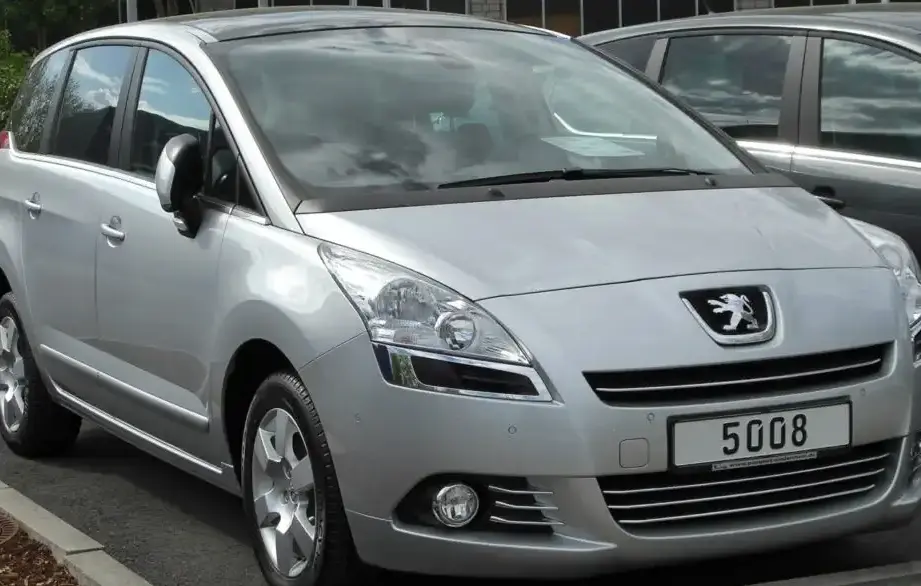
The Peugeot 5008, launched in 2009, represented Peugeot’s entry into the increasingly popular compact Multi-Purpose Vehicle (MPV) segment. The first generation, designated the 5008 I (Phase I), was produced from 2009 to 2013 and offered a practical and versatile option for families. Among the engine options available, the 1.6 HDi variant producing 112 horsepower with a Diesel Particulate Filter (FAP) and offered with seven seats, proved to be a popular choice, particularly in European markets. This configuration aimed to balance fuel efficiency with adequate performance for everyday driving needs.
Technical Specifications
| Brand | Peugeot |
| Model | 5008 |
| Generation | 5008 I (Phase I, 2009) |
| Type (Engine) | 1.6 HDi (112 Hp) FAP 7 seats |
| Start of production | 2009 |
| End of production | 2013 |
| Powertrain Architecture | Internal Combustion engine |
| Body type | MPV |
| Seats | 7 |
| Doors | 5 |
| Fuel consumption (urban) | 6.6 l/100 km (35.6 US mpg, 42.8 UK mpg, 15.2 km/l) |
| Fuel consumption (extra urban) | 4.9 l/100 km (48 US mpg, 57.6 UK mpg, 20.4 km/l) |
| Fuel consumption (combined) | 5.5 l/100 km (42.8 US mpg, 51.4 UK mpg, 18.2 km/l) |
| Fuel Type | Diesel |
| Acceleration 0 – 100 km/h | 12.9 sec |
| Acceleration 0 – 62 mph | 12.9 sec |
| Acceleration 0 – 60 mph | 12.3 sec |
| Maximum speed | 183 km/h (113.71 mph) |
| Emission standard | Euro 5 |
| Weight-to-power ratio | 13.4 kg/Hp, 74.6 Hp/tonne |
| Weight-to-torque ratio | 5.6 kg/Nm, 179.8 Nm/tonne |
| Power | 112 Hp @ 3600 rpm |
| Power per litre | 71.8 Hp/l |
| Torque | 270 Nm @ 1750 rpm (199.14 lb.-ft. @ 1750 rpm) |
| Engine layout | Front, Transverse |
| Engine Model/Code | 9HR DV6C |
| Engine displacement | 1560 cm3 (95.2 cu. in.) |
| Number of cylinders | 4 |
| Engine configuration | Inline |
| Number of valves per cylinder | 2 |
| Fuel injection system | Diesel Commonrail |
| Engine aspiration | Turbocharger, Intercooler |
| Engine oil capacity | 3.75 l (3.96 US qt, 3.3 UK qt) |
| Coolant capacity | 6 l (6.34 US qt, 5.28 UK qt) |
| Kerb Weight | 1502 kg (3311.34 lbs) |
| Max. weight | 2250 kg (4960.4 lbs) |
| Max load | 748 kg (1649.06 lbs) |
| Trunk (boot) space – minimum | 679 l (23.98 cu. ft.) |
| Trunk (boot) space – maximum | 1754 l (61.94 cu. ft.) |
| Fuel tank capacity | 60 l (15.85 US gal, 13.2 UK gal) |
| Length | 4529 mm (178.31 in.) |
| Width | 1888 mm (74.33 in.) |
| Height | 1622 mm (63.86 in.) |
| Wheelbase | 2727 mm (107.36 in.) |
| Minimum turning circle | 11.1 m (36.42 ft.) |
| Drivetrain Architecture | Front wheel drive |
| Number of gears | 6 gears, manual transmission |
| Front suspension | Independent type McPherson |
| Rear suspension | Semi-independent, coil spring |
| Front brakes | Ventilated discs |
| Rear brakes | Disc |
| Tires size | 215/55 R16; 215/50 R17 |
| Wheel rims size | 16; 17 |
Powertrain & Engine Architecture
The heart of this 5008 variant is the 1.6-liter HDi (High-Pressure Diesel Injection) engine, specifically the 9HR (DV6C) engine code. This engine is a four-cylinder, inline diesel utilizing a common rail direct injection system. The DV6 engine family was widely used across PSA Group (Peugeot-Citroën) vehicles, known for its relatively compact size and fuel efficiency. The turbocharger, coupled with an intercooler, helps to boost power output and improve combustion efficiency. The 112 horsepower peak is achieved at 3600 rpm, while the 270 Nm (199 lb-ft) of torque is available from as low as 1750 rpm, providing good low-end responsiveness. The engine is paired with a six-speed manual transmission, which was the standard offering for this trim level. The inclusion of a Diesel Particulate Filter (FAP) was crucial for meeting Euro 5 emission standards.
Driving Characteristics
The 1.6 HDi 112 hp engine, when paired with the six-speed manual transmission, offered a reasonable driving experience for the 5008. Acceleration was not particularly brisk, with a 0-60 mph time of around 12.3 seconds. However, the readily available torque made it suitable for everyday driving, including highway cruising and navigating urban environments. The gear ratios were well-spaced, allowing the engine to operate efficiently at various speeds. Compared to the more powerful 2.0 HDi variants, this engine prioritized fuel economy over outright performance. The manual transmission provided drivers with more control over gear selection, which could be beneficial when carrying a full load of passengers or luggage. It felt less strained than the engine when paired with the automatic transmission.
Equipment & Trim Levels
The 1.6 HDi 112 hp 7-seat version of the 5008 typically fell into the mid-range of the model lineup. Standard equipment generally included air conditioning, electric front windows, a CD stereo system, and ABS brakes. The seven-seat configuration was a key feature, making it a practical choice for larger families. Optional extras included alloy wheels, rear parking sensors, a panoramic sunroof, and a more advanced infotainment system. Interior upholstery was typically cloth, with a functional and durable design. Dashboard materials were generally of good quality for the price point, and the overall cabin layout was designed for practicality and ease of use.
Chassis & Braking
The 5008’s chassis featured an independent McPherson strut suspension at the front and a semi-independent coil spring suspension at the rear. This setup provided a comfortable ride quality, although it wasn’t particularly sporty. The front brakes were ventilated discs, while the rear brakes were solid discs, providing adequate stopping power for the vehicle’s weight. ABS (Anti-lock Braking System) was standard, enhancing safety during emergency braking situations. The steering utilized a rack and pinion system, offering reasonable precision and feedback.
Market Reception & Comparison
The Peugeot 5008 1.6 HDi 112 hp was well-received in European markets as a practical and fuel-efficient family vehicle. Critics praised its spacious interior, versatile seating configuration, and competitive fuel economy. Compared to the more powerful 2.0 HDi variants, this engine offered a lower purchase price and better fuel consumption, making it an attractive option for budget-conscious buyers. However, some reviewers noted that the engine could feel underpowered when fully loaded or driving uphill. The 1.6 HDi generally offered better fuel economy than the petrol engine options available at the time, but the petrol engines provided a smoother and more refined driving experience.
Legacy
The 1.6 HDi engine, in general, proved to be a reliable unit, although the Diesel Particulate Filter (FAP) could require periodic maintenance or replacement, particularly on vehicles primarily used for short journeys. The 5008 I (Phase I) remains a relatively affordable used car option today. The 1.6 HDi variant is often sought after for its fuel efficiency and practicality. While not the most exciting vehicle to drive, it provides a comfortable and reliable mode of transport for families. The engine’s longevity and relatively low maintenance costs contribute to its continued popularity in the used car market.
