
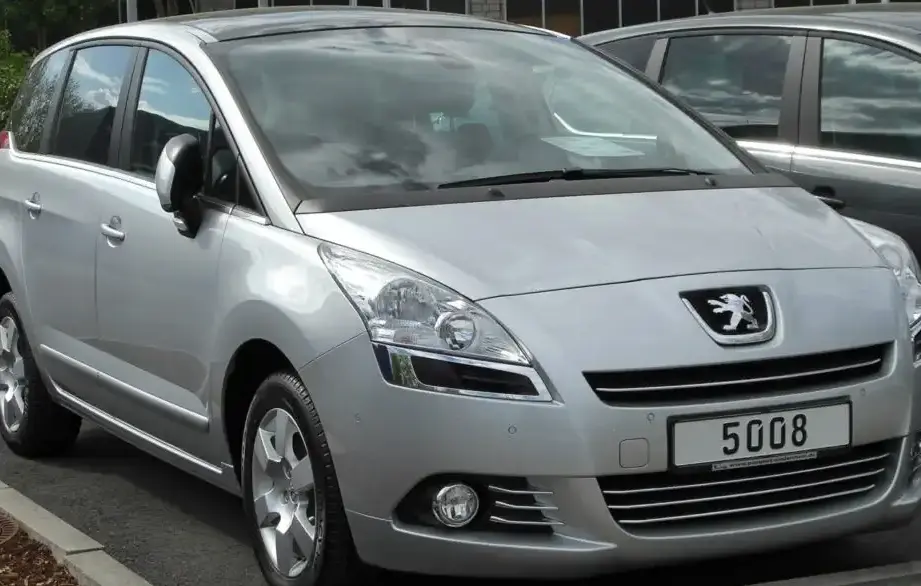
The Peugeot 5008, launched in 2009, represented Peugeot’s entry into the increasingly popular compact Multi-Purpose Vehicle (MPV) segment. The first generation, designated the 5008 I (Phase I), was produced from 2009 to 2013 and offered a practical and stylish alternative to traditional people carriers. Among the engine options available, the 1.6 THP (Turbo High Pressure) 156 horsepower variant with six-speed manual transmission and seven-seat configuration was a significant offering, positioned as a mid-range option balancing performance, fuel economy, and family practicality. This model aimed to appeal to buyers needing flexible seating and reasonable running costs.
Technical Specifications
| Brand | Peugeot |
| Model | 5008 |
| Generation | 5008 I (Phase I, 2009) |
| Type (Engine) | 1.6 THP (156 Hp) 7 seats |
| Start of production | 2009 |
| End of production | 2013 |
| Powertrain Architecture | Internal Combustion engine |
| Body type | MPV |
| Seats | 7 |
| Doors | 5 |
| Fuel consumption (urban) | 9.9 l/100 km (23.8 US mpg, 28.5 UK mpg, 10.1 km/l) |
| Fuel consumption (extra urban) | 5.8 l/100 km (40.6 US mpg, 48.7 UK mpg, 17.2 km/l) |
| Fuel consumption (combined) | 7.3 l/100 km (32.2 US mpg, 38.7 UK mpg, 13.7 km/l) |
| Fuel Type | Petrol (Gasoline) |
| Acceleration 0 – 100 km/h | 9.7 sec |
| Acceleration 0 – 62 mph | 9.7 sec |
| Acceleration 0 – 60 mph | 9.2 sec |
| Maximum speed | 195 km/h (121.17 mph) |
| Emission standard | Euro 5 |
| Weight-to-power ratio | 9.6 kg/Hp, 104.7 Hp/tonne |
| Weight-to-torque ratio | 6.2 kg/Nm, 161.1 Nm/tonne |
| Power | 156 Hp @ 5800 rpm |
| Power per litre | 97.6 Hp/l |
| Torque | 240 Nm @ 1400 rpm (177.01 lb.-ft. @ 1400 rpm) |
| Engine layout | Front, Transverse |
| Engine Model/Code | 5FV EP6CDT |
| Engine displacement | 1598 cm3 (97.52 cu. in.) |
| Number of cylinders | 4 |
| Engine configuration | Inline |
| Number of valves per cylinder | 4 |
| Fuel injection system | Direct injection |
| Engine aspiration | Turbocharger, Intercooler |
| Engine oil capacity | 4.25 l (4.49 US qt | 3.74 UK qt) |
| Coolant capacity | 6.4 l (6.76 US qt | 5.63 UK qt) |
| Kerb Weight | 1490 kg (3284.89 lbs.) |
| Max. weight | 2225 kg (4905.29 lbs.) |
| Max load | 735 kg (1620.4 lbs.) |
| Trunk (boot) space – minimum | 679 l (23.98 cu. ft.) |
| Trunk (boot) space – maximum | 1754 l (61.94 cu. ft.) |
| Fuel tank capacity | 60 l (15.85 US gal | 13.2 UK gal) |
| Length | 4529 mm (178.31 in.) |
| Width | 1888 mm (74.33 in.) |
| Height | 1622 mm (63.86 in.) |
| Wheelbase | 2727 mm (107.36 in.) |
| Minimum turning circle | 11.1 m (36.42 ft.) |
| Drivetrain Architecture | Front wheel drive |
| Number of gears | 6 gears, manual transmission |
| Front suspension | Independent type McPherson |
| Rear suspension | Semi-independent, coil spring |
| Front brakes | Ventilated discs |
| Rear brakes | Disc |
| Assisting systems | ABS (Anti-lock braking system) |
| Steering type | Steering rack and pinion |
| Tires size | 215/55 R16; 215/50 R17; 215/45 R18 |
| Wheel rims size | 16; 17; 18 |
Powertrain & Engine Architecture
The heart of this 5008 variant is the 5FV EP6CDT engine, a 1.6-liter turbocharged four-cylinder petrol engine. This engine is part of Peugeot and Citroën’s Prince engine family, developed in collaboration with BMW. The “THP” designation signifies Turbo High Pressure, indicating the use of a twin-scroll turbocharger for improved responsiveness and reduced turbo lag. Direct fuel injection is employed, delivering fuel directly into the combustion chamber for precise control and enhanced efficiency. The engine features a dual overhead camshaft (DOHC) valvetrain with four valves per cylinder, optimizing gas flow for increased power output. The six-speed manual transmission was the standard offering, providing drivers with full control over gear selection. The transmission’s ratios were tuned to balance acceleration with fuel economy, offering a comfortable driving experience for both urban and highway conditions.
Driving Characteristics
The 1.6 THP engine provided a noticeable step up in performance compared to the lower-powered naturally aspirated engines available in the 5008 range. With 156 horsepower and 240 Nm (177 lb-ft) of torque, the 5008 1.6 THP offered brisk acceleration, capable of reaching 60 mph in around 9.2 seconds. The turbocharger provided a strong mid-range punch, making overtaking maneuvers relatively effortless. However, it wasn’t a particularly sporty vehicle; the focus remained on practicality and comfort. The six-speed manual transmission allowed for precise gear changes, but the clutch pedal could feel slightly heavy during prolonged use. Compared to the diesel variants, the 1.6 THP offered a more responsive and refined driving experience, albeit with slightly higher fuel consumption.
Equipment & Trim Levels
The 1.6 THP 7-seat model typically came equipped with a reasonable level of standard features. These included air conditioning, electric front and rear windows, a CD stereo with auxiliary input, and ABS brakes. Higher trim levels, such as the Sportium or Allure, added features like alloy wheels, rear parking sensors, automatic headlights and wipers, and a more sophisticated infotainment system. Interior upholstery was typically cloth, with options for leather upgrades. The seven-seat configuration offered flexibility for families, with the third-row seats folding flat into the floor when not in use. Optional extras included a panoramic sunroof, satellite navigation, and a rear entertainment system.
Chassis & Braking
The 5008 I utilized a McPherson strut front suspension and a semi-independent coil spring rear suspension. This setup provided a comfortable ride quality, absorbing bumps and imperfections in the road surface effectively. The front brakes were ventilated discs, offering good stopping power, while the rear brakes were solid discs. ABS (Anti-lock Braking System) was standard, enhancing safety during emergency braking situations. The steering was a rack and pinion system, providing precise and responsive handling. The suspension was tuned for comfort rather than outright sportiness, prioritizing a smooth and stable ride for passengers.
Market Reception & Comparison
The Peugeot 5008 1.6 THP 7-seat variant was generally well-received by automotive critics. It was praised for its spacious interior, flexible seating, and refined engine. However, some reviewers noted that the fuel economy wasn’t as competitive as the diesel alternatives. Compared to the 1.6 HDi diesel models, the 1.6 THP offered a more engaging driving experience but at the cost of increased fuel consumption. The petrol engine also required more frequent servicing and was potentially more prone to long-term issues. Against competitors like the Renault Grand Scenic and Citroën C4 Grand Picasso, the 5008 offered a stylish and practical alternative, with a focus on driving enjoyment.
Legacy
The 1.6 THP engine, while offering good performance, has been known to exhibit some reliability issues, particularly related to carbon buildup on the intake valves. Regular servicing and the use of high-quality fuel are crucial for maintaining the engine’s health. The 5008 I, as a whole, has proven to be a relatively reliable vehicle, with many examples still on the road today. In the used car market, the 1.6 THP 7-seat variant represents a good value proposition for buyers seeking a spacious and practical MPV with a reasonably powerful engine. However, potential buyers should be aware of the potential engine issues and ensure a thorough inspection before purchase.
