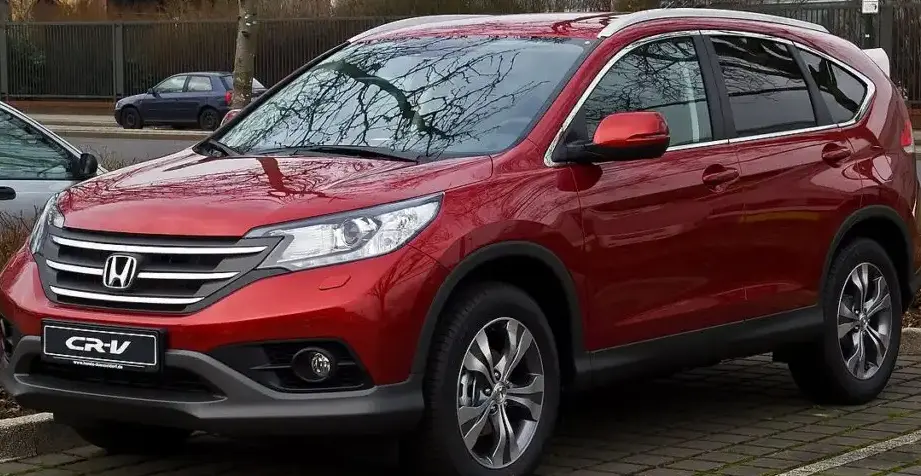
The Honda CR-V IV (facelift, introduced in September 2014 and produced through November 2016) represented a significant mid-cycle refresh of Honda’s popular compact SUV. This iteration of the fourth-generation CR-V, built on the 1HX0 platform, aimed to enhance both styling and efficiency while maintaining the model’s reputation for reliability and practicality. The 2.4 i-VTEC variant, equipped with a continuously variable transmission (CVT), was a key offering in the North American market, positioned as a mainstream choice balancing performance and fuel economy within the CR-V lineup. It sat above the base LX trim and below the more premium EX-L and Touring models.
Technical Specifications
| Brand | Honda |
| Model | CR-V |
| Generation | CR-V IV (facelift 2014) |
| Type (Engine) | 2.4 i-VTEC (185 Hp) CVT |
| Start of production | September, 2014 |
| End of production | November, 2016 |
| Powertrain Architecture | Internal Combustion engine |
| Body type | SUV |
| Seats | 5 |
| Doors | 5 |
| Fuel consumption (economy) – urban (EPA) | 8.7 l/100 km (27 US mpg, 32.5 UK mpg, 11.5 km/l) |
| Fuel consumption (economy) – extra urban (EPA) | 6.9 l/100 km (34.1 US mpg, 40.9 UK mpg, 14.5 km/l) |
| Fuel consumption (economy) – combined (EPA) | 8.1 l/100 km (29 US mpg, 34.9 UK mpg, 12.3 km/l) |
| Fuel Type | Petrol (Gasoline) |
| Emission standard | ULEV-2 |
| Weight-to-power ratio | 8.2 kg/Hp, 121.5 Hp/tonne |
| Weight-to-torque ratio | 6.2 kg/Nm, 160.9 Nm/tonne |
| Power | 185 Hp @ 6400 rpm |
| Power per litre | 78.5 Hp/l |
| Torque | 245 Nm @ 3900 rpm (180.7 lb.-ft. @ 3900 rpm) |
| Engine layout | Front, Transverse |
| Engine Model/Code | K24W9 |
| Engine displacement | 2356 cm3 (143.77 cu. in.) |
| Number of cylinders | 4 |
| Engine configuration | Inline |
| Cylinder Bore | 87 mm (3.43 in.) |
| Piston Stroke | 99.1 mm (3.9 in.) |
| Compression ratio | 11.1:1 |
| Number of valves per cylinder | 4 |
| Fuel injection system | Direct injection |
| Engine aspiration | Naturally aspirated engine |
| Valvetrain | DOHC, i-VTEC |
| Engine oil capacity | 4.4 l (4.65 US qt | 3.87 UK qt) |
| Coolant | 6.3 l (6.66 US qt | 5.54 UK qt) |
| Kerb Weight | 1523-1597 kg (3357.64 – 3520.78 lbs.) |
| Max. weight | 2025-2050 kg (4464.36 – 4519.48 lbs.) |
| Max load | 453-502 kg (998.69 – 1106.72 lbs.) |
| Trunk (boot) space – minimum | 997 l (35.21 cu. ft.) |
| Trunk (boot) space – maximum | 2008 l (70.91 cu. ft.) |
| Fuel tank capacity | 58 l (15.32 US gal | 12.76 UK gal) |
| Permitted trailer load with brakes (12%) | 680 kg (1499.14 lbs.) |
| Length | 4557 mm (179.41 in.) |
| Width | 1819 mm (71.61 in.) |
| Height | 1643 mm (64.69 in.) |
| Wheelbase | 2619 mm (103.11 in.) |
| Front track | 1577-1582 mm (62.09 – 62.28 in.) |
| Rear (Back) track | 1580-1582 mm (62.2 – 62.28 in.) |
| Ride height (ground clearance) | 163 mm (6.42 in.) |
| Minimum turning circle (turning diameter) | 11.4 m (37.4 ft.) |
| Drivetrain Architecture | The Internal combustion engine (ICE) drives the front wheels of the vehicle. |
| Drive wheel | Front wheel drive |
| Number of gears and type of gearbox | automatic transmission CVT |
| Front suspension | Independent, type McPherson with coil spring and anti-roll bar |
| Rear suspension | Double wishbone, Transverse stabilizer, Coil spring |
| Front brakes | Ventilated discs, 297 mm |
| Rear brakes | Disc, 305 mm |
| Assisting systems | ABS (Anti-lock braking system) |
| Steering type | Steering rack and pinion |
| Power steering | Electric Steering |
| Tires size | 215/70 R16; 225/65 R17; 225/60 R18 |
| Wheel rims size | 6.5J x 16; 7J x 17; 7J x 18 |
Powertrain & Engine Architecture
The heart of this CR-V variant is the K24W9 2.4-liter inline-four cylinder engine. This engine is a member of Honda’s K-series family, known for its reliability and relatively high output for its displacement. The K24W9 features Honda’s i-VTEC (intelligent Variable valve Timing and lift Electronic Control) system, which optimizes valve timing and lift based on engine speed and load, improving both fuel efficiency and performance. It utilizes direct fuel injection, further enhancing combustion efficiency and reducing emissions. The engine produces 185 horsepower at 6400 rpm and 245 Nm (180.7 lb-ft) of torque at 3900 rpm. The engine is transversely mounted in the front of the vehicle.
Paired with the K24W9 is a continuously variable transmission (CVT). Honda’s CVT, while offering smooth and stepless gear changes, was sometimes criticized for its “rubber band” feel and simulated shift points. However, it contributed significantly to the CR-V’s improved fuel economy compared to traditional automatic transmissions. The CVT is designed to keep the engine operating in its most efficient range, maximizing fuel savings.
Driving Characteristics
The 2.4L i-VTEC/CVT combination in the CR-V offered a comfortable and predictable driving experience. Acceleration was adequate for everyday driving, but not particularly sporty. The CVT’s programming prioritized fuel efficiency, resulting in a somewhat leisurely response to throttle inputs. Compared to the available six-speed manual transmission, the CVT felt less engaging, but it provided smoother operation and better fuel economy. Against higher-output CR-V trims, such as those with optional all-wheel drive, the front-wheel-drive 2.4L CVT model offered a lighter feel and slightly better fuel economy, but lacked the added traction and stability of the AWD system.
Equipment & Trim Levels
The 2.4 i-VTEC CVT CR-V typically came standard with features such as air conditioning, a rearview camera, Bluetooth connectivity, a 5-inch touchscreen display, and Honda’s LaneWatch blind spot display. Higher trim levels added features like leather upholstery, a power driver’s seat, a sunroof, and a more advanced infotainment system. Optional extras included navigation, premium audio systems, and various accessory packages.
Chassis & Braking
The CR-V IV utilized a MacPherson strut front suspension and a multi-link rear suspension, providing a comfortable ride and predictable handling. Front brakes were ventilated discs measuring 297mm, while rear brakes were solid discs measuring 305mm. All models were equipped with an Anti-lock Braking System (ABS). Stabilizer bars were fitted to both the front and rear suspensions to reduce body roll during cornering.
Market Reception & Comparison
The 2.4L i-VTEC CVT CR-V was generally well-received by critics as a practical and fuel-efficient compact SUV. However, some reviewers noted the CVT’s lack of responsiveness and the engine’s somewhat unrefined sound under hard acceleration. Compared to competitors like the Toyota RAV4 and Nissan Rogue, the CR-V offered a similar level of practicality and fuel economy, but was often praised for its spacious interior and Honda’s reputation for reliability. Fuel economy figures of 29 mpg combined were competitive for the segment.
Legacy
The K24W9 engine, when properly maintained, has proven to be a durable and reliable powerplant. The CVT, while sometimes requiring fluid changes and careful maintenance, has also demonstrated reasonable longevity. In the used car market, the 2014-2016 CR-V 2.4 i-VTEC CVT models are considered a good value, offering a blend of practicality, fuel efficiency, and Honda’s renowned reliability. Common issues reported by owners include occasional CVT hesitation and minor electrical glitches, but these are generally not major concerns.