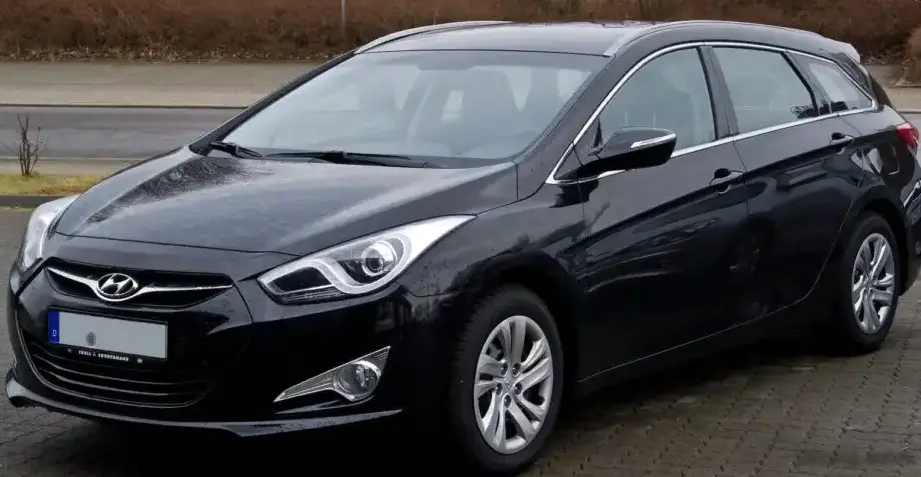
The Hyundai i40 Sedan 1.7 CRDi (116 hp) was a front-wheel-drive, four-door sedan produced by the South Korean automaker Hyundai from 2011 to 2015. Positioned as a mid-range offering within the i40 sedan lineup, it aimed to provide a balance of fuel efficiency, practicality, and affordability. The i40, designed primarily for the European market, represented Hyundai’s ambition to compete with established brands in the D-segment (mid-size) sedan class. This particular variant, with its 1.7-liter diesel engine and six-speed manual transmission, was a popular choice for drivers prioritizing economy and reasonable performance. It was part of the first generation of the i40, internally designated as the VF platform.
Technical Specifications
| Brand | Hyundai |
| Model | i40 |
| Generation | i40 Sedan |
| Type (Engine) | 1.7 CRDi (116 Hp) |
| Start of production | 2011 |
| End of production | 2015 |
| Powertrain Architecture | Internal Combustion engine |
| Body type | Sedan |
| Seats | 5 |
| Doors | 4 |
| Fuel consumption (urban) | 6 l/100 km (39.2 US mpg, 47.1 UK mpg, 16.7 km/l) |
| Fuel consumption (extra urban) | 5.4 l/100 km (43.6 US mpg, 52.3 UK mpg, 18.5 km/l) |
| Fuel consumption (combined) | 5 l/100 km (47 US mpg, 56.5 UK mpg, 20 km/l) |
| Fuel Type | Diesel |
| Acceleration 0 – 100 km/h | 12.3 sec |
| Acceleration 0 – 62 mph | 12.3 sec |
| Acceleration 0 – 60 mph | 11.7 sec |
| Maximum speed | 192 km/h (119.3 mph) |
| Emission standard | Euro 5 |
| Weight-to-power ratio | 12.8 kg/Hp, 78.1 Hp/tonne |
| Weight-to-torque ratio | 5.7 kg/Nm, 175.1 Nm/tonne |
| Power | 116 Hp @ 4000 rpm |
| Power per litre | 68.8 Hp/l |
| Torque | 260 Nm @ 1250-2750 rpm (191.77 lb.-ft. @ 1250-2750 rpm) |
| Engine layout | Front, Transverse |
| Engine Model/Code | U II / D4FD |
| Engine displacement | 1685 cm3 (102.83 cu. in.) |
| Number of cylinders | 4 |
| Engine configuration | Inline |
| Cylinder Bore | 77.2 mm (3.04 in.) |
| Piston Stroke | 90 mm (3.54 in.) |
| Compression ratio | 17:1 |
| Number of valves per cylinder | 4 |
| Fuel injection system | Diesel Commonrail |
| Engine aspiration | Turbocharger, Intercooler |
| Valvetrain | DOHC |
| Engine oil capacity | 5.3 l (5.6 US qt | 4.66 UK qt) |
| Coolant | 6.9 l (7.29 US qt | 6.07 UK qt) |
| Kerb Weight | 1485 kg (3273.86 lbs.) |
| Max. weight | 2120 kg (4673.8 lbs.) |
| Max load | 635 kg (1399.94 lbs.) |
| Trunk (boot) space – minimum | 525 l (18.54 cu. ft.) |
| Trunk (boot) space – maximum | 1672 l (59.05 cu. ft.) |
| Fuel tank capacity | 70 l (18.49 US gal | 15.4 UK gal) |
| Length | 4770 mm (187.8 in.) |
| Width | 1815 mm (71.46 in.) |
| Height | 1470 mm (57.87 in.) |
| Wheelbase | 2770 mm (109.06 in.) |
| Front track | 1591 mm (62.64 in.) |
| Rear (Back) track | 1597 mm (62.87 in.) |
| Minimum turning circle | 10.94 m (35.89 ft.) |
| Drivetrain Architecture | Front wheel drive |
| Number of gears | 6 gears, manual transmission |
| Front suspension | Independent type McPherson |
| Rear suspension | Independent coil spring |
| Front brakes | Ventilated discs |
| Rear brakes | Disc |
| Tires size | 205/60 R16; 215/50 R17; 225/45 R18 |
| Wheel rims size | 7.0J x 16; 7.5J x 17; 8.0J x 18 |
Powertrain & Engine Architecture
The heart of the i40 1.7 CRDi is the Hyundai D4FD engine, a 1.7-liter inline-four cylinder diesel. This engine utilizes a second-generation common-rail direct injection system, delivering fuel at extremely high pressures for optimized combustion. A turbocharger with an intercooler is employed to boost power and torque, mitigating turbo lag and improving responsiveness. The engine features a double overhead camshaft (DOHC) valvetrain with four valves per cylinder, enhancing volumetric efficiency. The engine’s design prioritized fuel efficiency and reduced emissions, meeting Euro 5 standards. The six-speed manual transmission was the standard offering for this variant, providing a good balance between fuel economy and driver control. The gear ratios were tuned for relaxed cruising and efficient acceleration.
Driving Characteristics
The 116 hp output of the 1.7 CRDi engine, coupled with 260 Nm (191.77 lb-ft) of torque, provided adequate performance for everyday driving. Acceleration from 0-60 mph took around 11.7 seconds, and top speed was approximately 119.3 mph. While not a particularly sporty configuration, the engine’s strong low-end torque made it well-suited for overtaking and navigating urban environments. Compared to higher-output versions of the i40, such as those equipped with the 1.6 GDI gasoline engine, the 1.7 CRDi offered significantly better fuel economy but lacked the same level of outright performance. The manual transmission allowed for precise gear selection, but the shift quality wasn’t considered particularly sporty. The focus was on smooth and comfortable operation.
Equipment & Trim Levels
The i40 1.7 CRDi typically came with a reasonable level of standard equipment. Base models included air conditioning, power windows, central locking, and a basic audio system. Higher trim levels, such as Style and Comfort, added features like alloy wheels, a touchscreen infotainment system, rear parking sensors, and climate control. Interior upholstery was typically cloth, with options for leather available on higher trims. Safety features included ABS, Electronic Stability Control (ESC), and multiple airbags. Optional extras included a panoramic sunroof, navigation system, and heated seats.
Chassis & Braking
The i40 Sedan featured a McPherson strut front suspension and an independent coil spring rear suspension. This setup provided a comfortable ride quality, absorbing bumps and irregularities in the road surface effectively. The front brakes were ventilated discs, while the rear brakes were solid discs. ABS (Anti-lock Braking System) was standard, enhancing braking performance and stability. The steering was electrically assisted, providing light and precise control. The suspension tuning was geared towards comfort rather than sporty handling.
Market Reception & Comparison
The Hyundai i40 1.7 CRDi was generally well-received by automotive critics for its fuel efficiency, spacious interior, and competitive pricing. It was often praised as a practical and sensible choice for families and commuters. Compared to rivals like the Ford Mondeo, Volkswagen Passat, and Toyota Avensis, the i40 offered a strong value proposition, often undercutting its competitors on price while providing a comparable level of equipment. However, some critics noted that the interior materials weren’t as premium as those found in some of its rivals, and the driving experience wasn’t particularly engaging. Fuel economy was a key strength, consistently achieving around 50 mpg in combined driving.
Legacy
The Hyundai i40 1.7 CRDi has proven to be a relatively reliable powertrain in the used car market. The D4FD engine is known for its durability, and with regular maintenance, it can provide many years of trouble-free service. Common issues are typically related to diesel particulate filter (DPF) clogging, particularly on vehicles that are primarily used for short journeys. The i40’s spacious interior and practical design continue to make it an appealing option for buyers seeking an affordable and reliable mid-size sedan. While it has been superseded by the newer Hyundai Sonata, the i40 remains a popular choice for those seeking a well-rounded and economical vehicle.