Technical Specifications
| Brand | Volkswagen |
| Model | Golf |
| Generation | Golf VII (3-door) |
| Type (Engine) | 1.2 TSI (105 Hp) DSG |
| Start of production | 2012 |
| End of production | 2014 |
| Powertrain Architecture | Internal Combustion engine |
| Body type | Hatchback |
| Seats | 5 |
| Doors | 3 |
| Fuel consumption (urban) | 5.8 l/100 km (40.6 US mpg, 48.7 UK mpg, 17.2 km/l) |
| Fuel consumption (extra urban) | 4.5 l/100 km (52.3 US mpg, 62.8 UK mpg, 22.2 km/l) |
| Fuel consumption (combined) | 5 l/100 km (47 US mpg, 56.5 UK mpg, 20 km/l) |
| CO2 emissions | 115 g/km |
| Fuel Type | Petrol (Gasoline) |
| Acceleration 0 – 100 km/h | 10.2 sec |
| Acceleration 0 – 62 mph | 10.2 sec |
| Acceleration 0 – 60 mph | 9.7 sec |
| Maximum speed | 192 km/h (119.3 mph) |
| Emission standard | Euro 5 |
| Weight-to-power ratio | 11 kg/Hp, 91 Hp/tonne |
| Weight-to-torque ratio | 6.6 kg/Nm, 151.6 Nm/tonne |
| Power | 105 Hp @ 5000 rpm |
| Power per litre | 87.7 Hp/l |
| Torque | 175 Nm @ 1550-4100 rpm (129.07 lb.-ft. @ 1550-4100 rpm) |
| Engine layout | Front, Transverse |
| Engine Model/Code | CJZA |
| Engine displacement | 1197 cm3 (73.05 cu. in.) |
| Number of cylinders | 4 |
| Engine configuration | Inline |
| Cylinder Bore | 71 mm (2.8 in.) |
| Piston Stroke | 75.6 mm (2.98 in.) |
| Compression ratio | 10.5:1 |
| Number of valves per cylinder | 2 |
| Fuel injection system | Direct injection |
| Engine aspiration | Turbocharger, Intercooler |
| Valvetrain | SOHC |
| Engine oil capacity | 4 l (4.23 US qt | 3.52 UK qt) |
| Kerb Weight | 1154 kg (2544.13 lbs.) |
| Max. weight | 1730 kg (3814 lbs.) |
| Max load | 576 kg (1269.86 lbs.) |
| Trunk (boot) space – minimum | 380 l (13.42 cu. ft.) |
| Trunk (boot) space – maximum | 1270 l (44.85 cu. ft.) |
| Fuel tank capacity | 50 l (13.21 US gal | 11 UK gal) |
| Max. roof load | 75 kg (165.35 lbs.) |
| Permitted trailer load with brakes (12%) | 1300 kg (2866.01 lbs.) |
| Permitted trailer load without brakes | 610 kg (1344.82 lbs.) |
| Permitted towbar download | 80 kg (176.37 lbs.) |
| Length | 4255 mm (167.52 in.) |
| Width | 1799 mm (70.83 in.) |
| Width including mirrors | 2027 mm (79.8 in.) |
| Height | 1452 mm (57.17 in.) |
| Wheelbase | 2637 mm (103.82 in.) |
| Front track | 1549 mm (60.98 in.) |
| Rear (Back) track | 1520 mm (59.84 in.) |
| Ride height (ground clearance) | 142 mm (5.59 in.) |
| Minimum turning circle | 10.9 m (35.76 ft.) |
| Drivetrain Architecture | Front wheel drive |
| Number of gears and type of gearbox | 7 gears, automatic transmission DSG |
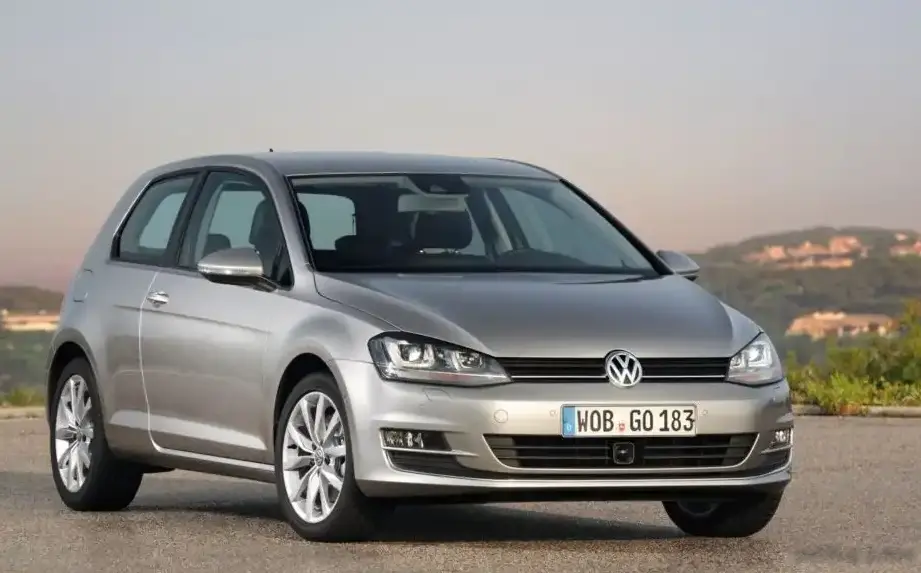
The Volkswagen Golf VII 1.2 TSI (105 hp) DSG, a three-door hatchback, was produced from 2012 to 2014. This variant occupied the entry-level position within the seventh-generation Golf lineup, offering a balance of fuel efficiency and practicality for the European market. It was built on the Volkswagen Group’s A7 platform (internally designated 5G), shared with models like the Audi A3 and SEAT Leon. The 1.2 TSI with the dual-clutch DSG transmission aimed to provide a more accessible Golf experience, appealing to buyers prioritizing economy and ease of driving over outright performance.
Powertrain & Engine Architecture
The heart of this Golf variant is the CJZA engine, a 1.2-liter turbocharged inline-four cylinder petrol engine. This engine is part of Volkswagen’s EA111 family, known for its compact size and efficiency. The CJZA utilizes direct fuel injection, delivering fuel directly into the combustion chamber for improved combustion efficiency and reduced emissions. A single overhead camshaft (SOHC) controls the two valves per cylinder. The turbocharger, coupled with an intercooler, provides a boost in power and torque, mitigating the typical power deficit associated with smaller displacement engines. The engine’s 175 Nm (129 lb-ft) of torque is available from a low 1550 rpm, contributing to good drivability in urban conditions. Paired with the engine is the 7-speed DSG (Direct-Shift Gearbox), a dual-clutch transmission that offers quick and smooth gear changes. The DSG automatically selects the optimal gear for the driving situation, enhancing both performance and fuel economy.
Driving Characteristics
The 105 hp output and the DSG transmission provide a competent, if not exhilarating, driving experience. Acceleration from 0-60 mph takes approximately 9.7 seconds, and top speed is rated at 119.3 mph. The DSG transmission is programmed for fuel efficiency, meaning it upshifts quickly to maintain lower engine speeds. This results in a slightly less responsive feel compared to the manual transmission versions or higher-powered Golf models. However, the DSG offers the convenience of automatic operation and the ability to manually shift gears using the selector lever or steering wheel-mounted paddles (depending on the specific configuration). The relatively low weight of the 1.2 TSI Golf contributes to decent handling, but it doesn’t possess the sporty dynamics of the GTI or R models. The gear ratios in the DSG are tuned for a balance between acceleration and fuel economy, prioritizing the latter.
Equipment & Trim Levels
The 1.2 TSI DSG typically came equipped with a reasonable level of standard features. These included air conditioning, electric front windows, a basic audio system with USB connectivity, and alloy wheels. Safety features such as ABS, ESP (Electronic Stability Program), and multiple airbags were standard. Higher trim levels, such as Trendline or Comfortline, added features like cruise control, parking sensors, a multi-function steering wheel, and upgraded upholstery. Optional extras included a panoramic sunroof, navigation system, and more advanced audio systems. Interior upholstery was typically cloth, with a functional and durable design. The dashboard layout was typical of the Golf VII, with a clean and modern aesthetic.
Chassis & Braking
The Golf VII 1.2 TSI utilized an independent McPherson strut suspension at the front, providing a comfortable ride and predictable handling. The rear suspension employed a torsion beam setup, which is a cost-effective and space-saving solution. Braking duties were handled by ventilated discs at the front and solid discs at the rear. The braking system was assisted by ABS and ESP, enhancing safety and stability. The steering system was an electric power steering setup, offering light and precise steering feel. The 1.2 TSI models generally featured smaller wheels and tires (typically 195/65 R15) compared to higher-performance variants, contributing to a more comfortable ride but less grip.
Market Reception & Comparison
The Golf VII 1.2 TSI DSG was generally well-received by automotive critics as a practical and economical choice. It was praised for its fuel efficiency, comfortable ride, and the convenience of the DSG transmission. However, some reviewers noted that the engine lacked the punch of larger displacement engines, and the driving experience wasn’t particularly engaging. Compared to the 1.4 TSI or 2.0 TDI models, the 1.2 TSI offered lower performance but superior fuel economy. The 1.4 TSI provided a noticeable power increase, while the 2.0 TDI offered even greater torque and fuel efficiency, albeit with a diesel engine’s characteristic noise and vibration. In terms of reliability, the 1.2 TSI engine proved generally reliable, although some owners reported issues with the turbocharger and direct injection system over the long term.
Legacy
The Volkswagen Golf VII 1.2 TSI DSG remains a popular choice in the used car market, particularly for buyers seeking an affordable and fuel-efficient hatchback. The CJZA engine, while not known for its high performance, has proven to be reasonably durable with proper maintenance. The DSG transmission, if serviced regularly, is also generally reliable. However, potential buyers should be aware of the potential for issues with the turbocharger and direct injection system. The Golf VII’s reputation for build quality and practicality ensures continued demand for this variant, making it a sensible and economical option for everyday transportation.