
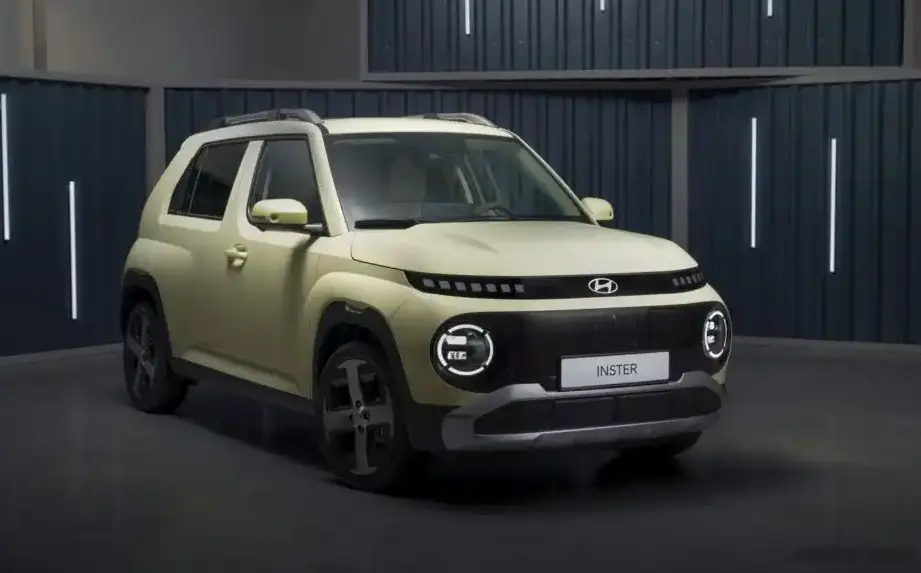
The Hyundai Inster Standard Range, equipped with a 42 kWh battery and a 97 horsepower electric motor, represents Hyundai’s entry into the rapidly expanding subcompact electric vehicle (EV) market. Introduced in June 2024, the Inster is primarily targeted at European consumers seeking an affordable and practical electric hatchback. It slots below the Kona Electric in Hyundai’s lineup, offering a more accessible price point for first-time EV buyers. The Inster utilizes Hyundai’s all-electric vehicle (BEV) architecture and is built on a dedicated EV platform, emphasizing efficiency and space optimization within its compact dimensions.
Technical Specifications
| Brand | Hyundai |
| Model | Inster |
| Generation | Inster |
| Type (Engine) | Standard Range 42 kWh (97 Hp) Electric |
| Start of production | June, 2024 |
| Powertrain Architecture | BEV (Electric Vehicle) |
| Body type | Hatchback |
| Seats | 4 |
| Doors | 5 |
| Fuel Type | Electricity |
| Acceleration 0 – 100 km/h | 11.7 sec |
| Acceleration 0 – 62 mph | 11.7 sec |
| Acceleration 0 – 60 mph | 11.1 sec |
| Maximum speed | 140 km/h (86.99 mph) |
| Gross battery capacity | 42 kWh |
| Battery technology | Lithium nickel manganese cobalt oxides (Li-NMC) |
| Battery location | Below the floor |
| All-electric range (WLTP) | 300 km (186.41 mi) |
| Electric motor power | 97 Hp |
| Electric motor location | Front axle, Transverse |
| Electric motor type | Synchronous |
| System power | 97 Hp |
| Trunk (boot) space – minimum | 280-351 l (9.89 – 12.4 cu. ft.) |
| Length | 3825 mm (150.59 in.) |
| Width | 1610 mm (63.39 in.) |
| Height | 1575 mm (62.01 in.) |
| Wheelbase | 2580 mm (101.57 in.) |
| Drivetrain Architecture | One electric motor drives the front wheels. |
| Drive wheel | Front wheel drive |
| Number of gears and type of gearbox | 1 gears, automatic transmission |
| Assisting systems | ABS (Anti-lock braking system) |
| Steering type | Steering rack and pinion |
| Power steering | Electric Steering |
| Tires size | 205/45 R17 |
| Wheel rims size | 17 |
Powertrain & Engine Architecture
The Hyundai Inster Standard Range utilizes a single synchronous electric motor positioned transversely on the front axle. This motor produces 97 horsepower and delivers instant torque characteristic of electric powertrains. The 42 kWh lithium nickel manganese cobalt oxide (Li-NMC) battery pack is located under the vehicle floor, contributing to a low center of gravity and maximizing interior space. The Inster employs a single-speed automatic transmission, simplifying the driving experience and focusing on efficient power delivery. The charging system supports both AC and DC fast charging, allowing for convenient replenishment of the battery at home or public charging stations. The vehicle’s electronic control unit (ECU) manages the motor, battery, and charging systems, optimizing performance and efficiency based on driving conditions.
Driving Characteristics
The Inster Standard Range offers a comfortable and practical driving experience, prioritizing efficiency over outright performance. Acceleration from 0 to 100 km/h takes approximately 11.7 seconds, making it suitable for urban and suburban commuting. The single-speed automatic transmission provides seamless acceleration, and the instant torque of the electric motor ensures responsive performance in everyday driving situations. While not designed for spirited driving, the Inster delivers adequate power for merging onto highways and navigating traffic. The low center of gravity, thanks to the underfloor battery pack, contributes to stable handling. The regenerative braking system allows for one-pedal driving in certain conditions, enhancing efficiency and driver convenience.
Equipment & Trim Levels
The Inster Standard Range is positioned as the entry-level trim, focusing on providing essential features at an affordable price. Standard equipment typically includes air conditioning, a touchscreen infotainment system with smartphone integration (Apple CarPlay and Android Auto), power windows, and central locking. Safety features such as ABS, electronic stability control, and multiple airbags are also standard. Interior upholstery is typically cloth, and the dashboard features a functional, minimalist design. Optional extras may include alloy wheels, a larger touchscreen display, and advanced driver-assistance systems (ADAS) such as lane keeping assist and automatic emergency braking, depending on regional specifications.
Chassis & Braking
The Inster’s chassis is designed to maximize space efficiency and provide a comfortable ride. It utilizes a MacPherson strut front suspension and a torsion beam rear suspension. The braking system features disc brakes on the front wheels and drum brakes on the rear wheels, providing adequate stopping power for the vehicle’s weight and performance. Electric power steering provides light and precise steering feel. The Inster rides on 17-inch alloy wheels with 205/45 R17 tires, offering a balance of comfort and grip. The vehicle’s relatively low weight contributes to improved handling and efficiency.
Market Reception & Comparison
The Hyundai Inster Standard Range has been generally well-received by critics as an affordable and practical EV option. Its competitive pricing and decent range make it an attractive choice for budget-conscious buyers. Compared to other entry-level EVs, the Inster offers a good balance of features and performance. Its range of 300 km (186 miles) on the WLTP cycle is competitive within its segment. Fuel economy, expressed as energy consumption, is significantly better than comparable gasoline-powered vehicles. Reliability is expected to be good, based on Hyundai’s reputation for building durable vehicles. However, some critics have noted that the Inster’s acceleration is not particularly brisk, and its interior materials are relatively basic.
Legacy
As a relatively new model, the long-term reliability of the Hyundai Inster Standard Range remains to be seen. However, Hyundai’s electric powertrain technology has proven to be reliable in other models, such as the Kona Electric. The Inster’s Li-NMC battery pack is expected to provide years of reliable service, although battery degradation over time is a factor to consider. In the used car market, the Inster is likely to appeal to buyers seeking an affordable and efficient electric vehicle for urban commuting. Its compact size and practical features make it well-suited for city driving. The Inster represents Hyundai’s commitment to expanding access to electric mobility and accelerating the transition to a sustainable transportation future.
