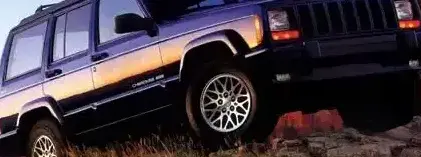
The Jeep Cherokee II (XJ), produced from 1984 to 2001, represented a significant departure from its full-sized predecessor, offering a more compact and efficient SUV option. The 5-door variant, particularly those equipped with the 4.0-liter inline-six engine producing 184 horsepower, became a popular choice for American drivers seeking a capable and versatile vehicle. Production of this specific configuration ran from 1991 to 1996, falling within the later years of the XJ generation. This model occupied a mid-range position within the Cherokee lineup, offering a balance between affordability and performance, slotting above the base 2.5-liter four-cylinder models and below the higher-trim levels with more luxurious features.
Technical Specifications
| Brand | Jeep |
| Model | Cherokee |
| Generation | Cherokee II (XJ) 5-door |
| Type (Engine) | 4.0 i (184 Hp) |
| Start of production | 1991 year |
| End of production | 1996 year |
| Powertrain Architecture | Internal Combustion engine |
| Body type | SUV |
| Seats | 5 |
| Doors | 5 |
| Fuel consumption (economy) – combined | 12.8 l/100 km |
| Fuel consumption (economy) – combined | 18.4 US mpg |
| Fuel consumption (economy) – combined | 22.1 UK mpg |
| Fuel consumption (economy) – combined | 7.8 km/l |
| Fuel Type | Petrol (Gasoline) |
| Acceleration 0 – 100 km/h | 10.1 sec |
| Acceleration 0 – 62 mph | 10.1 sec |
| Acceleration 0 – 60 mph | 9.6 sec |
| Maximum speed | 180 km/h |
| Maximum speed | 111.85 mph |
| Weight-to-power ratio | 8.3 kg/Hp |
| Weight-to-power ratio | 120.3 Hp/tonne |
| Weight-to-torque ratio | 5.3 kg/Nm |
| Weight-to-torque ratio | 189.5 Nm/tonne |
| Power | 184 Hp @ 4750 rpm |
| Power per litre | 46.4 Hp/l |
| Torque | 290 Nm @ 3950 rpm |
| Torque | 213.89 lb.-ft. @ 3950 rpm |
| Engine layout | Front, Longitudinal |
| Engine Model/Code | MX |
| Engine displacement | 3964 cm3 |
| Engine displacement | 241.9 cu. in. |
| Number of cylinders | 6 |
| Engine configuration | Inline |
| Cylinder Bore | 98.5 mm |
| Cylinder Bore | 3.88 in. |
| Piston Stroke | 86.7 mm |
| Piston Stroke | 3.41 in. |
| Compression ratio | 8.8:1 |
| Number of valves per cylinder | 2 |
| Fuel injection system | Multi-port manifold injection |
| Engine aspiration | Naturally aspirated engine |
| Engine oil capacity | 5.7 l |
| Engine oil capacity | 6.02 US qt | 5.02 UK qt |
| Coolant | 11.4 l |
| Coolant | 12.05 US qt | 10.03 UK qt |
| Kerb Weight | 1530 kg |
| Kerb Weight | 3373.07 lbs. |
| Max. weight | 2210 kg |
| Max. weight | 4872.22 lbs. |
| Max load | 680 kg |
| Max load | 1499.14 lbs. |
| Trunk (boot) space – minimum | 1011 l |
| Trunk (boot) space – minimum | 35.7 cu. ft. |
| Trunk (boot) space – maximum | 2033 l |
| Trunk (boot) space – maximum | 71.79 cu. ft. |
| Fuel tank capacity | 76 l |
| Fuel tank capacity | 20.08 US gal | 16.72 UK gal |
| Length | 4288 mm |
| Length | 168.82 in. |
| Width | 1790 mm |
| Width | 70.47 in. |
| Height | 1630 mm |
| Height | 64.17 in. |
| Wheelbase | 2576 mm |
| Wheelbase | 101.42 in. |
| Front track | 1473 mm |
| Front track | 57.99 in. |
| Rear (Back) track | 1473 mm |
| Rear (Back) track | 57.99 in. |
| Drive wheel | All wheel drive (4×4) |
| Number of gears and type of gearbox | 5 gears, manual transmission |
| Front suspension | Coil spring |
| Rear suspension | Leaf spring |
| Front brakes | Ventilated discs |
| Rear brakes | Drum |
| Assisting systems | ABS (Anti-lock braking system) |
| Power steering | Hydraulic Steering |
| Tires size | 225/70 R15 T |
Powertrain & Engine Architecture
The heart of this Cherokee variant is the 4.0-liter (3964 cc) inline-six cylinder engine, designated the MX code. This engine, a mainstay of Jeep vehicles for decades, is known for its durability and relatively simple design. It features a cast iron block and cylinder head, a 8.8:1 compression ratio, and a multi-port fuel injection system. The valvetrain utilizes two valves per cylinder, operated by a single overhead camshaft. The 4.0L engine delivers a respectable 184 horsepower at 4750 rpm and 290 Nm (213.89 lb-ft) of torque at 3950 rpm. The engine is longitudinally mounted in the chassis, driving all four wheels through a 5-speed manual transmission. While an automatic transmission was available, the manual offered a more direct connection to the engine’s power.
Driving Characteristics
The 184 hp 4.0L engine, paired with the 5-speed manual transmission, provided a reasonably spirited driving experience for the Cherokee II. Acceleration from 0-60 mph took approximately 9.6 seconds, and top speed was around 111.85 mph. While not a sports car, the engine’s torque output made it capable of handling everyday driving situations and even moderate off-road conditions with ease. The manual transmission allowed drivers to maintain control over gear selection, maximizing engine braking and providing a more engaging driving experience compared to the automatic option. The gear ratios were well-suited for both on-road cruising and low-speed off-road crawling.
Equipment & Trim Levels
The 1991-1996 Cherokee II 4.0L typically came standard with features like air conditioning, a basic AM/FM radio, cloth upholstery, and manual windows and locks. Power steering and anti-lock brakes (ABS) were also commonly included. Optional extras included a cassette player, upgraded sound system, cruise control, and a sunroof. Interior trim levels varied, with higher trims offering more comfortable seating and upgraded interior materials. The exterior often featured black plastic cladding around the lower body panels, a hallmark of the XJ Cherokee’s rugged aesthetic.
Chassis & Braking
The Cherokee II utilized a body-on-frame construction, providing a robust and durable platform. The front suspension consisted of coil springs, while the rear suspension employed leaf springs – a traditional setup for trucks and SUVs of the era. This configuration provided a comfortable ride quality, although it wasn’t as refined as more modern independent suspension systems. Braking duties were handled by ventilated discs at the front and drum brakes at the rear. The ABS system helped to improve braking performance and stability, particularly on slippery surfaces.
Market Reception & Comparison
The Cherokee II 4.0L was generally well-received by automotive critics and consumers alike. It was praised for its ruggedness, reliability, and off-road capability. Compared to the base 2.5-liter models, the 4.0L offered a significant performance boost, making it a more desirable option for those who needed extra power for towing or off-road adventures. Fuel economy, however, was a notable drawback, averaging around 18.4 US mpg. The 4.0L was also more expensive to maintain than the smaller engine, due to its larger displacement and more complex components.
Legacy
The Jeep Cherokee II, particularly the 4.0L variants, has developed a strong following among enthusiasts. The 4.0L inline-six engine is renowned for its longevity and relatively simple maintenance requirements. Today, well-maintained examples of the Cherokee II 4.0L are sought after by collectors and off-road enthusiasts. While age and mileage can present challenges, the robust construction and readily available parts supply ensure that these vehicles can continue to provide years of reliable service. The Cherokee II remains a popular choice for those seeking a classic, capable, and affordable SUV.