
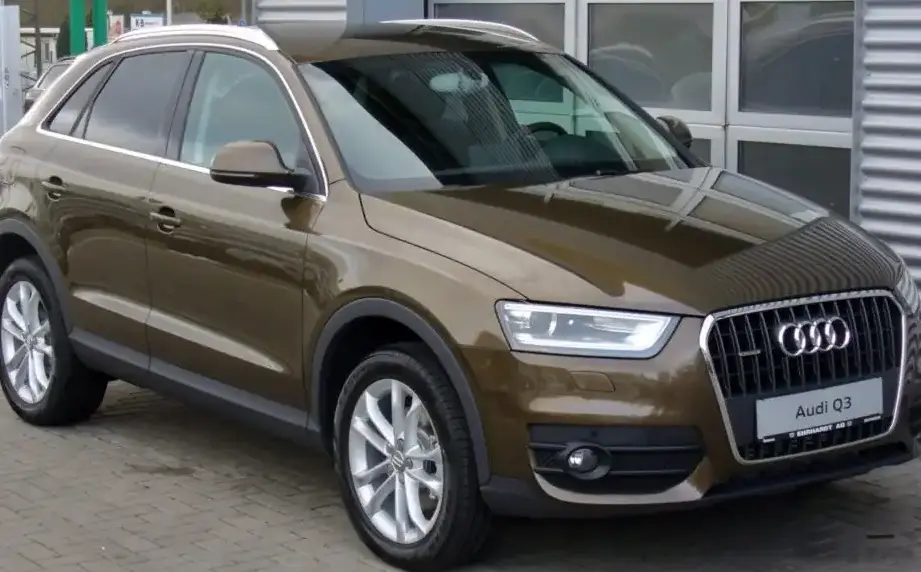
The Audi Q3 I (8U) 1.4 TFSI with the S tronic dual-clutch transmission represents an entry point into the luxury compact SUV segment for the Audi brand. Produced from 2013 to 2014, this variant occupied a key position in the first generation Q3 lineup, offering a balance of fuel efficiency, technology, and Audi’s signature refinement. It was designed to appeal to buyers seeking a premium SUV experience without the higher price tag associated with the more powerful engine options. The Q3 8U series, built on the Volkswagen Group’s PQ25 platform (shared with models like the Volkswagen Tiguan and SEAT Ateca), aimed to provide a more urban-focused and stylish alternative to larger, more traditional SUVs.
Technical Specifications
| Brand | Audi |
| Model | Q3 |
| Generation | Q3 I (8U) |
| Type (Engine) | 1.4 TFSI (150 Hp) S tronic |
| Start of production | October, 2013 |
| End of production | 2014 |
| Powertrain Architecture | Internal Combustion engine |
| Body type | SUV |
| Seats | 5 |
| Doors | 5 |
| Fuel consumption (urban) | 7.7 l/100 km (30.5 US mpg) |
| Fuel consumption (extra urban) | 5.4 l/100 km (43.6 US mpg) |
| Fuel consumption (combined) | 6.2 l/100 km (37.9 US mpg) |
| CO2 emissions | 145 g/km |
| Fuel Type | Petrol (Gasoline) |
| Acceleration 0 – 100 km/h | 8.9 sec |
| Acceleration 0 – 62 mph | 8.9 sec |
| Acceleration 0 – 60 mph | 8.5 sec |
| Maximum speed | 200 km/h (124.27 mph) |
| Emission standard | Euro 6 |
| Weight-to-power ratio | 9.9 kg/Hp |
| Weight-to-torque ratio | 5.9 kg/Nm |
| Power | 150 Hp @ 5000-6000 rpm |
| Torque | 250 Nm @ 1500-3500 rpm (184.39 lb.-ft.) |
| Engine layout | Front, Transverse |
| Engine Model/Code | CHPB |
| Engine displacement | 1395 cm3 (85.13 cu. in.) |
| Number of cylinders | 4 |
| Engine configuration | Inline |
| Fuel injection system | Direct injection |
| Engine aspiration | Turbocharger, Intercooler |
| Engine oil capacity | 4 l (4.23 US qt | 3.52 UK qt) |
| Kerb Weight | 1480 kg (3262.84 lbs.) |
| Max. weight | 2005 kg (4420.27 lbs.) |
| Max load | 525 kg (1157.43 lbs.) |
| Trunk (boot) space – minimum | 460 l (16.24 cu. ft.) |
| Fuel tank capacity | 64 l (16.91 US gal | 14.08 UK gal) |
| Length | 4385 mm (172.64 in.) |
| Width | 1831 mm (72.09 in.) |
| Height | 1608 mm (63.31 in.) |
| Wheelbase | 2603 mm (102.48 in.) |
| Front track | 1571 mm (61.85 in.) |
| Rear track | 1575 mm (62.01 in.) |
| Minimum turning circle | 11.8 m (38.71 ft.) |
| Drivetrain Architecture | Front wheel drive |
| Number of gears | 6 |
| Gearbox type | Automatic transmission S tronic |
| Front suspension | Independent type McPherson |
| Rear suspension | Independent multi-link suspension |
| Front brakes | Ventilated discs |
| Rear brakes | Disc |
| Assisting systems | ABS (Anti-lock braking system) |
| Steering type | Steering rack and pinion |
| Power steering | Electric Steering |
| Tires size | 215/65 R16 |
| Wheel rims size | 6.5J x 16 |
Powertrain & Engine Architecture
The heart of the Q3 1.4 TFSI is the CHPB engine, a 1.4-liter turbocharged inline-four cylinder gasoline engine. This engine utilizes direct fuel injection (FSI) and an intercooled turbocharger to deliver a respectable 150 horsepower and 250 Nm (184 lb-ft) of torque. The turbocharger provides a broad torque curve, peaking from 1500 to 3500 rpm, which contributes to good everyday drivability. The engine’s architecture is relatively compact, allowing for transverse mounting in the engine bay, optimizing space utilization. The S tronic transmission is a 6-speed dual-clutch transmission (DCT). This transmission offers quicker and smoother gear changes compared to a traditional automatic, enhancing both performance and fuel efficiency. It operates with two separate clutches, pre-selecting the next gear for near-instantaneous shifts.
Driving Characteristics
The 1.4 TFSI S tronic Q3 delivers a comfortable and refined driving experience. While not overtly sporty, the engine provides adequate power for typical driving situations. Acceleration from 0-60 mph takes around 8.5 seconds, which is competitive within its class. The S tronic transmission contributes to a responsive feel, and the gear ratios are well-matched for both city and highway driving. Compared to the more powerful 2.0 TFSI variants, the 1.4 TFSI feels less urgent in acceleration, but it offers significantly better fuel economy. The front-wheel-drive configuration provides predictable handling, although it lacks the all-weather capability of the quattro all-wheel-drive models. The steering is light and precise, making it easy to maneuver in urban environments.
Equipment & Trim Levels
The Q3 1.4 TFSI typically came with a generous level of standard equipment. This included features like air conditioning, a multi-function steering wheel, a 6.5-inch infotainment screen with Audi’s MMI system, alloy wheels, and a suite of safety features such as ABS, ESP, and multiple airbags. Interior upholstery was typically cloth, with options for leather upgrades. Common optional extras included a panoramic sunroof, navigation system, parking sensors, and upgraded sound systems. Trim levels varied slightly depending on the market, but generally, the 1.4 TFSI represented the entry-level offering, with higher trims featuring more luxurious appointments and additional technology.
Chassis & Braking
The Q3 8U features a McPherson strut front suspension and a multi-link rear suspension, providing a good balance of ride comfort and handling. The suspension is tuned to prioritize comfort, but it still offers decent body control in corners. The braking system consists of ventilated discs at the front and solid discs at the rear. ABS (Anti-lock Braking System) and ESP (Electronic Stability Program) are standard features, enhancing safety and stability. The Q3 1.4 TFSI’s curb weight of around 1480 kg (3263 lbs) is relatively moderate for its class, contributing to its manageable handling characteristics.
Market Reception & Comparison
The Audi Q3 1.4 TFSI was generally well-received by automotive critics. It was praised for its stylish design, refined interior, and fuel-efficient engine. However, some reviewers noted that the 1.4 TFSI engine could feel underpowered when fully loaded or tackling steep inclines. Compared to the 2.0 TFSI variants, the 1.4 TFSI offered a more affordable entry point into the Q3 range, but at the expense of performance. In terms of fuel economy, the 1.4 TFSI outperformed the larger-engined models, achieving around 38 mpg on the combined cycle. Reliability has generally been good, with few widespread issues reported.
Legacy
The Audi Q3 I (8U) 1.4 TFSI S tronic has proven to be a relatively reliable and durable vehicle in the used car market. The CHPB engine, while not known for being exceptionally powerful, is generally considered to be robust and long-lasting if properly maintained. The S tronic transmission, however, requires regular servicing, including fluid changes, to ensure optimal performance and longevity. Today, these Q3s represent a good value proposition for buyers seeking a premium compact SUV with a reasonable price tag. They continue to offer a comfortable and refined driving experience, along with Audi’s reputation for quality and build integrity.
