
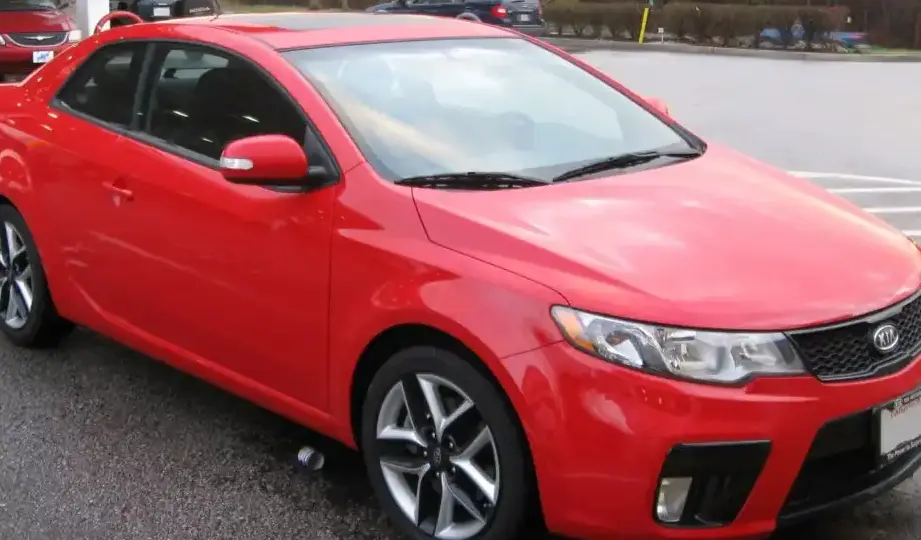
Technical Specifications
| Brand | Kia |
| Model | Forte |
| Generation | Forte I Koup |
| Type (Engine) | 2.0 (154 Hp) Automatic 4-speed |
| Start of production | 2009 |
| End of production | 2010 |
| Powertrain Architecture | Internal Combustion engine |
| Body type | Coupe |
| Seats | 5 |
| Doors | 2 |
| Fuel consumption (economy) – urban (EPA) | 9.4 l/100 km (25 US mpg) |
| Fuel consumption (economy) – extra urban (EPA) | 6.9 l/100 km (34.1 US mpg) |
| Fuel Type | Petrol (Gasoline) |
| Emission standard | SULEV |
| Weight-to-power ratio | 8.1 kg/Hp |
| Weight-to-torque ratio | 6.6 kg/Nm |
| Power | 154 Hp @ 6200 rpm |
| Power per litre | 77.1 Hp/l |
| Torque | 188 Nm @ 4600 rpm (138.66 lb.-ft. @ 4600 rpm) |
| Engine layout | Front, Transverse |
| Engine Model/Code | Theta II / G4KD |
| Engine displacement | 1998 cm3 (121.93 cu. in.) |
| Number of cylinders | 4 |
| Engine configuration | Inline |
| Cylinder Bore | 86 mm (3.39 in.) |
| Piston Stroke | 86 mm (3.39 in.) |
| Compression ratio | 10.5:1 |
| Number of valves per cylinder | 4 |
| Fuel injection system | Multi-port manifold injection |
| Engine aspiration | Naturally aspirated engine |
| Valvetrain | DOHC, CVVT |
| Engine oil capacity | 3.9 l (4.12 US qt | 3.43 UK qt) |
| Coolant | 6 l (6.34 US qt | 5.28 UK qt) |
| Kerb Weight | 1247 kg (2749.16 lbs.) |
| Trunk (boot) space – minimum | 357 l (12.61 cu. ft.) |
| Fuel tank capacity | 52 l (13.74 US gal | 11.44 UK gal) |
| Length | 4480 mm (176.38 in.) |
| Width | 1765 mm (69.49 in.) |
| Height | 1400 mm (55.12 in.) |
| Wheelbase | 2650 mm (104.33 in.) |
| Front track | 1560 mm (61.42 in.) |
| Rear (Back) track | 1564 mm (61.57 in.) |
| Ride height (ground clearance) | 140 mm (5.51 in.) |
| Minimum turning circle (turning diameter) | 10.3 m (33.79 ft.) |
| Drivetrain Architecture | The Internal combustion engine (ICE) drives the front wheels of the vehicle. |
| Drive wheel | Front wheel drive |
| Number of gears and type of gearbox | 4 gears, automatic transmission |
| Front suspension | Independent, type McPherson with coil spring and anti-roll bar |
| Rear suspension | Transverse stabilizer, Coil spring, Torsion |
| Front brakes | Ventilated discs, 280 mm |
| Rear brakes | Disc, 262 mm |
| Assisting systems | ABS (Anti-lock braking system) |
| Steering type | Steering rack and pinion |
| Power steering | Hydraulic Steering |
| Tires size | 205/55 R16 |
| Wheel rims size | 6J x 16 |
The Kia Forte Koup 2.0 Automatic, launched in 2009, was a pivotal model in Kia’s broader strategy to elevate its brand perception in the North American market. Building upon the established Forte sedan, the Koup presented a more youthful and visually dynamic alternative. The combination of the 2.0-liter engine and a four-speed automatic transmission proved to be a popular configuration, striking a balance between acceptable performance and the convenience expected by a wide range of drivers. This variant was specifically targeted at buyers who wanted the sporty aesthetic of a coupe without the added cost or complexity of a manual transmission or a more powerful engine option. The Koup aimed to compete directly with established compact coupes like the Honda Civic Coupe and the Nissan Sentra Coupe, offering a compelling value proposition through its standard features and Kia’s industry-leading 10-year/100,000-mile powertrain warranty.
Powertrain & Engine Architecture
The core of the Forte Koup 2.0 Automatic is the Theta II 2.0-liter inline-four cylinder engine, internally designated G4KD. This engine features a robust cast iron engine block paired with a lightweight aluminum cylinder head – a common design choice for achieving a balance between durability and reduced weight. The engine utilizes a multi-port fuel injection (MPI) system, delivering fuel directly into the intake ports for efficient combustion. A double overhead camshaft (DOHC) valvetrain, incorporating continuously variable valve timing (CVVT) on both the intake and exhaust valves, optimizes engine performance and fuel economy across a wide range of engine speeds and loads. The CVVT system dynamically adjusts valve timing to maximize volumetric efficiency. The four-speed automatic transmission, while not a cutting-edge design even at the time of its release, provided smooth and predictable shifting. It’s a conventional torque converter automatic, prioritizing comfort and ease of use over aggressive performance characteristics. The transmission’s gear ratios were calibrated for everyday driving conditions, emphasizing fuel efficiency and smooth acceleration.
Driving Characteristics
The 2.0-liter engine, generating 154 horsepower and 188 lb-ft of torque, delivered adequate, though not particularly thrilling, performance in the Koup. Acceleration from a standstill to 60 mph was estimated to be in the range of 9 to 10 seconds. The four-speed automatic transmission, while smooth in operation, did contribute to a slightly less responsive driving experience compared to a manual transmission equipped model. Gear changes were noticeable, and the transmission occasionally exhibited a slight hesitation during more urgent acceleration maneuvers. The Koup’s suspension system, tuned for a comfortable ride, provided a reasonably smooth experience on most road surfaces, but didn’t offer the firm, controlled handling characteristics found in more performance-focused coupes. Steering was light and easy to use, making it well-suited for navigating city streets and parking. Overall, the driving experience prioritized practicality and comfort, rather than delivering a particularly sporty or engaging feel.
Equipment & Trim Levels
The 2.0 Automatic Koup typically came standard with a reasonable array of features, including air conditioning, power windows and door locks, a CD player with MP3 playback capability, and an anti-lock braking system (ABS). Higher trim levels offered a range of optional extras, such as a power sunroof, an upgraded audio system, alloy wheels, and a keyless entry system. Interior upholstery was generally cloth, with optional leather seating available on select trims. The dashboard layout was functional and straightforward, featuring clear and easy-to-read gauges and intuitively placed controls. The Koup’s interior, while not overtly luxurious, was well-constructed and offered a respectable amount of space for a compact coupe.
Chassis & Braking
The Forte Koup employed a McPherson strut front suspension system coupled with a torsion beam rear suspension. This configuration represented a good compromise between ride comfort and handling stability. The front suspension incorporated a coil spring and an anti-roll bar to minimize body roll during cornering. Braking performance was provided by ventilated discs at the front wheels and solid discs at the rear. ABS was included as a standard safety feature, enhancing braking control during emergency stopping situations. The Koup’s relatively lightweight chassis contributed to its decent fuel economy and reasonably responsive handling characteristics.
Market Reception & Comparison
The Kia Forte Koup 2.0 Automatic was generally well-received by automotive critics as a stylish and affordable coupe option. Reviewers consistently praised its value for money, comfortable ride quality, and the peace of mind provided by Kia’s comprehensive warranty. However, some criticisms were directed towards its somewhat lackluster handling dynamics and the dated nature of the four-speed automatic transmission. When compared to the standard Forte sedan, the Koup offered a more visually appealing and sporty design, along with a slightly more engaging driving experience. In comparison to competitors such as the Honda Civic Coupe and the Nissan Sentra Coupe, the Koup offered a comparable level of features at a more competitive price point. Fuel economy figures were competitive within its class, averaging approximately 25 mpg in city driving and 34 mpg on the highway.
Legacy
The Kia Forte Koup 2.0 Automatic, while not a revolutionary vehicle, played a significant role in Kia’s ongoing efforts to reshape its brand image and gain wider acceptance in the North American automotive market. It demonstrated Kia’s growing capability to design and manufacture vehicles that could effectively compete with established Japanese and American automakers. The Theta II engine proved to be a reliable and durable powerplant, and a substantial number of Koup models remain in service today. On the used car market, the Koup 2.0 Automatic continues to represent an affordable and practical option for buyers seeking a stylish and economical coupe. Maintenance costs are generally reasonable, and parts availability remains good. While the four-speed automatic transmission may not be as desirable as more modern transmissions with more gears, it has proven to be a relatively trouble-free unit.
