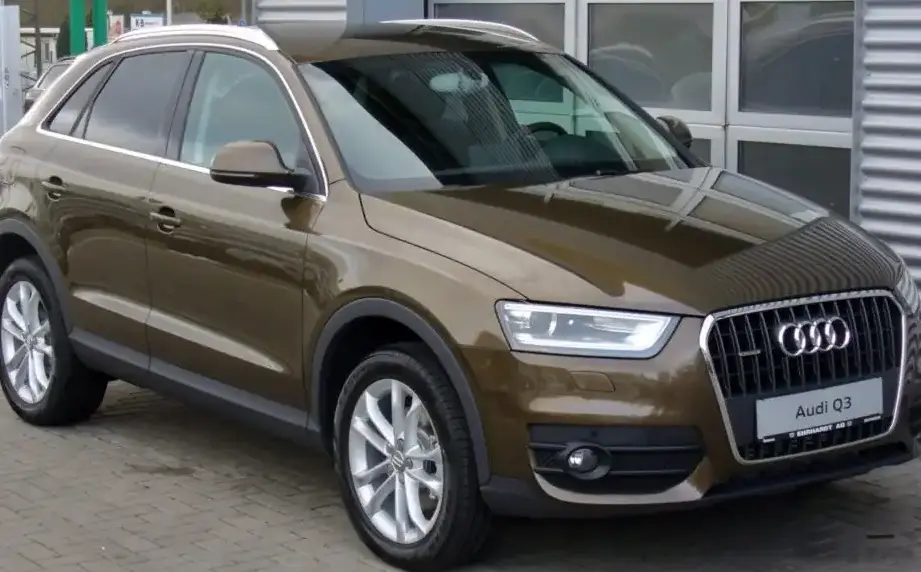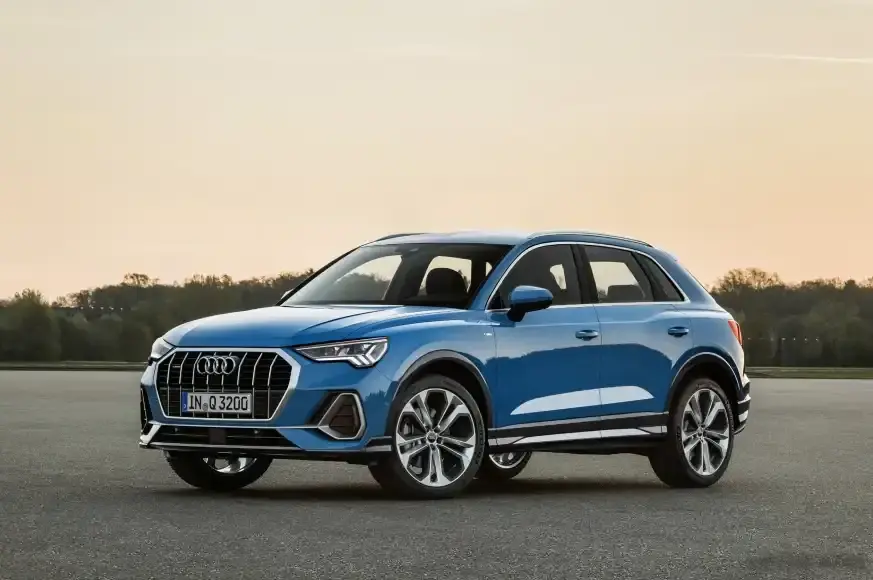
The Audi Q3 II (F3) 35 TDI quattro S tronic is a compact luxury crossover SUV produced by the German manufacturer Audi from 2020 to June 2025. Positioned as a mid-range offering within the second-generation Q3 lineup (F3), it combined a 2.0-liter turbocharged diesel engine with Audi’s seven-speed S tronic dual-clutch transmission and the quattro all-wheel-drive system. This variant aimed to balance fuel efficiency, respectable performance, and all-weather capability, appealing to buyers seeking a practical yet premium SUV. It slots between the lower-powered front-wheel-drive models and the more potent 40 TDI variants in terms of both price and performance.
Technical Specifications
| Brand | Audi |
| Model | Q3 |
| Generation | Q3 II (F3) |
| Type (Engine) | 35 TDI (150 Hp) quattro S tronic |
| Start of production | 2020 |
| End of production | June, 2025 |
| Powertrain Architecture | Internal Combustion engine |
| Body type | SUV |
| Seats | 5 |
| Doors | 5 |
| Fuel consumption (urban) | 5.7-5.8 l/100 km (41.3 – 40.6 US mpg, 49.6 – 48.7 UK mpg, 17.5 – 17.2 km/l) |
| Fuel consumption (extra urban) | 4.5-4.8 l/100 km (52.3 – 49 US mpg, 62.8 – 58.9 UK mpg, 22.2 – 20.8 km/l) |
| Fuel consumption (combined) | 4.9-5.2 l/100 km (48 – 45.2 US mpg, 57.6 – 54.3 UK mpg, 20.4 – 19.2 km/l) |
| CO2 emissions | 130-136 g/km |
| Fuel Type | Diesel |
| Acceleration 0 – 100 km/h | 9.4 sec |
| Acceleration 0 – 62 mph | 9.4 sec |
| Acceleration 0 – 60 mph | 8.9 sec |
| Maximum speed | 205 km/h (127.38 mph) |
| Emission standard | Euro 6d-ISC-FCM |
| Weight-to-power ratio | 11.1 kg/Hp, 90.4 Hp/tonne |
| Weight-to-torque ratio | 4.6 kg/Nm, 216.9 Nm/tonne |
| Power | 150 Hp @ 3000-4200 rpm |
| Torque | 360 Nm @ 1600-2750 rpm (265.52 lb.-ft. @ 1600-2750 rpm) |
| Engine layout | Front, Transverse |
| Engine Model/Code | EA288 evo / DTSB |
| Engine displacement | 1968 cm3 (120.09 cu. in.) |
| Number of cylinders | 4 |
| Engine configuration | Inline |
| Cylinder Bore | 81 mm (3.19 in.) |
| Piston Stroke | 95.5 mm (3.76 in.) |
| Compression ratio | 16:1 |
| Number of valves per cylinder | 4 |
| Fuel injection system | Diesel Commonrail |
| Engine aspiration | Turbocharger, Intercooler |
| Engine oil capacity | 5.5 l (5.81 US qt | 4.84 UK qt) |
| Coolant capacity | 8 l (8.45 US qt | 7.04 UK qt) |
| Kerb Weight | 1660 kg (3659.67 lbs.) |
| Max. weight | 2250 kg (4960.4 lbs.) |
| Max load | 590 kg (1300.73 lbs.) |
| Trunk (boot) space – minimum | 530 l (18.72 cu. ft.) |
| Fuel tank capacity | 58 l (15.32 US gal | 12.76 UK gal) |
| AdBlue tank | 18 l (4.76 US gal | 3.96 UK gal) |
| Max. roof load | 75 kg (165.35 lbs.) |
| Permitted trailer load with brakes (8%) | 2200 kg (4850.17 lbs.) |
| Permitted trailer load with brakes (12%) | 2200 kg (4850.17 lbs.) |
| Permitted trailer load without brakes | 750 kg (1653.47 lbs.) |
| Permitted towbar download | 90 kg (198.42 lbs.) |
| Length | 4484 mm (176.54 in.) |
| Width | 1849 mm (72.8 in.) |
| Width including mirrors | 2024 mm (79.69 in.) |
| Height | 1616 mm (63.62 in.) |
| Wheelbase | 2680 mm (105.51 in.) |
| Front track | 1584 mm (62.36 in.) |
| Rear track | 1576 mm (62.05 in.) |
| Front overhang | 896 mm (35.28 in.) |
| Rear overhang | 908 mm (35.75 in.) |
| Drag coefficient (Cd) | 0.32 |
| Minimum turning circle | 11.8 m (38.71 ft.) |
| Drivetrain Architecture | All wheel drive (4×4). ICE drives front wheels, rear driven by clutch. |
| Number of gears | 7 |
| Gearbox type | Automatic transmission S tronic |
| Front suspension | Independent type McPherson |
| Rear suspension | Independent multi-link suspension |
| Front brakes | Ventilated discs |
| Rear brakes | Disc |
| Assisting systems | ABS (Anti-lock braking system) |
| Steering type | Steering rack and pinion |
| Power steering | Electric Steering |
| Tires size | 215/65 R17 |
| Wheel rims size | 7 J x 17 |
Powertrain & Engine Architecture
The heart of the Q3 35 TDI quattro is the EA288 evo series 2.0-liter inline-four cylinder diesel engine, specifically the DTSB variant. This engine is a common sight in the Volkswagen Group’s product range, known for its robust construction and efficiency. It utilizes a common-rail direct fuel injection system, delivering fuel at extremely high pressures for optimized combustion. A turbocharger with an intercooler is employed to boost power and torque, providing 150 horsepower at 3000-4200 rpm and 360 Nm (265.52 lb.-ft.) of torque between 1600-2750 rpm. The engine also incorporates a particulate filter to reduce emissions, meeting stringent Euro 6d-ISC-FCM standards. The seven-speed S tronic dual-clutch transmission provides quick and smooth gear changes, contributing to both performance and fuel economy. This transmission is known for its efficiency and responsiveness compared to traditional torque-converter automatics.
Driving Characteristics
The Q3 35 TDI quattro S tronic offers a comfortable and composed driving experience. While not overtly sporty, the 150 hp engine and all-wheel-drive system provide adequate acceleration, achieving 0-60 mph in approximately 8.9 seconds. The S tronic transmission contributes to a seamless power delivery, and the quattro system ensures excellent traction in various weather conditions. Compared to the manual transmission versions of the same engine, the S tronic offers quicker acceleration and a more relaxed driving experience, particularly in urban environments. However, some drivers may prefer the more engaging feel of a manual gearbox. Against the more powerful 40 TDI variants, the 35 TDI feels less urgent, but it compensates with improved fuel economy and a lower price point.
Equipment & Trim Levels
The Q3 35 TDI quattro S tronic typically came well-equipped as standard. Features included Audi’s MMI infotainment system with a touchscreen display, automatic climate control, and a suite of safety systems such as ABS, electronic stability control, and multiple airbags. Interior upholstery was generally cloth, with leather options available as upgrades. Common optional extras included a panoramic sunroof, upgraded sound system, navigation system, and driver assistance packages offering features like adaptive cruise control and lane-keeping assist. Trim levels varied by market, but generally offered increasing levels of luxury and technology.
Chassis & Braking
The Q3 35 TDI quattro utilizes an independent McPherson strut suspension at the front and a multi-link suspension at the rear, providing a comfortable ride and good handling characteristics. The quattro all-wheel-drive system distributes power between the front and rear axles as needed, enhancing stability and traction. Braking duties are handled by ventilated discs at the front and solid discs at the rear, providing adequate stopping power. The steering is electrically assisted, offering a light and precise feel.
Market Reception & Comparison
The Audi Q3 35 TDI quattro S tronic was generally well-received by automotive critics. It was praised for its comfortable ride, refined interior, and efficient engine. The combination of all-wheel drive and the S tronic transmission was seen as a significant advantage, particularly in regions with inclement weather. Compared to rivals like the BMW X1 and Mercedes-Benz GLA, the Q3 offered a compelling blend of luxury, practicality, and fuel economy. However, some critics noted that the interior design, while modern, lacked the visual flair of some competitors. Fuel economy figures of 4.9-5.2 l/100 km (48-45.2 US mpg) were competitive within its class.
Legacy
The EA288 engine family, including the DTSB variant found in the Q3 35 TDI, has proven to be remarkably durable. With regular maintenance, these engines can reliably exceed 150,000 miles. The S tronic transmission, while generally reliable, requires more diligent maintenance, including fluid changes, to prevent issues. On the used car market, the Q3 35 TDI quattro S tronic represents a good value proposition, offering a premium SUV experience at a relatively affordable price. Its fuel efficiency and all-weather capability continue to make it an attractive option for buyers seeking a practical and refined compact crossover.