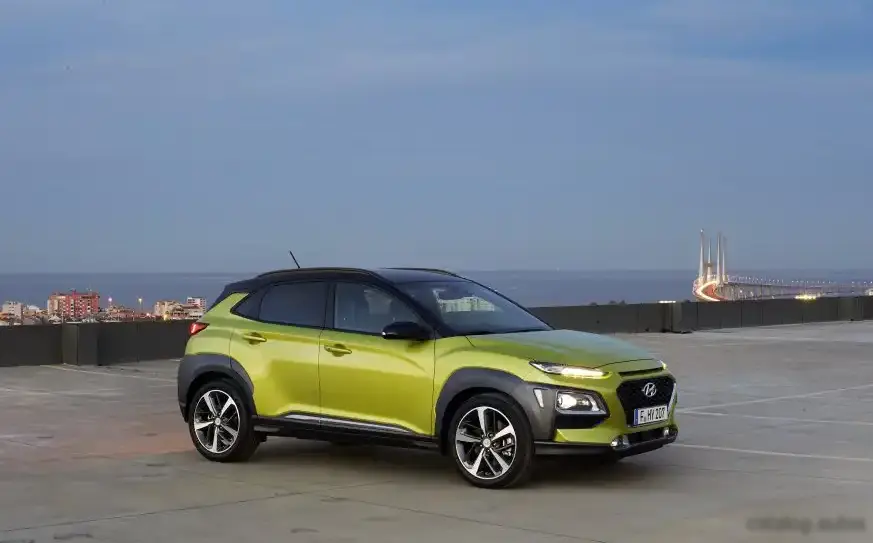
The Hyundai Kona I 1.6 GDi (141 Hp) Hybrid DCT represents a significant entry point into the hybrid SUV market for the Hyundai brand. Introduced in September 2019 and continuing through September 2020, this variant occupied a crucial position within the first generation (Kona I) lineup, built on the Hyundai-Kia B-platform. It aimed to provide a balance of fuel efficiency, practicality, and affordability, appealing to buyers seeking a modern, eco-conscious compact SUV. This model was primarily targeted towards the European and Asian markets, with limited availability in the United States.
Technical Specifications
| Brand | Hyundai |
| Model | Kona |
| Generation | Kona I |
| Type (Engine) | 1.6 GDi (141 Hp) Hybrid DCT |
| Start of production | September, 2019 |
| End of production | September, 2020 |
| Powertrain Architecture | FHEV (Full Hybrid Electric Vehicle) |
| Body type | SUV |
| Seats | 5 |
| Doors | 5 |
| Fuel consumption (combined) | 3.9-4.3 l/100 km (60.3 – 54.7 US mpg, 72.4 – 65.7 UK mpg, 25.6 – 23.3 km/l) |
| CO2 emissions | 90-99 g/km |
| Fuel Type | Petrol (Gasoline) |
| Acceleration 0 – 100 km/h | 11.2-11.6 sec |
| Acceleration 0 – 62 mph | 11.2-11.6 sec |
| Acceleration 0 – 60 mph | 10.6 sec |
| Maximum speed | 160 km/h (99.42 mph) |
| Emission standard | Euro 6 d-TEMP |
| Weight-to-power ratio | 9.8 kg/Hp, 102.5 Hp/tonne |
| Weight-to-torque ratio | 5.2 kg/Nm, 192.6 Nm/tonne |
| Gross battery capacity | 1.56 kWh |
| Battery voltage | 240 V |
| Battery technology | Lithium-polymer (LiPo) |
| Electric motor power | 43 Hp |
| Electric motor Torque | 170 Nm (125.39 lb.-ft.) |
| Electric motor type | Synchronous |
| System power | 141 Hp |
| System torque | 265 Nm (195.45 lb.-ft.) |
| Power | 105 Hp @ 5700 rpm |
| Torque | 147 Nm @ 4000 rpm (108.42 lb.-ft. @ 4000 rpm) |
| Engine layout | Front, Transverse |
| Engine Model/Code | Smartstream / G4LE |
| Engine displacement | 1580 cm3 (96.42 cu. in.) |
| Number of cylinders | 4 |
| Engine configuration | Inline |
| Cylinder Bore | 72 mm (2.83 in.) |
| Piston Stroke | 97 mm (3.82 in.) |
| Compression ratio | 13:1 |
| Number of valves per cylinder | 4 |
| Fuel injection system | Direct injection |
| Engine aspiration | Naturally aspirated engine |
| Engine oil capacity | 3.8 l (4.02 US qt | 3.34 UK qt) |
| Coolant | 6 l (6.34 US qt | 5.28 UK qt) |
| Kerb Weight | 1376 kg (3033.56 lbs.) |
| Max. weight | 1880 kg (4144.69 lbs.) |
| Max load | 504 kg (1111.13 lbs.) |
| Trunk (boot) space – minimum | 361 l (12.75 cu. ft.) |
| Trunk (boot) space – maximum | 1143 l (40.36 cu. ft.) |
| Fuel tank capacity | 38 l (10.04 US gal | 8.36 UK gal) |
| Max. roof load | 80 kg (176.37 lbs.) |
| Permitted trailer load with brakes (12%) | 1300 kg (2866.01 lbs.) |
| Permitted trailer load without brakes | 600 kg (1322.77 lbs.) |
| Permitted towbar download | 80 kg (176.37 lbs.) |
| Length | 4165 mm (163.98 in.) |
| Width | 1800 mm (70.87 in.) |
| Height | 1565 mm (61.61 in.) |
| Wheelbase | 2600 mm (102.36 in.) |
| Front track | 1559-1575 mm (61.38 – 62.01 in.) |
| Rear (Back) track | 1568-1584 mm (61.73 – 62.36 in.) |
| Front overhang | 845 mm (33.27 in.) |
| Rear overhang | 720 mm (28.35 in.) |
| Ride height (ground clearance) | 170 mm (6.69 in.) |
| Minimum turning circle | 10.6 m (34.78 ft.) |
| Drivetrain Architecture | ICE and electric motor drive the front wheels, full electric or mixed mode. |
| Drive wheel | Front wheel drive |
| Number of gears and type of gearbox | 6 gears, automatic transmission DCT |
| Front suspension | Independent, McPherson with coil spring and anti-roll bar |
| Rear suspension | Independent multi-link suspension |
| Front brakes | Ventilated discs, 305 mm |
| Rear brakes | Disc, 284 mm |
| Assisting systems | ABS (Anti-lock braking system) |
| Steering type | Steering rack and pinion |
| Power steering | Electric Steering |
| Tires size | 205/60 R16; 225/45 R18 |
| Wheel rims size | 6.5J x 16; 7.5J x 18 |
Powertrain & Engine Architecture
The Kona 1.6 GDi Hybrid utilizes a full hybrid electric vehicle (FHEV) powertrain. The core of the system is the Hyundai Smartstream G4LE 1.6-liter inline-four cylinder gasoline engine. This engine produces 105 horsepower at 5700 rpm and 147 Nm (108.42 lb-ft) of torque at 4000 rpm. It features direct fuel injection and a relatively high compression ratio of 13:1, contributing to its efficiency. Supplementing the gasoline engine is a 43 horsepower electric motor powered by a 1.56 kWh lithium-polymer battery pack. The combined system output is 141 horsepower and 265 Nm (195.45 lb-ft) of torque. The engine code is crucial for identifying specific components and maintenance requirements. The powertrain is paired with a 6-speed dual-clutch transmission (DCT), which provides quick and smooth gear changes, enhancing both performance and fuel economy. The DCT is a key component in managing the power delivery between the engine and the electric motor.
Driving Characteristics
The 1.6 GDi Hybrid DCT offers a comfortable and efficient driving experience. Acceleration from 0-60 mph takes approximately 10.6 seconds, which is adequate for everyday driving but not particularly sporty. The DCT transmission provides responsive shifts, and the hybrid system seamlessly blends power from the gasoline engine and electric motor. In city driving, the vehicle can often operate in electric-only mode, resulting in near-silent operation and zero emissions. The gear ratios are tuned for fuel efficiency, prioritizing smooth cruising over aggressive acceleration. Compared to higher-output Kona variants, such as those with the 1.6 T-GDI engine, this version feels less powerful, but it compensates with significantly improved fuel economy.
Equipment & Trim Levels
The 1.6 GDi Hybrid DCT typically came with a generous level of standard equipment. This included features like air conditioning, a touchscreen infotainment system with Apple CarPlay and Android Auto compatibility, Bluetooth connectivity, and a suite of safety features such as lane departure warning, forward collision avoidance assist, and automatic emergency braking. Interior upholstery was typically cloth, with options for leather upgrades. Higher trim levels offered additional features like a sunroof, heated seats, and a premium sound system. The dashboard configuration was modern and driver-focused, with a clear instrument cluster and intuitive controls.
Chassis & Braking
The Kona 1.6 GDi Hybrid utilizes a front-wheel-drive layout. The front suspension consists of an independent McPherson strut setup with coil springs and an anti-roll bar, while the rear suspension employs an independent multi-link system. This configuration provides a good balance of ride comfort and handling. The braking system features ventilated discs on the front wheels (305mm) and solid discs on the rear wheels (284mm). ABS (Anti-lock Braking System) is standard. The suspension tuning is geared towards comfort, making it well-suited for everyday driving conditions.
Market Reception & Comparison
The Hyundai Kona 1.6 GDi Hybrid DCT was generally well-received by critics for its fuel efficiency and practicality. It offered a compelling alternative to other hybrid SUVs in its class. Fuel economy figures of 3.9-4.3 l/100 km (60.3 – 54.7 US mpg) were highly competitive. Compared to the non-hybrid Kona variants, the hybrid model offered significantly better fuel economy but came at a slightly higher price point. Reliability reports have been generally positive, with few major issues reported. However, some owners have noted the relatively modest power output compared to other engine options.
Legacy
The Hyundai Kona I 1.6 GDi Hybrid DCT has established itself as a reliable and fuel-efficient option in the used car market. The Smartstream engine and DCT transmission have proven to be durable, with proper maintenance. As a first-generation hybrid model, it represents a significant step forward for Hyundai in terms of electrification. While newer hybrid and electric Kona models have since been introduced, the 1.6 GDi Hybrid DCT remains a popular choice for buyers seeking an affordable and eco-friendly compact SUV.