
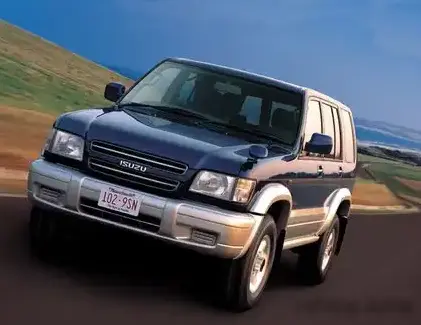
The Isuzu Bighorn, known as the Trooper in North American markets, was a mid-size SUV produced by Isuzu between 1981 and 2002, spanning three generations. The first generation, introduced in 1981, was a significant departure for Isuzu, moving them into the increasingly popular SUV segment. The 2.8 DT variant, powered by the 4JB1-T diesel engine producing 115 horsepower, was available between 1987 and 1991. This model represented a key offering for Isuzu, particularly in markets where diesel engines were favored for their fuel efficiency and durability. It served as a robust, capable vehicle aimed at buyers needing a practical and reliable four-wheel-drive vehicle for both on and off-road use.
Technical Specifications
| Brand | Isuzu |
| Model | Bighorn |
| Generation | Bighorn (SUV) |
| Type (Engine) | 2.8 DT (115 Hp) |
| Start of production | 1987 |
| End of production | 1991 |
| Powertrain Architecture | Internal Combustion engine |
| Body type | SUV |
| Seats | 5 |
| Doors | 5 |
| Fuel Type | Diesel |
| Weight-to-power ratio | 14.8 kg/Hp, 67.6 Hp/tonne |
| Weight-to-torque ratio | 7.2 kg/Nm, 138.2 Nm/tonne |
| Power | 115 Hp @ 3600 rpm |
| Power per litre | 41.5 Hp/l |
| Torque | 235 Nm @ 2300 rpm (173.33 lb.-ft. @ 2300 rpm) |
| Engine layout | Front, Longitudinal |
| Engine Model/Code | 4JB1-T |
| Engine displacement | 2771 cm3 (169.1 cu. in.) |
| Number of cylinders | 4 |
| Engine configuration | Inline |
| Cylinder Bore | 93 mm (3.66 in.) |
| Piston Stroke | 102 mm (4.02 in.) |
| Compression ratio | 17:1 |
| Fuel injection system | Diesel Commonrail |
| Engine aspiration | Turbocharger |
| Kerb Weight | 1700 kg (3747.86 lbs.) |
| Fuel tank capacity | 83 l (21.93 US gal | 18.26 UK gal) |
| Length | 4470 mm (175.98 in.) |
| Width | 1760 mm (69.29 in.) |
| Height | 1845 mm (72.64 in.) |
| Wheelbase | 2650 mm (104.33 in.) |
| Front track | 1450 mm (57.09 in.) |
| Rear (Back) track | 1460 mm (57.48 in.) |
| Minimum turning circle | 10.8 m (35.43 ft.) |
| Drive wheel | All wheel drive (4×4) |
| Number of gears | 5 |
| Gearbox type | Manual transmission |
| Front brakes | Ventilated discs |
| Rear brakes | Drum |
Powertrain & Engine Architecture
The heart of the 2.8 DT Bighorn is the 4JB1-T, a 2.8-liter inline-four cylinder diesel engine. This engine, a staple of Isuzu’s diesel lineup, was known for its robust construction and relatively simple design. The ‘T’ designation indicates the presence of a turbocharger, which significantly boosted power output compared to naturally aspirated versions. The 4JB1-T utilized a direct injection system, injecting fuel directly into the combustion chamber for improved efficiency and power. The engine featured a cast iron block and aluminum cylinder head, contributing to its durability. The 5-speed manual transmission was the standard offering for this variant, providing a good balance between fuel economy and usability. The transmission was chosen for its reliability and ability to handle the engine’s torque output.
Driving Characteristics
The 115 horsepower and 235 Nm (173 lb-ft) of torque delivered by the 2.8 DT engine provided adequate, though not exhilarating, performance. The Bighorn 2.8 DT wasn’t designed for rapid acceleration; instead, it prioritized low-end torque for off-road capability and towing. The manual transmission allowed for precise control, and the gear ratios were well-suited for both on-road cruising and navigating challenging terrain. Compared to the later, more powerful engines offered in the Bighorn, this variant felt noticeably slower, particularly when fully loaded. However, it offered a more economical driving experience and a simpler mechanical setup. The 4×4 system, typically part-time with selectable 2H, 4H, and 4L modes, provided excellent traction in various conditions.
Equipment & Trim Levels
The 2.8 DT Bighorn typically occupied a mid-range position in the lineup. Standard equipment generally included basic features like cloth upholstery, manual windows and door locks, and a relatively simple dashboard layout. Air conditioning was often an optional extra, as were power windows and upgraded audio systems. The interior was functional and durable, designed to withstand the rigors of off-road use. Trim levels varied depending on the market, but generally focused on adding convenience features rather than luxury items. The emphasis was on practicality and reliability, rather than opulent appointments.
Chassis & Braking
The Bighorn’s chassis was a body-on-frame construction, providing a robust and durable platform. The suspension consisted of independent front suspension with coil springs and a live rear axle with leaf springs. This setup provided a comfortable ride on paved roads while maintaining good off-road articulation. The braking system featured ventilated discs on the front wheels and drum brakes on the rear. While adequate for the vehicle’s weight and performance, the rear drum brakes were a point of criticism compared to the all-disc setups found on some competitors. Stabilizer bars were typically fitted to both the front and rear axles to reduce body roll during cornering.
Market Reception & Comparison
The Isuzu Bighorn 2.8 DT was generally well-received in markets where diesel engines were popular, such as Europe and Australia. Critics praised its durability, fuel efficiency, and off-road capability. However, some reviewers noted its relatively slow acceleration and basic interior compared to some competitors. Compared to the gasoline-powered Bighorn variants, the 2.8 DT offered significantly better fuel economy and a more robust powertrain. It was often seen as a more practical choice for those who prioritized durability and fuel efficiency over outright performance. Against rivals like the Mitsubishi Pajero and Toyota Land Cruiser, the Bighorn offered a competitive price point and a reputation for reliability.
Legacy
The Isuzu Bighorn 2.8 DT, and the 4JB1-T engine it housed, have developed a strong reputation for longevity and reliability. Many examples are still on the road today, testament to the engine’s robust construction. The 4JB1-T engine became a popular choice for engine swaps and modifications due to its durability and readily available parts. In the used car market, these Bighorns are often sought after by those looking for a dependable and affordable four-wheel-drive vehicle. While not known for its speed or luxury, the 2.8 DT Bighorn remains a capable and practical SUV, representing a significant chapter in Isuzu’s history.

