Technical Specifications
| Brand | Volkswagen |
| Model | Golf |
| Generation | Golf VII (5-door, facelift 2017) |
| Type (Engine) | 1.6 TDI (115 Hp) |
| Start of production | April, 2017 |
| End of production | 2019 |
| Powertrain Architecture | Internal Combustion engine |
| Body type | Hatchback |
| Seats | 5 |
| Doors | 5 |
| Fuel consumption (urban) | 4.6-4.7 l/100 km (51.1 – 50 US mpg, 61.4 – 60.1 UK mpg, 21.7 – 21.3 km/l) |
| Fuel consumption (extra urban) | 3.8-3.9 l/100 km (61.9 – 60.3 US mpg, 74.3 – 72.4 UK mpg, 26.3 – 25.6 km/l) |
| Fuel consumption (combined) | 4.1-4.2 l/100 km (57.4 – 56 US mpg, 68.9 – 67.3 UK mpg, 24.4 – 23.8 km/l) |
| CO2 emissions | 106-109 g/km |
| Fuel Type | Diesel |
| Acceleration 0 – 100 km/h | 10.2 sec |
| Acceleration 0 – 62 mph | 10.2 sec |
| Acceleration 0 – 60 mph | 9.7 sec |
| Maximum speed | 198 km/h (123.03 mph) |
| Emission standard | Euro 6 |
| Weight-to-power ratio | 10.7 kg/Hp, 93.8 Hp/tonne |
| Weight-to-torque ratio | 4.9 kg/Nm, 203.9 Nm/tonne |
| Power | 115 Hp @ 3250-4000 rpm |
| Power per litre | 72 Hp/l |
| Torque | 250 Nm @ 1500-3200 rpm (184.39 lb.-ft. @ 1500-3200 rpm) |
| Engine layout | Front, Transverse |
| Engine Model/Code | DDYA, DGTE |
| Engine displacement | 1598 cm3 (97.52 cu. in.) |
| Number of cylinders | 4 |
| Engine configuration | Inline |
| Number of valves per cylinder | 4 |
| Fuel injection system | Diesel Commonrail |
| Engine aspiration | Turbocharger, Intercooler |
| Engine oil capacity | 4.7 l (4.97 US qt | 4.14 UK qt) |
| Kerb Weight | 1226 kg (2702.87 lbs.) |
| Max. weight | 1800 kg (3968.32 lbs.) |
| Max load | 574 kg (1265.45 lbs.) |
| Trunk (boot) space – minimum | 380 l (13.42 cu. ft.) |
| Trunk (boot) space – maximum | 1270 l (44.85 cu. ft.) |
| Fuel tank capacity | 50 l (13.21 US gal | 11 UK gal) |
| Max. roof load | 75 kg (165.35 lbs.) |
| Permitted trailer load with brakes (8%) | 1800 kg (3968.32 lbs.) |
| Permitted trailer load with brakes (12%) | 1500 kg (3306.93 lbs.) |
| Permitted trailer load without brakes | 650 kg (1433 lbs.) |
| Permitted towbar download | 80 kg (176.37 lbs.) |
| Length | 4258 mm (167.64 in.) |
| Width | 1799 mm (70.83 in.) |
| Height | 1492 mm (58.74 in.) |
| Wheelbase | 2620 mm (103.15 in.) |
| Front track | 1549 mm (60.98 in.) |
| Rear (Back) track | 1521 mm (59.88 in.) |
| Minimum turning circle | 10.9 m (35.76 ft.) |
| Drive wheel | Front wheel drive |
| Number of gears and type of gearbox | 5 gears, manual transmission |
| Front brakes | Ventilated discs |
| Rear brakes | Disc |
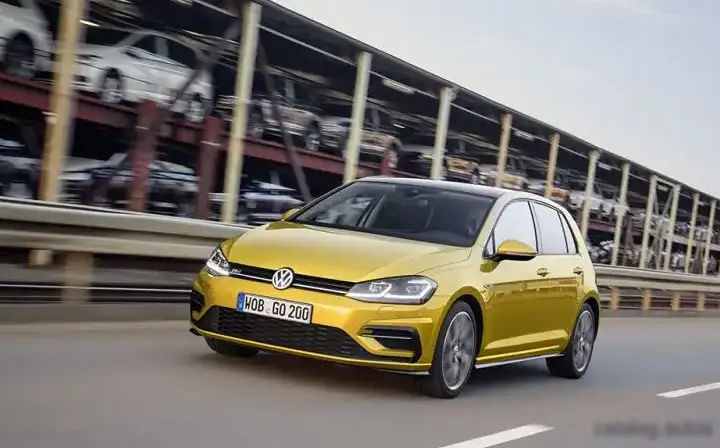
The 1.6 TDI 115 hp Golf VII facelift, produced between 2017 and 2019, was a mainstay of the Golf lineup in Europe and other markets where diesel fuel was prevalent. Built on the Volkswagen Group’s MQB (Modular Transverse Matrix) platform – specifically the A3 variant – this iteration of the Golf aimed to refine the already successful seventh generation. The facelift brought subtle but noticeable changes to the exterior styling, including revised bumpers, headlights, and taillights, as well as an updated interior with improved infotainment systems. The 1.6 TDI engine was chosen for its fuel efficiency and suitability for everyday driving, making it a popular choice for commuters and families.
Powertrain & Engine Architecture
The heart of this Golf variant is the 1.6-liter inline-four cylinder diesel engine, identified by engine codes DDYA or DGTE. This engine is a common-rail direct injection diesel, meaning fuel is injected directly into the combustion chamber at extremely high pressure. This technology, coupled with a turbocharger and intercooler, allows for a good balance of power and efficiency. The engine utilizes four valves per cylinder and a single overhead camshaft. The 115 hp output is achieved at 3250-4000 rpm, while the peak torque of 250 Nm (184 lb-ft) is available from a low 1500-3200 rpm, providing good responsiveness in everyday driving situations. The engine is paired with a 5-speed manual transmission, which was the standard offering. While a 7-speed DSG (Dual Clutch Gearbox) was available as an option, the manual transmission was more common in this trim level.
Driving Characteristics
The 1.6 TDI 115 hp Golf offers a comfortable and practical driving experience. Acceleration from 0-60 mph takes around 9.7 seconds, and top speed is 123 mph. While not a performance-oriented model, the engine provides sufficient power for everyday driving, including highway cruising and overtaking. The turbocharger provides a noticeable boost in power, but it’s not as aggressive as in the larger 2.0 TDI variants. The 5-speed manual transmission is well-matched to the engine’s characteristics, offering smooth gear changes. Compared to the more powerful Golf models, the 1.6 TDI feels less eager to rev, but it excels in fuel economy. The gear ratios are optimized for efficiency, prioritizing lower engine speeds at cruising speeds. The driving experience is generally refined, with good noise insulation and a comfortable ride.
Equipment & Trim Levels
The 1.6 TDI 115 hp Golf typically came equipped with a reasonable level of standard features. These included air conditioning, power windows, power mirrors, a basic infotainment system with a touchscreen display, and alloy wheels. Safety features such as ABS, ESP (Electronic Stability Program), and multiple airbags were also standard. Higher trim levels, such as Comfortline and Highline, added features like automatic climate control, parking sensors, a more advanced infotainment system with navigation, and upgraded interior upholstery. Optional extras included a panoramic sunroof, adaptive cruise control, and a premium sound system.
Chassis & Braking
The Golf VII utilizes a MacPherson strut front suspension and a multi-link rear suspension, providing a good balance of ride comfort and handling. The 1.6 TDI models typically featured smaller wheels and tires (e.g., 205/55 R16) compared to the higher-performance variants. The braking system consists of ventilated discs on the front wheels and solid discs on the rear wheels. ABS (Anti-lock Braking System) and ESP (Electronic Stability Program) are standard features, enhancing safety and stability. The suspension setup is tuned for comfort, but it still provides adequate handling for everyday driving. Stabilizer bars are fitted to both the front and rear axles to reduce body roll.
Market Reception & Comparison
The 1.6 TDI 115 hp Golf was generally well-received by critics and consumers alike. It was praised for its fuel efficiency, practicality, and comfortable ride. However, some reviewers noted that the engine lacked the punch of the more powerful diesel options. Compared to the 2.0 TDI models, the 1.6 TDI offered lower running costs but less performance. It also provided a more affordable entry point into the Golf range. In terms of reliability, the 1.6 TDI engine proved to be generally robust, although like all diesel engines, it was susceptible to issues with the diesel particulate filter (DPF) if not driven on longer journeys regularly. Fuel economy was a key selling point, with combined figures averaging around 56-57 mpg.
Legacy
The 1.6 TDI 115 hp Golf VII remains a popular choice in the used car market, particularly for buyers seeking a fuel-efficient and reliable hatchback. While newer Golf models offer more advanced technology and features, the seventh-generation Golf still holds its own in terms of practicality and driving experience. The 1.6 TDI engine, while not the most exciting, is known for its durability and relatively low maintenance costs. However, potential buyers should be aware of the potential for DPF issues and ensure the vehicle has been properly maintained. The Golf VII, and specifically this 1.6 TDI variant, cemented the Golf’s reputation as a versatile and dependable family car.