
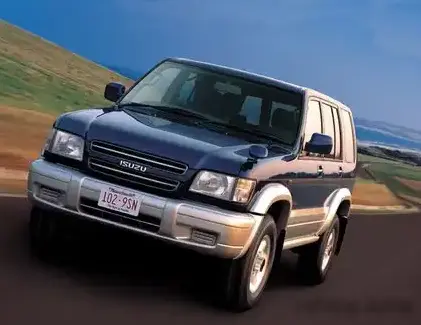
The Isuzu Bighorn, known as the Isuzu Mu in some markets, was a mid-size SUV produced by Isuzu between 1991 and 1998. This generation, internally designated as the UBS series, represented Isuzu’s entry into the increasingly popular SUV segment. The 3.1 DT variant, powered by the 4JG2 engine producing 125 horsepower, was a significant offering within the Bighorn lineup, particularly in markets where diesel engines were favored for their fuel efficiency and durability. It served as a robust, capable vehicle aimed at families and those needing a practical, all-terrain vehicle.
Technical Specifications
| Brand | Isuzu |
| Model | Bighorn |
| Generation | Bighorn (SUV) |
| Type (Engine) | 3.1 DT (125 Hp) |
| Start of production | 1991 |
| End of production | 1998 |
| Powertrain Architecture | Internal Combustion engine |
| Body type | SUV |
| Seats | 5 |
| Doors | 5 |
| Fuel Type | Diesel |
| Weight-to-power ratio | 16.2 kg/Hp, 61.6 Hp/tonne |
| Weight-to-torque ratio | 7.4 kg/Nm, 135.5 Nm/tonne |
| Power | 125 Hp @ 3600 rpm |
| Power per litre | 40.9 Hp/l |
| Torque | 275 Nm @ 2000 rpm (202.83 lb.-ft. @ 2000 rpm) |
| Engine layout | Front, Longitudinal |
| Engine Model/Code | 4JG2 |
| Engine displacement | 3059 cm3 (186.67 cu. in.) |
| Number of cylinders | 4 |
| Engine configuration | Inline |
| Cylinder Bore | 95.4 mm (3.76 in.) |
| Piston Stroke | 107 mm (4.21 in.) |
| Compression ratio | 20:1 |
| Number of valves per cylinder | 2 |
| Fuel injection system | Diesel Commonrail |
| Engine aspiration | Turbocharger |
| Engine oil capacity | 6 l (6.34 US qt | 5.28 UK qt) |
| Kerb Weight | 2030 kg (4475.38 lbs.) |
| Fuel tank capacity | 85 l (22.45 US gal | 18.7 UK gal) |
| Length | 4750 mm (187.01 in.) |
| Width | 1745 mm (68.7 in.) |
| Height | 1840 mm (72.44 in.) |
| Wheelbase | 2760 mm (108.66 in.) |
| Front track | 1455 mm (57.28 in.) |
| Rear (Back) track | 1460 mm (57.48 in.) |
| Minimum turning circle | 11.6 m (38.06 ft.) |
| Drive wheel | All wheel drive (4×4) |
| Number of gears | 5 |
| Gearbox type | Manual transmission |
| Front brakes | Ventilated discs |
| Rear brakes | Drum |
| Tires size | 245/70 R16 |
| Wheel rims size | 7JJ x 16 |
Powertrain & Engine Architecture
The heart of the Bighorn 3.1 DT is the 4JG2, a 3.1-liter inline-four cylinder diesel engine. This engine, a workhorse for Isuzu, featured direct injection and was turbocharged to boost power output. The 4JG2 utilized a robust cast iron block and aluminum cylinder head, contributing to its longevity. The engine’s 20:1 compression ratio was typical for diesel engines of the era, maximizing combustion efficiency. The fuel injection system, while not a modern common rail system in its initial form, was a sophisticated direct injection setup for its time, delivering fuel directly into the cylinders under high pressure. The five-speed manual transmission was a standard offering, providing a balance between fuel economy and usability. The longitudinal engine layout allowed for a more traditional front-engine, rear-wheel-drive-based four-wheel-drive system.
Driving Characteristics
The 125 horsepower and 275 Nm (202.83 lb-ft) of torque delivered by the 4JG2 engine in the Bighorn 3.1 DT provided adequate, though not exhilarating, performance. The engine’s torque curve was relatively flat, offering good pulling power from low RPMs, making it well-suited for off-road driving and towing. However, compared to gasoline-powered Bighorns or higher-output diesel variants, the 3.1 DT felt noticeably slower, especially during acceleration. The five-speed manual transmission allowed drivers to keep the engine in its optimal power band, but the overall experience was geared towards practicality and efficiency rather than sporty driving. The gear ratios were tuned for maximizing fuel economy and providing sufficient torque for challenging terrain.
Equipment & Trim Levels
The Bighorn 3.1 DT typically came with a fairly basic level of equipment, reflecting its position as a more affordable option within the range. Standard features generally included power steering, central locking, and basic instrumentation. Interior upholstery was typically cloth, and the dashboard featured a functional, utilitarian design. Optional extras could include air conditioning, power windows, and upgraded audio systems. The trim level often dictated the availability of these options, with higher trims offering more creature comforts. The focus was on providing a durable and functional vehicle rather than a luxurious one.
Chassis & Braking
The Bighorn 3.1 DT utilized a body-on-frame construction, providing a robust and durable chassis. The suspension consisted of independent double wishbones at the front and a multi-link setup at the rear, offering a reasonable balance between ride comfort and off-road capability. Front brakes were ventilated discs, providing adequate stopping power, while the rear brakes were drums, a cost-saving measure common in vehicles of this class. Stabilizer bars were fitted to both the front and rear axles to reduce body roll during cornering. The all-wheel-drive system typically featured a selectable four-wheel-drive mode with low range gearing, enhancing its off-road prowess.
Market Reception & Comparison
The Isuzu Bighorn 3.1 DT was generally well-received in markets where diesel SUVs were popular, such as Europe and Australia. Critics praised its durability, fuel efficiency, and off-road capability. However, some noted its relatively modest power output and basic interior compared to competitors. Compared to the gasoline-powered Bighorn variants, the 3.1 DT offered significantly better fuel economy but lacked the same level of performance. Against other diesel SUVs of the time, such as the Mitsubishi Pajero or Toyota Land Cruiser, the Bighorn offered a more affordable alternative, albeit with slightly less refinement.
Legacy
The Isuzu Bighorn 3.1 DT has proven to be a relatively reliable vehicle, with many examples still on the road today. The 4JG2 engine is known for its durability and longevity, provided it has been properly maintained. However, like any older vehicle, it is prone to age-related issues such as rust and wear and tear on suspension components. In the used car market, the Bighorn 3.1 DT remains a popular choice for those seeking a capable and affordable all-terrain vehicle. Its simplicity and robust construction make it relatively easy to maintain and repair, contributing to its enduring appeal. While not a collector’s item, it holds a respected place as a practical and dependable SUV from the early 1990s.

