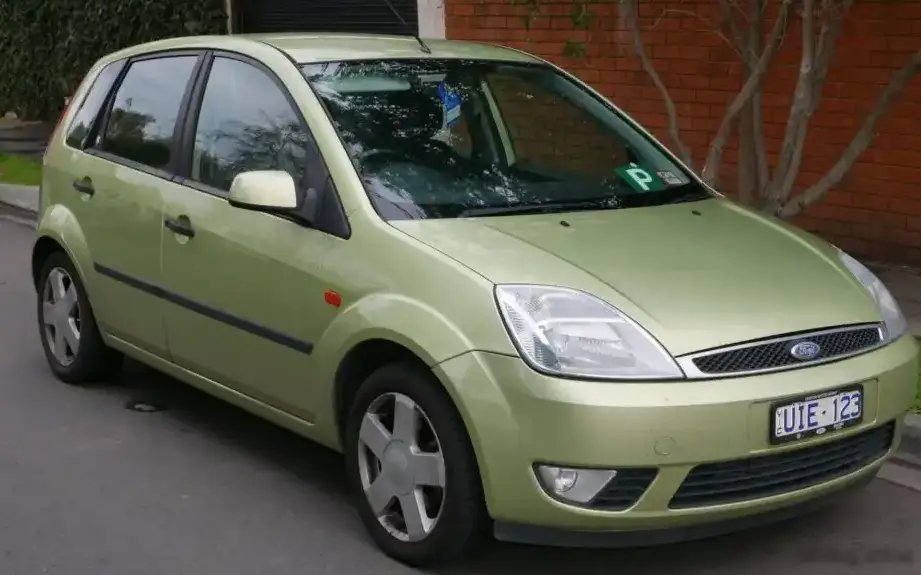
The Ford Fiesta Mk6, produced from 2001 to 2005, represented a significant step forward for Ford’s supermini. The 1.3 Duratec variant, equipped with a five-speed manual transmission, served as the entry point into the Mk6 Fiesta range. Positioned as the most affordable option, it targeted budget-conscious buyers and those prioritizing fuel economy over outright performance. This model was a key component of Ford’s strategy to offer a versatile and accessible small car in the European market, and later, in select regions globally. The Mk6 Fiesta, built on the B3 platform, aimed to improve upon its predecessor with enhanced refinement, safety features, and a more modern interior.
Technical Specifications
| Brand | Ford |
| Model | Fiesta |
| Generation | Fiesta VI (Mk6) 5 door |
| Type (Engine) | 1.3 Duratec (60 Hp) |
| Start of production | 2001 |
| End of production | 2005 |
| Powertrain Architecture | Internal Combustion engine |
| Body type | Hatchback |
| Seats | 5 |
| Doors | 5 |
| Fuel consumption (urban) | 8.3 l/100 km (28.3 US mpg, 34 UK mpg, 12 km/l) |
| Fuel consumption (extra urban) | 5 l/100 km (47 US mpg, 56.5 UK mpg, 20 km/l) |
| Fuel consumption (combined) | 5.8 l/100 km (40.6 US mpg, 48.7 UK mpg, 17.2 km/l) |
| Fuel Type | Petrol (Gasoline) |
| Acceleration 0 – 100 km/h | 18.8 sec |
| Acceleration 0 – 62 mph | 18.8 sec |
| Acceleration 0 – 60 mph | 17.9 sec |
| Maximum speed | 151 km/h (93.83 mph) |
| Weight-to-power ratio | 17.3 kg/Hp, 58 Hp/tonne |
| Weight-to-torque ratio | 10.5 kg/Nm, 95.7 Nm/tonne |
| Power | 60 Hp @ 5000 rpm |
| Power per litre | 46.2 Hp/l |
| Torque | 99 Nm @ 2500 rpm (73.02 lb.-ft. @ 2500 rpm) |
| Engine layout | Front, Transverse |
| Engine Model/Code | BAJA, A9JA |
| Engine displacement | 1299 cm3 (79.27 cu. in.) |
| Number of cylinders | 4 |
| Engine configuration | Inline |
| Cylinder Bore | 74 mm (2.91 in.) |
| Piston Stroke | 75.5 mm (2.97 in.) |
| Compression ratio | 9.5:1 |
| Number of valves per cylinder | 2 |
| Fuel injection system | Multi-port manifold injection |
| Engine aspiration | Naturally aspirated engine |
| Valvetrain | OHC |
| Engine oil capacity | 4.35 l (4.6 US qt | 3.83 UK qt) |
| Coolant | 5 l (5.28 US qt | 4.4 UK qt) |
| Kerb Weight | 1035 kg (2281.78 lbs.) |
| Max. weight | 1520 kg (3351.03 lbs.) |
| Max load | 485 kg (1069.24 lbs.) |
| Trunk (boot) space – minimum | 284 l (10.03 cu. ft.) |
| Trunk (boot) space – maximum | 947 l (33.44 cu. ft.) |
| Fuel tank capacity | 45 l (11.89 US gal | 9.9 UK gal) |
| Length | 3917 mm (154.21 in.) |
| Width | 1683 mm (66.26 in.) |
| Height | 1417 mm (55.79 in.) |
| Wheelbase | 2486 mm (97.87 in.) |
| Front track | 1477 mm (58.15 in.) |
| Rear (Back) track | 1444 mm (56.85 in.) |
| Drivetrain Architecture | The Internal combustion engine (ICE) drives the front wheels of the vehicle. |
| Drive wheel | Front wheel drive |
| Number of gears and type of gearbox | 5 gears, manual transmission |
| Front suspension | Wishbone |
| Rear suspension | Spring Strut |
| Front brakes | Ventilated discs |
| Rear brakes | Drum |
| Steering type | Steering rack and pinion |
| Power steering | Hydraulic Steering |
| Tires size | 175/65 R14 |
Powertrain & Engine Architecture
The heart of this Fiesta variant is the 1.3-liter Duratec engine, specifically the BAJA or A9JA engine code depending on the exact production date and market. This engine is an inline-four cylinder, naturally aspirated unit featuring a single overhead camshaft (OHC) design and two valves per cylinder. The Duratec engine family was designed to be a modular and cost-effective powerplant, and the 1.3L version prioritized fuel efficiency and reliability over high performance. Fuel delivery is managed by a multi-port fuel injection system, providing adequate atomization for clean combustion. The engine produces 60 horsepower at 5000 rpm and 99 Nm (73 lb-ft) of torque at 2500 rpm. This power is transmitted to the front wheels via a standard five-speed manual transmission. The transmission was chosen for its affordability and simplicity, contributing to the overall low cost of ownership.
Driving Characteristics
The 1.3L Fiesta Mk6 with a manual transmission delivers a driving experience focused on practicality and economy. Acceleration is modest, taking approximately 18.8 seconds to reach 62 mph (100 km/h). The engine feels somewhat strained when pushed hard, and overtaking maneuvers require careful planning. However, around town, the engine provides sufficient power for everyday driving. The five-speed gearbox is well-matched to the engine’s characteristics, allowing for comfortable cruising at highway speeds, although engine noise is noticeable. Compared to the higher-output 1.6L or even the diesel variants, the 1.3L feels significantly less powerful, but it offers a lighter, more nimble feel in corners. The gear ratios are optimized for fuel efficiency, prioritizing lower engine speeds at cruising speeds.
Equipment & Trim Levels
The 1.3L Fiesta Mk6 typically came with a basic level of equipment. Standard features generally included power steering, central locking, and an adjustable steering column. Interior upholstery was typically cloth, and the dashboard featured a simple, functional design. Air conditioning, alloy wheels, and electric windows were usually offered as optional extras, allowing buyers to customize their vehicle to some extent. Trim levels varied slightly depending on the market, but the 1.3L generally represented the base model, often referred to as ‘Style’ or ‘Base’ in various European markets. Safety features included driver and passenger airbags, and an anti-lock braking system (ABS) was often available as an option.
Chassis & Braking
The Fiesta Mk6’s chassis utilizes a MacPherson strut front suspension and a twist-beam rear suspension. This setup provides a good balance between ride comfort and handling. The 1.3L variant, being the lightest in the range, benefits from a slightly more agile feel. Braking duties are handled by ventilated discs at the front and drum brakes at the rear. While adequate for everyday driving, the braking system isn’t particularly powerful, and drivers should allow for a longer stopping distance. The steering is hydraulic power-assisted, providing a light and responsive feel. Stabilizer bars were typically fitted to both the front and rear axles, helping to reduce body roll during cornering.
Market Reception & Comparison
The 1.3L Fiesta Mk6 was generally well-received as an affordable and economical small car. Critics praised its fuel efficiency and ease of driving, but noted its lack of outright performance. Compared to the 1.6L variant, the 1.3L offered significantly lower running costs but sacrificed acceleration and overall driving enjoyment. The diesel variants, while more expensive to purchase, provided superior fuel economy and torque. However, the 1.3L remained a popular choice for first-time buyers, city dwellers, and those seeking a reliable and inexpensive mode of transportation. Its fuel economy figures of around 40.6 US mpg combined were competitive for its class.
Legacy
The 1.3 Duratec engine, while not known for its high performance, proved to be a reliable and durable unit. Many examples of the 1.3L Fiesta Mk6 are still on the road today, testament to its robust construction. In the used car market, these models are typically very affordable, making them attractive to buyers on a tight budget. Maintenance costs are relatively low, and spare parts are readily available. However, potential buyers should be aware of the engine’s limitations and ensure that the vehicle has been properly maintained. The Fiesta Mk6, and particularly the 1.3L variant, played a significant role in establishing the Fiesta as one of Europe’s most popular superminis, and its legacy continues to this day.