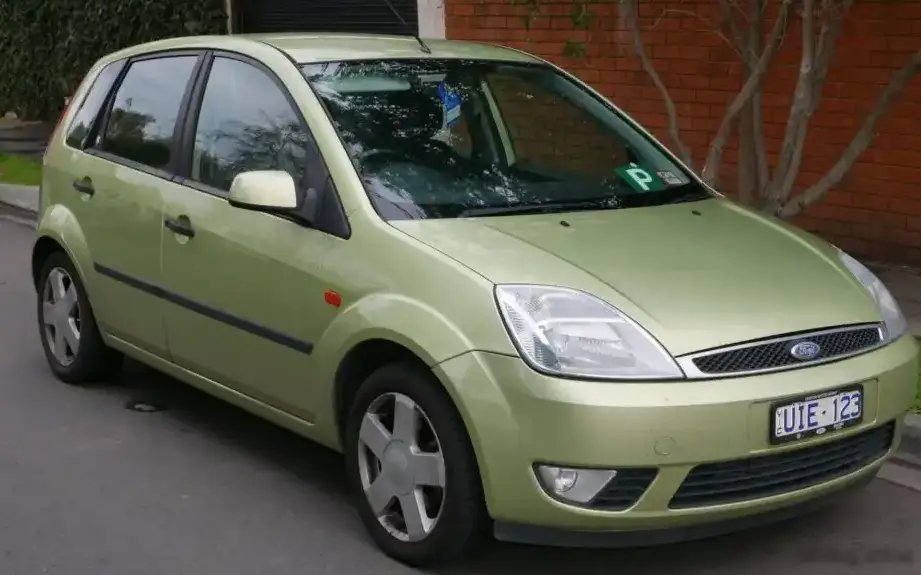
The Ford Fiesta Mk6, produced from 2001 to 2005, represented a significant step forward for Ford’s supermini. The 5-door variant, particularly when equipped with the 1.3-liter Duratec engine producing 70 horsepower, served as the entry point into the Mk6 Fiesta range. This model aimed to provide affordable and practical transportation, appealing to first-time buyers, city commuters, and those seeking a fuel-efficient vehicle. It was positioned below the more powerful 1.4 and 1.6-liter variants, and significantly below the performance-oriented Zetec models. The Mk6 Fiesta was a crucial model for Ford in Europe, competing directly with vehicles like the Volkswagen Polo, Renault Clio, and Opel Corsa.
Technical Specifications
| Brand | Ford |
| Model | Fiesta |
| Generation | Fiesta VI (Mk6) 5 door |
| Type (Engine) | 1.3 Duratec (70 Hp) |
| Start of production | 2001 |
| End of production | 2005 |
| Powertrain Architecture | Internal Combustion engine |
| Body type | Hatchback |
| Seats | 5 |
| Doors | 5 |
| Fuel consumption (urban) | 8.4 l/100 km (28 US mpg, 33.6 UK mpg, 11.9 km/l) |
| Fuel consumption (extra urban) | 5 l/100 km (47 US mpg, 56.5 UK mpg, 20 km/l) |
| Fuel consumption (combined) | 5.8 l/100 km (40.6 US mpg, 48.7 UK mpg, 17.2 km/l) |
| Fuel Type | Petrol (Gasoline) |
| Acceleration 0 – 100 km/h | 15.3 sec |
| Acceleration 0 – 62 mph | 15.3 sec |
| Acceleration 0 – 60 mph | 14.5 sec |
| Maximum speed | 160 km/h (99.42 mph) |
| Weight-to-power ratio | 14.8 kg/Hp, 67.6 Hp/tonne |
| Weight-to-torque ratio | 9.8 kg/Nm, 102.4 Nm/tonne |
| Power | 70 Hp @ 5000 rpm |
| Power per litre | 53.9 Hp/l |
| Torque | 106 Nm @ 2800 rpm (78.18 lb.-ft. @ 2800 rpm) |
| Engine layout | Front, Transverse |
| Engine Model/Code | BAJA, A9JB |
| Engine displacement | 1299 cm3 (79.27 cu. in.) |
| Number of cylinders | 4 |
| Engine configuration | Inline |
| Cylinder Bore | 74 mm (2.91 in.) |
| Piston Stroke | 75.5 mm (2.97 in.) |
| Compression ratio | 10.2:1 |
| Number of valves per cylinder | 2 |
| Fuel injection system | Multi-port manifold injection |
| Engine aspiration | Naturally aspirated engine |
| Valvetrain | OHC |
| Engine oil capacity | 4.35 l (4.6 US qt | 3.83 UK qt) |
| Coolant | 5 l (5.28 US qt | 4.4 UK qt) |
| Kerb Weight | 1035 kg (2281.78 lbs.) |
| Max. weight | 1520 kg (3351.03 lbs.) |
| Max load | 485 kg (1069.24 lbs.) |
| Trunk (boot) space – minimum | 284 l (10.03 cu. ft.) |
| Trunk (boot) space – maximum | 947 l (33.44 cu. ft.) |
| Fuel tank capacity | 45 l (11.89 US gal | 9.9 UK gal) |
| Length | 3917 mm (154.21 in.) |
| Width | 1683 mm (66.26 in.) |
| Height | 1417 mm (55.79 in.) |
| Wheelbase | 2486 mm (97.87 in.) |
| Front track | 1477 mm (58.15 in.) |
| Rear (Back) track | 1440 mm (56.69 in.) |
| Drivetrain Architecture | The Internal combustion engine (ICE) drives the front wheels of the vehicle. |
| Drive wheel | Front wheel drive |
| Number of gears and type of gearbox | 5 gears, manual transmission |
| Front suspension | Wishbone |
| Rear suspension | Spring Strut |
| Front brakes | Ventilated discs |
| Rear brakes | Drum |
| Steering type | Steering rack and pinion |
| Power steering | Hydraulic Steering |
| Tires size | 175/65 R14 |
Powertrain & Engine Architecture
The heart of this Fiesta variant is the 1.3-liter Duratec engine, specifically the BAJA or A9JB engine code depending on the exact production year and market. This engine is a naturally aspirated, inline-four cylinder unit featuring a single overhead camshaft (OHC) and two valves per cylinder. It utilizes a multi-port fuel injection system, providing adequate fuel delivery for its modest power output. The Duratec engine family was designed to be relatively simple and reliable, prioritizing affordability over outright performance. The 70 horsepower peak is achieved at 5000 rpm, while the 106 Nm (78 lb-ft) of torque is available at 2800 rpm. This engine was paired with a five-speed manual transmission, offering a reasonable balance between fuel economy and drivability. The transmission itself is a standard configuration for the Fiesta Mk6, known for its relatively light shift action.
Driving Characteristics
The 1.3-liter Fiesta Mk6 with the five-speed manual transmission delivers a driving experience focused on practicality and economy. Acceleration is modest, taking around 15.3 seconds to reach 62 mph (100 km/h). The engine feels somewhat strained when pushed hard, particularly when fully loaded or climbing hills. However, around town, it provides sufficient power for everyday driving. The gear ratios are well-chosen to keep the engine within its optimal operating range, and the light clutch and steering make it easy to maneuver in urban environments. Compared to the 1.4 or 1.6-liter versions, this variant feels noticeably slower, but it offers superior fuel economy. The handling is typical of a small Ford – responsive and engaging, with a decent level of grip.
Equipment & Trim Levels
The base-level 1.3-liter Fiesta Mk6 typically came equipped with a fairly basic specification. Standard features included power steering, central locking, and an adjustable steering column. Interior upholstery was typically cloth, and the dashboard featured a simple, functional design. Optional extras included air conditioning, electric front windows, and an upgraded audio system. Higher trim levels, such as the Style or Zetec, added features like alloy wheels, body-colored bumpers, and more luxurious interior trim. However, the 1.3-liter engine was rarely offered in the higher trim levels, as buyers opting for those features generally preferred the more powerful engine options.
Chassis & Braking
The Fiesta Mk6 utilizes a front-wheel-drive layout with independent wishbone suspension at the front and a semi-independent spring strut rear suspension. This setup provides a good balance between ride comfort and handling. The front brakes are ventilated discs, offering adequate stopping power, while the rear brakes are drums. This configuration was common for entry-level models in this class to keep costs down. The steering is a hydraulic power-assisted rack and pinion system, providing a light and precise feel. The 14-inch wheels, typically fitted with 175/65 R14 tires, contribute to the car’s comfortable ride quality.
Market Reception & Comparison
The 1.3-liter Fiesta Mk6 was generally well-received as an affordable and practical city car. Critics praised its fuel efficiency and ease of driving, but noted its lack of outright performance. Compared to the 1.4 and 1.6-liter variants, the 1.3 offered significantly lower running costs but at the expense of acceleration and overall refinement. The 1.4-liter engine provided a noticeable performance boost without a substantial increase in fuel consumption, making it a popular alternative. However, the 1.3-liter model remained a strong seller, particularly among budget-conscious buyers and those who primarily used the car for short trips.
Legacy
The 1.3-liter Duratec engine, while not known for its high performance, proved to be a reliable and durable unit. Fiesta Mk6 models equipped with this engine are still relatively common on the used car market today. Maintenance is generally straightforward and affordable, thanks to the engine’s simple design. Common issues include oil leaks and occasional sensor failures, but these are typically inexpensive to repair. The Fiesta Mk6, in general, has earned a reputation as a dependable and economical supermini, and the 1.3-liter variant remains a viable option for those seeking a low-cost, practical vehicle.