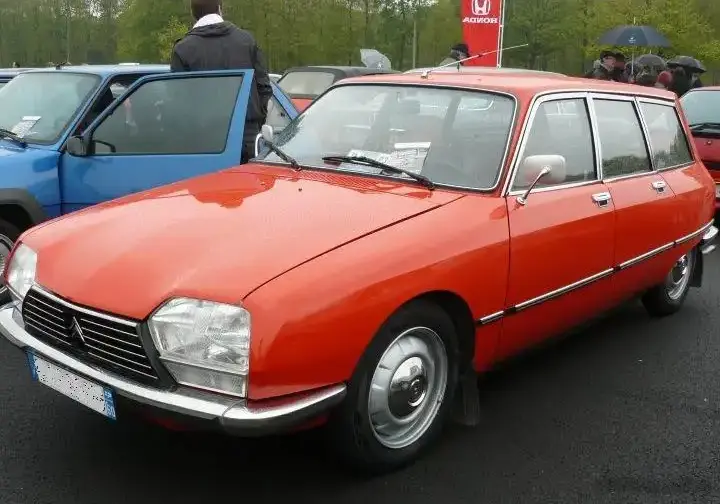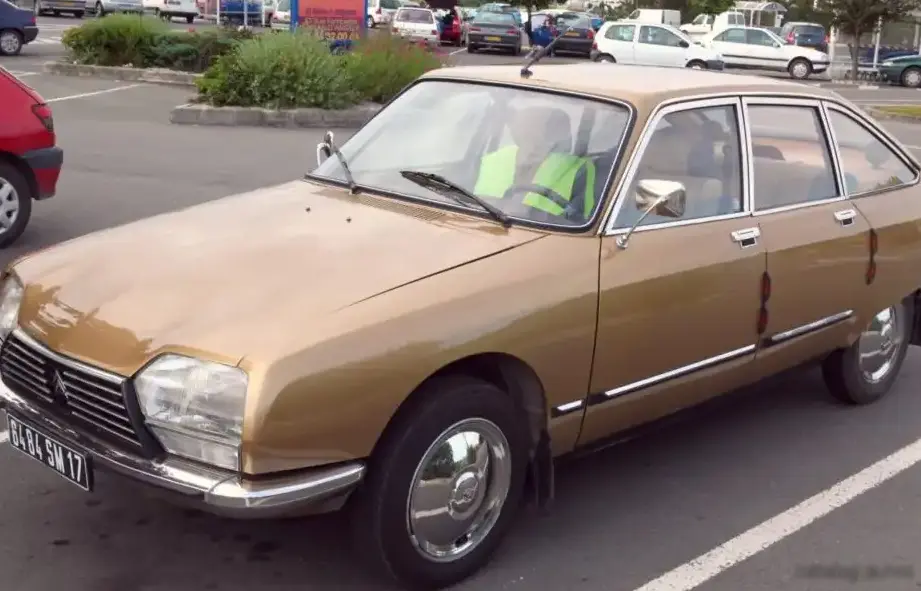
The Citroen GS 1.1, produced between 1977 and 1979, represented the entry point into Citroen’s innovative GS range. Positioned as the most affordable variant, it offered the distinctive styling and advanced hydropneumatic suspension system of its more powerful siblings, but with a smaller displacement engine geared towards economy-minded buyers. The GS itself was a significant vehicle for Citroen, representing a departure from their traditionally curvaceous designs and embracing a more aerodynamic, modern aesthetic. It was built on Citroen’s ‘G’ platform, and shared some components with the Peugeot 604, a result of the post-merger cooperation between the two French automakers.
Technical Specifications
| Brand | Citroen |
| Model | GS |
| Generation | GS |
| Type (Engine) | 1.1 (56 Hp) |
| Start of production | 1977 year |
| End of production | 1979 year |
| Powertrain Architecture | Internal Combustion engine |
| Body type | Hatchback |
| Seats | 5 |
| Doors | 4 |
| Fuel Type | Petrol (Gasoline) |
| Acceleration 0 – 100 km/h | 17.5 sec |
| Acceleration 0 – 62 mph | 17.5 sec |
| Acceleration 0 – 60 mph | 16.6 sec |
| Maximum speed | 149 km/h (92.58 mph) |
| Weight-to-power ratio | 16.5 kg/Hp, 60.5 Hp/tonne |
| Weight-to-torque ratio | 11.6 kg/Nm, 86.5 Nm/tonne |
| Power | 56 Hp @ 5750 rpm |
| Power per litre | 49.6 Hp/l |
| Torque | 80 Nm @ 3500 rpm (59 lb.-ft. @ 3500 rpm) |
| Engine Model/Code | G11/631 |
| Engine displacement | 1129 cm3 (68.9 cu. in.) |
| Number of cylinders | 4 |
| Engine configuration | Boxer |
| Cylinder Bore | 74 mm (2.91 in.) |
| Piston Stroke | 65.5 mm (2.58 in.) |
| Compression ratio | 9:1 |
| Engine oil capacity | 3.5 l (3.7 US qt | 3.08 UK qt) |
| Kerb Weight | 925 kg (2039.28 lbs.) |
| Max. weight | 1335 kg (2943.17 lbs.) |
| Max load | 410 kg (903.9 lbs.) |
| Trunk (boot) space – minimum | 409 l (14.44 cu. ft.) |
| Trunk (boot) space – maximum | 846 l (29.88 cu. ft.) |
| Fuel tank capacity | 43 l (11.36 US gal | 9.46 UK gal) |
| Max. roof load | 60 kg (132.28 lbs.) |
| Permitted trailer load with brakes (12%) | 800 kg (1763.7 lbs.) |
| Permitted trailer load without brakes | 460 kg (1014.13 lbs.) |
| Length | 4120 mm (162.2 in.) |
| Width | 1608 mm (63.31 in.) |
| Height | 1349 mm (53.11 in.) |
| Wheelbase | 2550 mm (100.39 in.) |
| Front track | 1378 mm (54.25 in.) |
| Rear (Back) track | 1328 mm (52.28 in.) |
| Front overhang | 818 mm (32.2 in.) |
| Rear overhang | 752 mm (29.61 in.) |
| Ride height (ground clearance) | 154 mm (6.06 in.) |
| Minimum turning circle (turning diameter) | 9.7 m (31.82 ft.) |
| Drivetrain Architecture | The Internal combustion engine (ICE) drives the front wheels of the vehicle. |
| Drive wheel | Front wheel drive |
| Number of gears and type of gearbox | 4 gears, manual transmission |
| Front suspension | Hydro-pneumatic element, Double wishbone |
| Rear suspension | Hydro-pneumatic element, Trailing arm |
| Front brakes | Disc |
| Rear brakes | Disc |
| Steering type | Steering rack and pinion |
Powertrain & Engine Architecture
The Citroen GS 1.1 was powered by the G11/631 engine, a 1.1-liter (1129 cc) inline-four cylinder boxer engine. This engine was notable for its horizontally opposed configuration, which helped to lower the car’s center of gravity and improve handling. The engine featured a single overhead camshaft and a two-barrel Solex carburetor. While relatively simple in design, the boxer layout contributed to a smoother running engine with reduced vibration. The 56 horsepower output was achieved at 5750 rpm, with a torque figure of 80 Nm (59 lb-ft) at 3500 rpm. The engine was paired with a four-speed manual transmission, as an automatic transmission was not offered on this base model. The transmission was front-wheel drive, a relatively modern configuration for the time.
Driving Characteristics
The GS 1.1’s driving experience was defined by its comfortable ride, largely thanks to Citroen’s renowned hydropneumatic suspension. This system used pressurized fluid and spheres filled with nitrogen to provide a remarkably smooth and level ride, even over uneven surfaces. However, the 1.1-liter engine’s modest power output meant that performance was leisurely. Acceleration to 60 mph took around 16.6 seconds, and top speed was limited to approximately 92.58 mph. Compared to the more powerful 1.6-liter and 2.0-liter versions of the GS, the 1.1 felt noticeably slower, particularly when carrying a full load of passengers or luggage. The four-speed manual transmission was well-matched to the engine’s characteristics, offering reasonable gear spacing for everyday driving. The steering, utilizing a rack and pinion system, was light and precise, contributing to the car’s easy maneuverability.
Equipment & Trim Levels
The GS 1.1 was the entry-level model, and as such, it featured a relatively basic level of equipment. Standard features included cloth upholstery, a basic instrument panel, and manually operated windows and door locks. The interior was functional and well-built, but lacked the luxury appointments found in higher-spec GS models. Optional extras included a sunroof, upgraded upholstery, and a radio. The exterior trim was also fairly simple, with steel wheels and minimal chrome detailing. The focus was on providing a practical and affordable family car.
Chassis & Braking
The GS featured an independent suspension system on all four wheels, utilizing Citroen’s hydropneumatic technology. The front suspension employed double wishbones, while the rear suspension used a trailing arm design. This setup provided excellent ride quality and handling, despite the car’s relatively simple construction. Braking was provided by disc brakes on all four wheels, offering adequate stopping power for the car’s weight and performance. The steering system was a rack and pinion type, providing precise and responsive steering feel.
Market Reception & Comparison
The Citroen GS 1.1 was generally well-received by critics as an affordable and comfortable family car. However, its lack of performance was often cited as a drawback. Compared to the 1.6-liter and 2.0-liter GS models, the 1.1 offered significantly less power and acceleration. The 1.6-liter version, for example, provided a noticeable improvement in performance without a substantial increase in price. Fuel economy was a strong point for the 1.1, making it an attractive option for budget-conscious buyers. Reliability was generally good, although the hydropneumatic suspension system required periodic maintenance to ensure optimal performance.
Legacy
The Citroen GS 1.1, while not the most powerful or desirable version of the GS, played an important role in making Citroen’s advanced technology accessible to a wider audience. The hydropneumatic suspension system, in particular, was a groundbreaking innovation that set the GS apart from its competitors. Today, the GS 1.1 is a relatively rare car, and well-maintained examples are sought after by classic Citroen enthusiasts. The boxer engine, while not known for its high performance, is generally reliable if properly maintained. The GS remains a testament to Citroen’s engineering ingenuity and its commitment to providing a unique and comfortable driving experience.