Technical Specifications
| Brand | Hyundai |
| Model | Kona |
| Generation | Kona II |
| Type (Engine) | 1.0T (120 Hp) |
| Start of production | April, 2023 |
| End of production | August, 2024 |
| Powertrain Architecture | Internal Combustion engine |
| Body type | SUV |
| Seats | 5 |
| Doors | 5 |
| CO2 emissions (WLTP) | 131-150 g/km |
| Fuel Type | Petrol (Gasoline) |
| Acceleration 0 – 100 km/h | 11.8 sec |
| Acceleration 0 – 62 mph | 11.8 sec |
| Acceleration 0 – 60 mph | 11.2 sec |
| Maximum speed | 180 km/h (111.85 mph) |
| Emission standard | Euro 6d |
| Weight-to-power ratio | 10.8 kg/Hp, 92.7 Hp/tonne |
| Weight-to-torque ratio | 7.5 kg/Nm, 132.8 Nm/tonne |
| Power | 120 Hp @ 6000 rpm |
| Power per litre | 120.2 Hp/l |
| Torque | 172 Nm @ 1500-4000 rpm (126.86 lb.-ft. @ 1500-4000 rpm) |
| Engine layout | Front, Transverse |
| Engine Model/Code | Smartstream |
| Engine displacement | 998 cm3 (60.9 cu. in.) |
| Number of cylinders | 3 |
| Engine configuration | Inline |
| Cylinder Bore | 71 mm (2.8 in.) |
| Piston Stroke | 84 mm (3.31 in.) |
| Compression ratio | 10.5:1 |
| Number of valves per cylinder | 4 |
| Fuel injection system | Direct injection |
| Engine aspiration | Turbocharger, Intercooler |
| Valvetrain | DOHC |
| Engine systems | Start & Stop System, Particulate filter |
| Kerb Weight | 1295-1435 kg (2854.99 – 3163.63 lbs.) |
| Max. weight | 1860 kg (4100.6 lbs.) |
| Max load | 425-565 kg (936.96 – 1245.61 lbs.) |
| Trunk (boot) space – minimum | 466 l (16.46 cu. ft.) |
| Trunk (boot) space – maximum | 1300 l (45.91 cu. ft.) |
| Fuel tank capacity | 47 l (12.42 US gal | 10.34 UK gal) |
| Max. roof load | 100 kg (220.46 lbs.) |
| Permitted trailer load with brakes (12%) | 1200 kg (2645.55 lbs.) |
| Permitted towbar download | 80 kg (176.37 lbs.) |
| Length | 4350 mm (171.26 in.) |
| Width | 1825 mm (71.85 in.) |
| Height | 1585 mm (62.4 in.) |
| Wheelbase | 2660 mm (104.72 in.) |
| Front track | 1591 mm (62.64 in.) |
| Rear (Back) track | 1600 mm (62.99 in.) |
| Minimum turning circle | 10.6 m (34.78 ft.) |
| Drivetrain Architecture | The Internal combustion engine (ICE) drives the front wheels of the vehicle. |
| Drive wheel | Front wheel drive |
| Number of gears and type of gearbox | 6 gears, manual transmission |
| Front suspension | Independent type McPherson |
| Rear suspension | Torsion |
| Front brakes | Ventilated discs |
| Rear brakes | Disc |
| Assisting systems | ABS (Anti-lock braking system) |
| Steering type | Steering rack and pinion |
| Power steering | Electric Steering |
| Tires size | 215/60 R17; 215/55 R18 |
| Wheel rims size | 7.0J x 17; 7J x 18 |
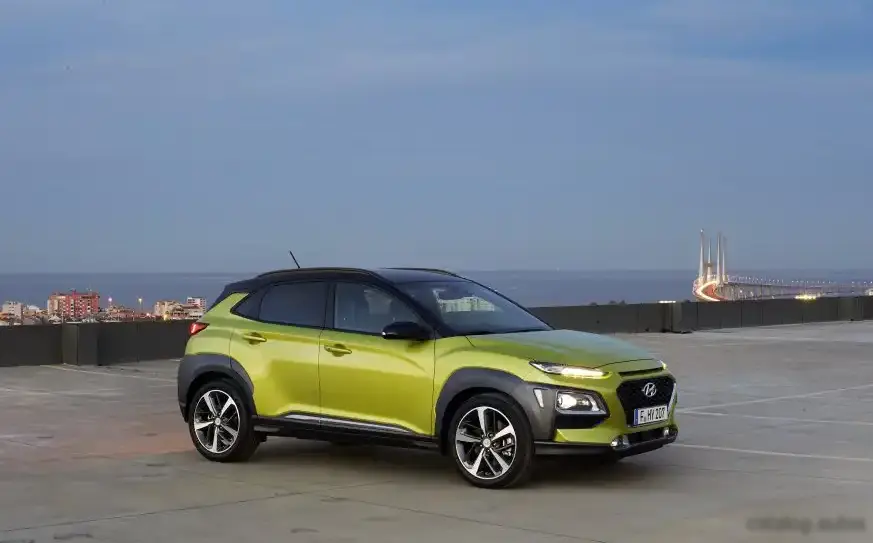
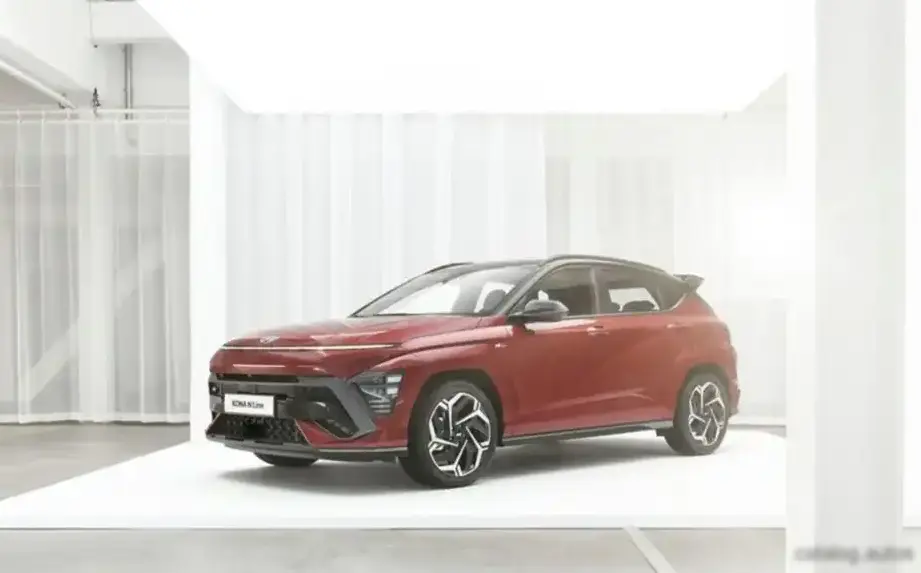
The Hyundai Kona II 1.0T (120 hp) is a front-wheel-drive subcompact SUV powered by a three-cylinder turbocharged gasoline engine. Introduced as part of the second-generation Kona (SX2) lineup in 2023, this variant was designed to offer an economical and practical entry point into the Kona range. It caters to buyers prioritizing fuel efficiency and affordability over outright performance. The 1.0T engine, part of Hyundai’s Smartstream engine family, represents a downsized, turbocharged approach to maximizing fuel economy while still providing adequate power for everyday driving. This trim level typically served as the base model in many European and Asian markets.
Powertrain & Engine Architecture
At the heart of the Kona II 1.0T lies Hyundai’s Smartstream G3LC 1.0-liter turbocharged three-cylinder engine. This engine, designated with internal codes varying by market, utilizes direct fuel injection and a twin-scroll turbocharger to deliver a balance of power and efficiency. The engine’s architecture features a lightweight aluminum block and cylinder head, contributing to overall weight reduction. The DOHC (Double Overhead Camshaft) valvetrain, with four valves per cylinder, optimizes airflow for improved combustion. The 1.0T engine is paired with a 6-speed manual transmission as standard, delivering power to the front wheels. The engine incorporates a gasoline particulate filter (GPF) to meet stringent Euro 6d emission standards. The turbocharger and intercooler are integrated into the engine design to enhance performance and reduce turbo lag.
Driving Characteristics
The 120 hp output of the 1.0T engine translates to a 0-60 mph (0-100 km/h) acceleration time of approximately 11.8 seconds, making it the slowest variant in the Kona II lineup. The engine delivers its peak torque of 172 Nm (126.86 lb-ft) between 1500 and 4000 rpm, providing reasonable responsiveness for everyday driving situations. The 6-speed manual transmission offers precise shifts, but the relatively long gearing emphasizes fuel economy over spirited acceleration. Compared to the more powerful 1.6T engine options, the 1.0T feels noticeably less energetic, particularly when fully loaded or tackling uphill climbs. However, for urban commuting and highway cruising, the 1.0T provides sufficient power and a comfortable driving experience. The front-wheel-drive configuration contributes to a lighter vehicle weight, further aiding fuel efficiency.
Equipment & Trim Levels
The Kona II 1.0T typically came equipped with a standard array of features, including air conditioning, a touchscreen infotainment system with Apple CarPlay and Android Auto compatibility, and a suite of safety features such as lane keeping assist and forward collision avoidance assist. Interior upholstery was generally cloth, with plastic trim accents. Optional extras included alloy wheels, a larger touchscreen display, a rearview camera, and parking sensors. Higher trim levels within the 1.0T range might have added features like automatic climate control, heated seats, and a premium sound system. The overall interior design prioritized functionality and practicality over luxury, reflecting the entry-level positioning of this variant.
Chassis & Braking
The Kona II 1.0T utilizes a McPherson strut front suspension and a torsion beam rear suspension. This setup provides a comfortable ride quality, well-suited for everyday driving conditions. The front brakes are ventilated discs, while the rear brakes are solid discs. ABS (Anti-lock Braking System) is standard, enhancing braking performance and stability. The steering is electrically assisted, providing light and precise control. The suspension tuning is geared towards comfort rather than sporty handling, resulting in a predictable and stable driving experience. Stabilizer bars are included to reduce body roll during cornering, but the overall handling characteristics are not as sharp as those of higher-performance Kona variants.
Market Reception & Comparison
The Hyundai Kona II 1.0T was generally well-received by critics as a practical and affordable option within the subcompact SUV segment. Its fuel efficiency was a key selling point, with WLTP-tested CO2 emissions ranging from 131-150 g/km. Compared to the 1.6T variants, the 1.0T offered lower running costs but sacrificed performance. The 1.0T also provided a more economical alternative to the hybrid versions of the Kona II, appealing to buyers who did not require the added complexity and cost of hybrid technology. Reliability reports have been generally positive, with the Smartstream engine proving to be a durable and dependable unit. However, some owners have reported minor issues with the turbocharger and fuel injection system.
Legacy
The Hyundai Kona II 1.0T (120 hp) represents a significant step forward in terms of fuel efficiency and technology for the Kona model line. While not the most powerful or dynamically engaging version of the Kona II, it provided an accessible and practical entry point for buyers seeking a well-equipped and economical subcompact SUV. On the used car market, these models are becoming increasingly popular due to their affordability and relatively low running costs. The Smartstream 1.0T engine has proven to be a reliable powertrain, and with proper maintenance, these vehicles are expected to provide years of dependable service. The Kona II 1.0T’s success demonstrates Hyundai’s commitment to offering a diverse range of powertrain options to meet the varying needs and preferences of its customers.