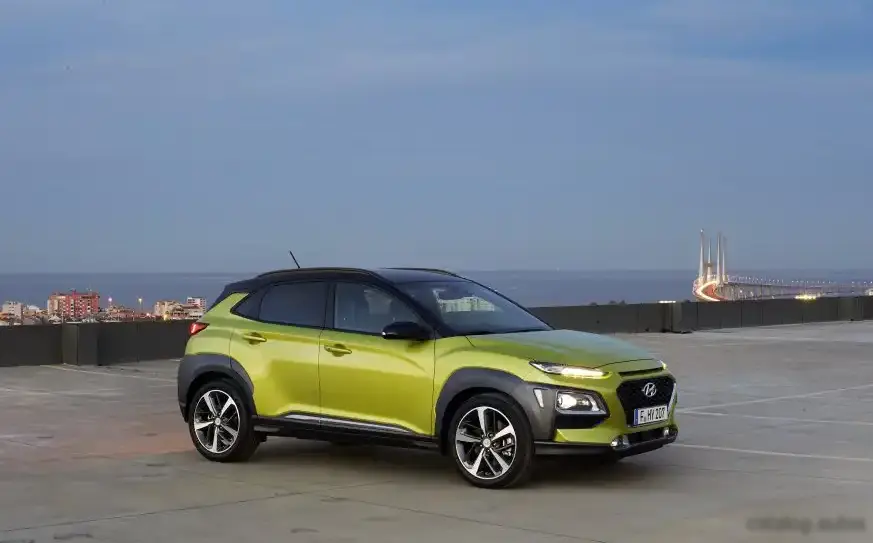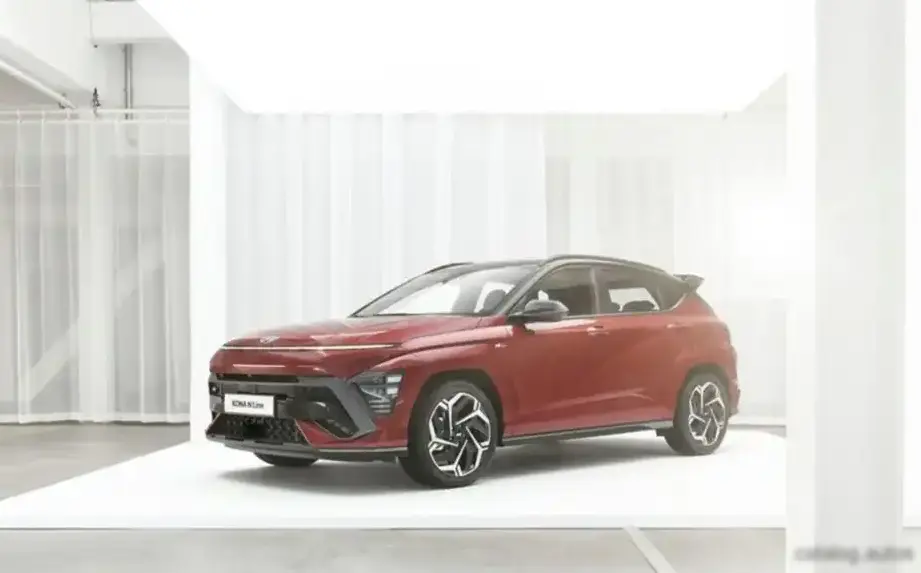
The Hyundai Kona II 1.0T (120 hp) DCT represents an entry-level powertrain option within the second generation of Hyundai’s popular subcompact SUV, the Kona. Introduced in April 2023 and continuing through August 2024, this variant aimed to provide a balance of fuel efficiency and affordability for the European and Asian markets, with limited availability in North America. It slots into the Kona II lineup as the base engine choice, positioned below higher-output turbocharged engines and potential hybrid options. The Kona II, built on the B3 platform, represents a significant evolution over the first-generation model, offering increased space, updated technology, and a more refined driving experience.
Technical Specifications
| Brand | Hyundai |
| Model | Kona |
| Generation | Kona II |
| Type (Engine) | 1.0T (120 Hp) DCT |
| Start of production | April, 2023 |
| End of production | August, 2024 |
| Powertrain Architecture | Internal Combustion engine |
| Body type | SUV |
| Seats | 5 |
| Doors | 5 |
| CO2 emissions (WLTP) | 131-150 g/km |
| Fuel Type | Petrol (Gasoline) |
| Acceleration 0 – 100 km/h | 11.7 sec |
| Acceleration 0 – 62 mph | 11.7 sec |
| Acceleration 0 – 60 mph | 11.1 sec |
| Maximum speed | 180 km/h (111.85 mph) |
| Emission standard | Euro 6d |
| Weight-to-power ratio | 11 kg/Hp, 90.9 Hp/tonne |
| Weight-to-torque ratio | 6.6 kg/Nm, 151.5 Nm/tonne |
| Power | 120 Hp @ 6000 rpm |
| Power per litre | 120.2 Hp/l |
| Torque | 200 Nm @ 2000-3500 rpm (147.51 lb.-ft. @ 2000-3500 rpm) |
| Engine layout | Front, Transverse |
| Engine Model/Code | Smartstream |
| Engine displacement | 998 cm3 (60.9 cu. in.) |
| Number of cylinders | 3 |
| Engine configuration | Inline |
| Cylinder Bore | 71 mm (2.8 in.) |
| Piston Stroke | 84 mm (3.31 in.) |
| Compression ratio | 10.5:1 |
| Number of valves per cylinder | 4 |
| Fuel injection system | Direct injection |
| Engine aspiration | Turbocharger, Intercooler |
| Valvetrain | DOHC |
| Engine systems | Start & Stop System, Particulate filter |
| Kerb Weight | 1320-1445 kg (2910.1 – 3185.68 lbs.) |
| Max. weight | 1855 kg (4089.57 lbs.) |
| Max load | 410-535 kg (903.9 – 1179.47 lbs.) |
| Trunk (boot) space – minimum | 466 l (16.46 cu. ft.) |
| Trunk (boot) space – maximum | 1300 l (45.91 cu. ft.) |
| Fuel tank capacity | 47 l (12.42 US gal | 10.34 UK gal) |
| Max. roof load | 100 kg (220.46 lbs.) |
| Permitted trailer load with brakes (12%) | 1200 kg (2645.55 lbs.) |
| Permitted towbar download | 80 kg (176.37 lbs.) |
| Length | 4350 mm (171.26 in.) |
| Width | 1825 mm (71.85 in.) |
| Height | 1585 mm (62.4 in.) |
| Wheelbase | 2660 mm (104.72 in.) |
| Front track | 1591 mm (62.64 in.) |
| Rear (Back) track | 1600 mm (62.99 in.) |
| Minimum turning circle | 10.6 m (34.78 ft.) |
| Drivetrain Architecture | ICE to Front Wheels |
| Drive wheel | Front wheel drive |
| Number of gears and type of gearbox | 7 gears, automatic transmission DCT |
| Front suspension | Independent type McPherson |
| Rear suspension | Torsion |
| Front brakes | Ventilated discs |
| Rear brakes | Disc |
| Assisting systems | ABS (Anti-lock braking system) |
| Steering type | Steering rack and pinion |
| Power steering | Electric Steering |
| Tires size | 215/60 R17; 215/55 R18 |
| Wheel rims size | 7.0J x 17; 7J x 18 |
INTRODUCTION
The Hyundai Kona II 1.0T (120 hp) DCT, launched in 2023, is a front-wheel-drive subcompact SUV designed to appeal to buyers seeking an economical and practical urban vehicle. As part of the second-generation Kona (internally designated as SX2), this variant utilizes Hyundai’s Smartstream engine family and a 7-speed dual-clutch transmission (DCT). It represents the entry point into the Kona II range, offering a more accessible price point compared to the more powerful turbocharged options. The Kona II aimed to improve upon the first generation’s success by offering a more spacious interior, enhanced safety features, and a more modern design.
Powertrain & Engine Architecture
At the heart of the Kona II 1.0T is Hyundai’s Smartstream G3LC 1.0-liter turbocharged three-cylinder engine. This engine, identified by internal codes depending on the specific market, is characterized by its direct injection system and a single-scroll turbocharger with intercooling. The engine produces 120 horsepower at 6,000 rpm and 200 Nm (147.51 lb-ft) of torque between 2,000 and 3,500 rpm. The Smartstream engine incorporates features like integrated exhaust manifold and cylinder head for improved thermal efficiency. The 7-speed DCT, supplied by Hyundai Mobis, is a key component of this powertrain. It offers quick and smooth gear changes, contributing to both fuel efficiency and a more engaging driving experience. The DCT utilizes a wet dual-clutch design for improved cooling and durability. The engine also features a start-stop system to further reduce fuel consumption in urban driving conditions and a particulate filter to meet stringent Euro 6d emissions standards.
Driving Characteristics
The 120 hp 1.0T DCT powertrain delivers adequate performance for everyday driving, particularly in urban and suburban environments. Acceleration from 0-60 mph takes approximately 11.1 seconds, and the top speed is 180 km/h (111.85 mph). While not particularly sporty, the turbocharger provides a noticeable boost in power during acceleration, making overtaking maneuvers manageable. The DCT transmission contributes to a responsive feel, although some drivers may notice slight hesitation at low speeds. Compared to the more powerful 1.6T variants, the 1.0T offers a more relaxed driving experience, prioritizing fuel economy over outright performance. The gear ratios are tuned for efficiency, with taller gearing in higher gears to reduce engine speed at cruising speeds. The front-wheel-drive configuration provides predictable handling, but it lacks the all-weather capability of optional all-wheel-drive systems available on other Kona II trims.
Equipment & Trim Levels
The Kona II 1.0T DCT typically came equipped with a respectable level of standard features, though specific equipment levels varied by market. Common features included air conditioning, a touchscreen infotainment system with Apple CarPlay and Android Auto compatibility, Bluetooth connectivity, and a suite of safety features such as lane keeping assist, forward collision avoidance assist, and automatic emergency braking. Interior upholstery was typically cloth, with options for upgraded materials on higher trim levels. Optional extras included a larger touchscreen display, a premium sound system, a sunroof, and heated seats. The dashboard layout was modern and driver-focused, with a digital instrument cluster available on some trims.
Chassis & Braking
The Kona II 1.0T utilizes a McPherson strut front suspension and a torsion beam rear suspension. This setup provides a comfortable ride quality, well-suited for everyday driving. The torsion beam rear suspension is a cost-effective solution that minimizes complexity and weight. Braking duties are handled by ventilated discs at the front and solid discs at the rear. Anti-lock braking system (ABS) is standard, along with electronic stability control (ESC). The steering system is an electric power-assisted rack and pinion system, providing light and precise steering feel. Tire sizes typically ranged from 215/60 R17 to 215/55 R18, depending on the trim level.
Market Reception & Comparison
The Hyundai Kona II 1.0T DCT was generally well-received by automotive critics as a practical and fuel-efficient option within the subcompact SUV segment. Reviewers praised its comfortable ride, modern interior, and comprehensive safety features. However, some criticized its relatively modest power output and the occasional hesitation of the DCT transmission. Compared to the 1.6T variants, the 1.0T offered significantly better fuel economy, but at the expense of performance. The 1.0T’s fuel consumption figures typically ranged from 131-150 g/km of CO2 emissions, making it an attractive option for environmentally conscious buyers. In terms of reliability, the Smartstream engine and DCT transmission have proven to be generally reliable, although regular maintenance is essential to ensure optimal performance.
Legacy
The Hyundai Kona II 1.0T (120 hp) DCT represents a significant step forward in Hyundai’s efforts to offer a compelling range of subcompact SUVs. While it may not be the most powerful or engaging variant in the Kona II lineup, its combination of fuel efficiency, practicality, and affordability has made it a popular choice among buyers seeking a versatile and economical urban vehicle. On the used car market, these models are generally considered to be a good value, offering a well-equipped and reliable vehicle at a competitive price point. The longevity of the Smartstream engine and DCT transmission suggests that these vehicles should provide years of reliable service with proper maintenance.