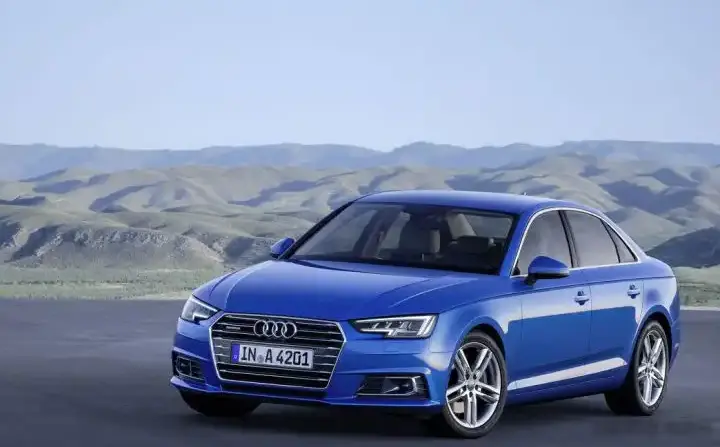
The Audi A4 (B9 8W) 2.0 TDI 150 hp S tronic represents a significant iteration of Audi’s popular executive sedan, produced from 2015 to 2018. Positioned as a mid-range offering within the B9 A4 lineup, this variant balanced fuel efficiency with respectable performance, appealing to buyers prioritizing practicality and running costs. It was a key model in the European market, where diesel engines and dual-clutch transmissions were highly favored, and also saw moderate sales in other regions. The B9 generation, built on the Volkswagen Group’s MLB Evo platform, brought advancements in technology, lightweight construction, and refinement compared to its predecessor.
Technical Specifications
| Brand | Audi |
| Model | A4 |
| Generation | A4 (B9 8W) |
| Type (Engine) | 2.0 TDI (150 Hp) S tronic |
| Start of production | 2015 |
| End of production | 2018 |
| Powertrain Architecture | Internal Combustion engine |
| Body type | Sedan |
| Seats | 5 |
| Doors | 4 |
| Fuel consumption (urban) | 4.3-5.1 l/100 km (54.7 – 46.1 US mpg, 65.7 – 55.4 UK mpg, 23.3 – 19.6 km/l) |
| Fuel consumption (extra urban) | 3.6-3.9 l/100 km (65.3 – 60.3 US mpg, 78.5 – 72.4 UK mpg, 27.8 – 25.6 km/l) |
| Fuel consumption (combined) | 4.0-4.3 l/100 km (58.8 – 54.7 US mpg, 70.6 – 65.7 UK mpg, 25 – 23.3 km/l) |
| CO2 emissions | 104-112 g/km |
| Fuel Type | Diesel |
| Acceleration 0 – 100 km/h | 8.7 sec |
| Acceleration 0 – 62 mph | 8.7 sec |
| Acceleration 0 – 60 mph | 8.3 sec |
| Maximum speed | 219 km/h (136.08 mph) |
| Emission standard | Euro 6 |
| Weight-to-power ratio | 9.8 kg/Hp, 102.4 Hp/tonne |
| Weight-to-torque ratio | 4.6 kg/Nm, 218.4 Nm/tonne |
| Power | 150 Hp @ 3250-4200 rpm |
| Power per litre | 76.2 Hp/l |
| Torque | 320 Nm @ 1500-3250 rpm (236.02 lb.-ft. @ 1500-3250 rpm) |
| Engine layout | Front, Longitudinal |
| Engine Model/Code | DEUA |
| Engine displacement | 1968 cm3 (120.09 cu. in.) |
| Number of cylinders | 4 |
| Engine configuration | Inline |
| Cylinder Bore | 81 mm (3.19 in.) |
| Piston Stroke | 95.5 mm (3.76 in.) |
| Compression ratio | 16.2:1 |
| Number of valves per cylinder | 4 |
| Fuel injection system | Diesel Commonrail |
| Engine aspiration | Turbocharger, Intercooler |
| Valvetrain | DOHC |
| Engine oil capacity | 4.7 l (4.97 US qt | 4.14 UK qt) |
| Kerb Weight | 1465 kg (3229.77 lbs.) |
| Max. weight | 2065 kg (4552.55 lbs.) |
| Max load | 600 kg (1322.77 lbs.) |
| Trunk (boot) space – minimum | 480 l (16.95 cu. ft.) |
| Trunk (boot) space – maximum | 965 l (34.08 cu. ft.) |
| Fuel tank capacity | 40 l (10.57 US gal | 8.8 UK gal) |
| Max. roof load | 90 kg (198.42 lbs.) |
| Permitted trailer load with brakes (8%) | 1900 kg (4188.78 lbs.) |
| Permitted trailer load with brakes (12%) | 1700 kg (3747.86 lbs.) |
| Permitted trailer load without brakes | 750 kg (1653.47 lbs.) |
| Permitted towbar download | 80 kg (176.37 lbs.) |
| Length | 4726 mm (186.06 in.) |
| Width | 1842 mm (72.52 in.) |
| Width including mirrors | 2022 mm (79.61 in.) |
| Height | 1427 mm (56.18 in.) |
| Wheelbase | 2820 mm (111.02 in.) |
| Front track | 1572 mm (61.89 in.) |
| Rear (Back) track | 1555 mm (61.22 in.) |
| Front overhang | 880 mm (34.65 in.) |
| Rear overhang | 1026 mm (40.39 in.) |
| Drag coefficient (Cd) | 0.26 |
| Minimum turning circle (turning diameter) | 11.6 m (38.06 ft.) |
| Drivetrain Architecture | The Internal combustion engine (ICE) drives the front wheels of the vehicle. |
| Drive wheel | Front wheel drive |
| Number of gears and type of gearbox | 7 gears, automatic transmission S tronic |
| Front suspension | Independent multi-link suspension |
| Rear suspension | Independent multi-link suspension |
| Front brakes | Ventilated discs |
| Rear brakes | Ventilated discs |
| Assisting systems | ABS (Anti-lock braking system) |
| Steering type | Steering rack and pinion |
| Power steering | Electric Steering |
| Tires size | 205/60 R16; 225/50 R17; 245/40 R18; 245/35 R19 |
| Wheel rims size | 7J x 16; 17; 18; 19 |
Powertrain & Engine Architecture
At the heart of the A4 2.0 TDI 150 hp S tronic lies the Volkswagen Group’s DEUA engine. This is a 2.0-liter, four-cylinder diesel engine employing common-rail direct injection and a turbocharger with an intercooler. The engine code ‘DEUA’ signifies a specific calibration within the broader 2.0 TDI family. It produces 150 horsepower at 3250-4200 rpm and 320 Nm (236 lb-ft) of torque between 1500-3250 rpm. The engine features a double overhead camshaft (DOHC) valvetrain with four valves per cylinder, optimizing gas flow for improved efficiency and power. The S tronic transmission is a seven-speed dual-clutch transmission (DCT), known for its rapid shifts and efficiency. It allows for both fully automatic operation and manual gear selection via steering wheel-mounted paddles or the gear selector.
Driving Characteristics
The 150 hp 2.0 TDI with the S tronic transmission delivered a balanced driving experience. While not overtly sporty, it provided sufficient power for everyday driving and highway cruising. Acceleration from 0-60 mph took approximately 8.3 seconds. The S tronic transmission’s quick shifts contributed to a responsive feel, and the broad torque band of the diesel engine meant that strong pulling power was available from low engine speeds. Compared to the more powerful 190 hp TDI variants, this version felt less urgent in acceleration, but it offered superior fuel economy. The automatic transmission, while efficient, could sometimes exhibit slight hesitation at lower speeds, a characteristic noted in some contemporary reviews.
Equipment & Trim Levels
The A4 2.0 TDI 150 hp S tronic typically came equipped with a respectable level of standard features. These included automatic climate control, a multi-function steering wheel, an infotainment system with a color display, and alloy wheels. Interior upholstery was generally cloth, with leather options available as an upgrade. Optional extras included a navigation system, parking sensors, a sunroof, and advanced driver-assistance systems like adaptive cruise control and lane departure warning. Trim levels varied by market, but generally followed a progression from ‘SE’ or ‘Sport’ to higher-spec ‘S line’ models, with the latter offering more aggressive styling and additional equipment.
Chassis & Braking
The B9 A4 featured a sophisticated chassis design. Both front and rear suspension utilized a multi-link setup, providing a comfortable ride and good handling characteristics. The 150 hp TDI models typically employed ventilated disc brakes on all four wheels, offering adequate stopping power. ABS (Anti-lock Braking System) was standard. The suspension tuning was generally geared towards comfort, with a focus on absorbing road imperfections. Stabilizer bars were fitted front and rear to reduce body roll during cornering.
Market Reception & Comparison
The A4 2.0 TDI 150 hp S tronic was well-received in the market, particularly in Europe, where it was seen as a sensible and economical choice. Critics praised its fuel efficiency, comfortable ride, and refined interior. However, some reviewers noted that the engine lacked the outright performance of its more powerful siblings. Compared to the 190 hp TDI, the 150 hp version offered better fuel economy but slower acceleration. Against competitors like the BMW 3 Series and Mercedes-Benz C-Class, the A4 2.0 TDI 150 hp S tronic held its own in terms of refinement and technology, though some rivals offered a more engaging driving experience.
Legacy
The DEUA engine, in its various iterations, proved to be a reliable and durable powerplant. The S tronic transmission, while requiring more diligent maintenance than a traditional automatic, also demonstrated good longevity when properly serviced. Today, used examples of the A4 2.0 TDI 150 hp S tronic represent a good value proposition, offering a blend of comfort, efficiency, and practicality. Common maintenance items include regular oil changes, timing belt replacement (depending on mileage), and inspection of the S tronic transmission’s mechatronic unit. Overall, this variant remains a popular choice for buyers seeking a well-rounded and dependable executive sedan.